What self-compassion actually is
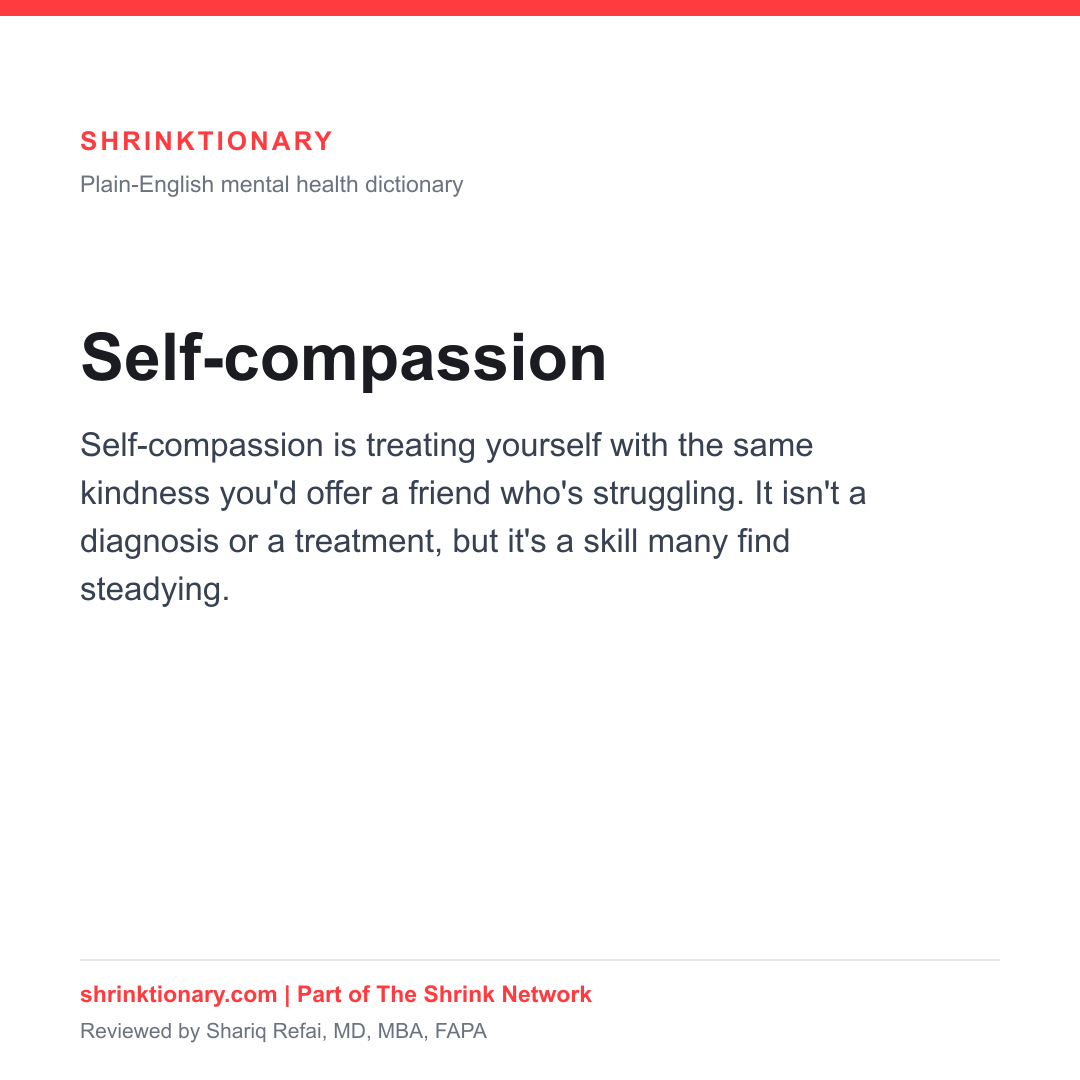
Self-compassion is the practice of meeting your own struggles with kindness instead of criticism. The idea is simple to state and harder to do, treat yourself the way you’d treat a good friend who’s having a hard time. Researchers usually describe it as having a few parts, being gentle with yourself rather than harsh, remembering that struggle is part of being human rather than a personal failing, and noticing painful feelings without getting swept away by them.
It isn’t a clinical diagnosis, and it isn’t a formal treatment on its own, though it shows up inside several evidence-based therapies. It’s better understood as a skill, something that can be practiced and strengthened. For people whose inner voice runs harsh, self-compassion offers a different way of relating to their own mistakes and setbacks.
What self-compassion can feel like
At first it can feel awkward or even undeserved, especially for people used to driving themselves with criticism. A common worry is that being kind to yourself will make you lazy or let you off the hook. In practice, many people find the opposite, that easing up on the harshness makes it easier to face problems rather than hide from them.
When it’s working, self-compassion can feel like a steadier inner footing. Instead of piling shame on top of a mistake, a person can acknowledge the slip, feel the disappointment, and still treat themselves as worth caring for. The hard feeling is still there, but it isn’t multiplied by self-attack.
What self-compassion isn’t
Self-compassion isn’t self-pity, self-indulgence, or making excuses. It doesn’t mean ignoring mistakes or letting yourself off every hook. It means facing what happened without adding cruelty on top. It also isn’t the same as high self-esteem. Self-esteem often depends on doing well and comparing favorably to others, while self-compassion holds steady even when things go badly.
It isn’t a cure or a promise. It’s a way of relating to yourself that many people find supportive, not a guaranteed outcome or a replacement for treatment when one is needed.
Related terms you’ll see next
Perfectionism and a harsh inner critic are often what self-compassion is meant to soften. Low self-esteem is related but different, since self-compassion doesn’t hinge on feeling above average. Radical acceptance shares the spirit of meeting reality without piling on judgment.
When it helps to get support
Building self-compassion is something many people do on their own with books and practice. It helps to reach for more support when the inner critic is loud enough to fuel real distress, when self-kindness feels impossible, or when harsh self-judgment comes wrapped in low mood, anxiety, or hopelessness. Therapists who work with approaches that include self-compassion can help. No one can promise the critical voice will vanish, but it can become quieter and easier to live with.
When this word matters
It matters when the inner critic is loud enough to fuel real distress, when self-kindness feels impossible, or when harsh self-judgment comes wrapped in low mood, anxiety, or hopelessness. Building self-compassion is often a personal practice, but a persistent harsh inner voice is worth support.
Commonly confused with
Frequently asked questions
What is self-compassion?
Self-compassion is meeting your own struggles with kindness instead of criticism, treating yourself the way you'd treat a good friend who's having a hard time. Researchers describe it as being gentle with yourself, remembering that struggle is part of being human, and noticing painful feelings without getting swept away.
Will self-compassion make me lazy?
A common worry is that being kind to yourself lets you off the hook. In practice, many people find the opposite, that easing up on harshness makes it easier to face problems rather than hide from them. Self-compassion means facing mistakes without piling on cruelty, not ignoring them.
Is self-compassion the same as self-esteem?
No. Self-esteem often depends on doing well and comparing favorably to others, while self-compassion holds steady even when things go badly. It also isn't self-pity or making excuses. It's a way of relating to yourself that many people find supportive.
Related terms
Sources
- Caring for Your Mental Health , National Institute of Mental Health
- Mental Health , MedlinePlus
Use or cite this definition
Free to reuse with attribution. Paste the block into your own page, or grab a citation.
Embed on your site
<blockquote>
<p><strong>Self-compassion:</strong> Self-compassion is treating yourself with the same kindness you'd offer a friend who's struggling. It isn't a diagnosis or a treatment, but it's a skill many find steadying.</p>
<p>— <a href="https://shrinktionary.com/terms/self-compassion/">Shrinktionary</a>, a plain-English mental health dictionary, medically reviewed by a board certified psychiatrist.</p>
</blockquote>Cite (APA)
Refai, S. (2026). Self-compassion. Shrinktionary. https://shrinktionary.com/terms/self-compassion/
Cite (MLA)
"Self-compassion." Shrinktionary, https://shrinktionary.com/terms/self-compassion/. Accessed September 26, 2026.
Your next step in The Shrink Network
You are here: Shrinktionary, the language layer of The Shrink Network.
Each site in the network has one job. No matter where you enter, we help you find the next step that makes sense.
Want to understand more first?
See how this connects to everything else in the Term Web →
Take it with you
Free printable references you can save or share. For education, not medical advice.