What perfectionism actually is
Perfectionism is a pattern of holding yourself to standards so high that almost nothing measures up. It’s more than wanting to do good work. A perfectionist tends to treat anything short of flawless as failure, to focus on the one mistake instead of the ninety-nine things that went right, and to tie their sense of worth to how well they perform.
It isn’t a clinical diagnosis. It’s a personality pattern, and it comes in different flavors. Some people aim their standards at themselves, some aim them at others, and some feel that the world expects perfection from them. Healthy striving and perfectionism can look similar on the outside, but striving is flexible and energizing, while perfectionism tends to be rigid and draining. Perfectionism often overlaps with anxiety, low self-esteem, and burnout.
What perfectionism can feel like
From the inside, it can feel like a voice that’s never satisfied. Finishing a task brings a brief flicker of relief, quickly replaced by a list of what could have been better. Many perfectionists describe trouble starting things at all, because if it can’t be done perfectly, beginning feels too risky. Others can’t stop, reworking the same piece long past the point of usefulness.
It often comes with a knot of fear underneath, the worry that one slip will reveal them as not good enough. That fear can make praise hard to take in and criticism land far heavier than intended.
What perfectionism isn’t
Perfectionism isn’t the same as having high standards or caring about quality. Plenty of people do excellent work without punishing themselves over every flaw. The difference is the cost. When standards stop being a guide and start being a stick, the pattern has tipped into something that wears a person down.
It also isn’t a diagnosis on its own. It can show up alongside conditions like obsessive-compulsive disorder, anxiety, or depression, but the word itself describes a tendency, not a clinical label.
Related terms you’ll see next
Self-compassion is often the counterweight, since perfectionists tend to be far kinder to others than to themselves. Self-sabotage can grow out of perfectionism, when impossible standards make starting feel pointless. Burnout is a common endpoint when the pressure never lets up.
When it helps to get support
A high bar isn’t a problem on its own. It’s worth paying attention when perfectionism starts to cost real time, sleep, or peace of mind, when it stops projects before they begin, or when it comes wrapped in constant anxiety or low mood. If the inner critic rarely goes quiet, a therapist can help loosen the link between worth and performance. No one can promise a person will stop caring about quality, but the standards can become less punishing.
When this word matters
It matters when perfectionism starts to cost real time, sleep, or peace of mind, when it stops projects before they begin, or when it comes wrapped in constant anxiety or low mood. A high bar on its own isn't a problem; the cost is what makes it worth attention.
Commonly confused with
Frequently asked questions
Is perfectionism a mental illness?
No. Perfectionism isn't a clinical diagnosis. It's a personality pattern. It can show up alongside conditions like anxiety, depression, or obsessive-compulsive disorder, but the word itself describes a tendency, not a disorder.
What's the difference between perfectionism and high standards?
High standards are flexible and can be energizing, and a person can do excellent work without punishing themselves over every flaw. Perfectionism tends to be rigid and draining, treating anything short of flawless as failure and tying self-worth to performance.
Can perfectionism be a problem?
It can. When standards stop being a guide and start being a stick, perfectionism can fuel anxiety, stall projects before they begin, and lead to burnout. If the inner critic rarely goes quiet, a therapist can help loosen the link between worth and performance.
Related terms
In these language clusters
Compare
Sources
- Caring for Your Mental Health , National Institute of Mental Health
- Mental Health , MedlinePlus
Use or cite this definition
Free to reuse with attribution. Paste the block into your own page, or grab a citation.
Embed on your site
<blockquote>
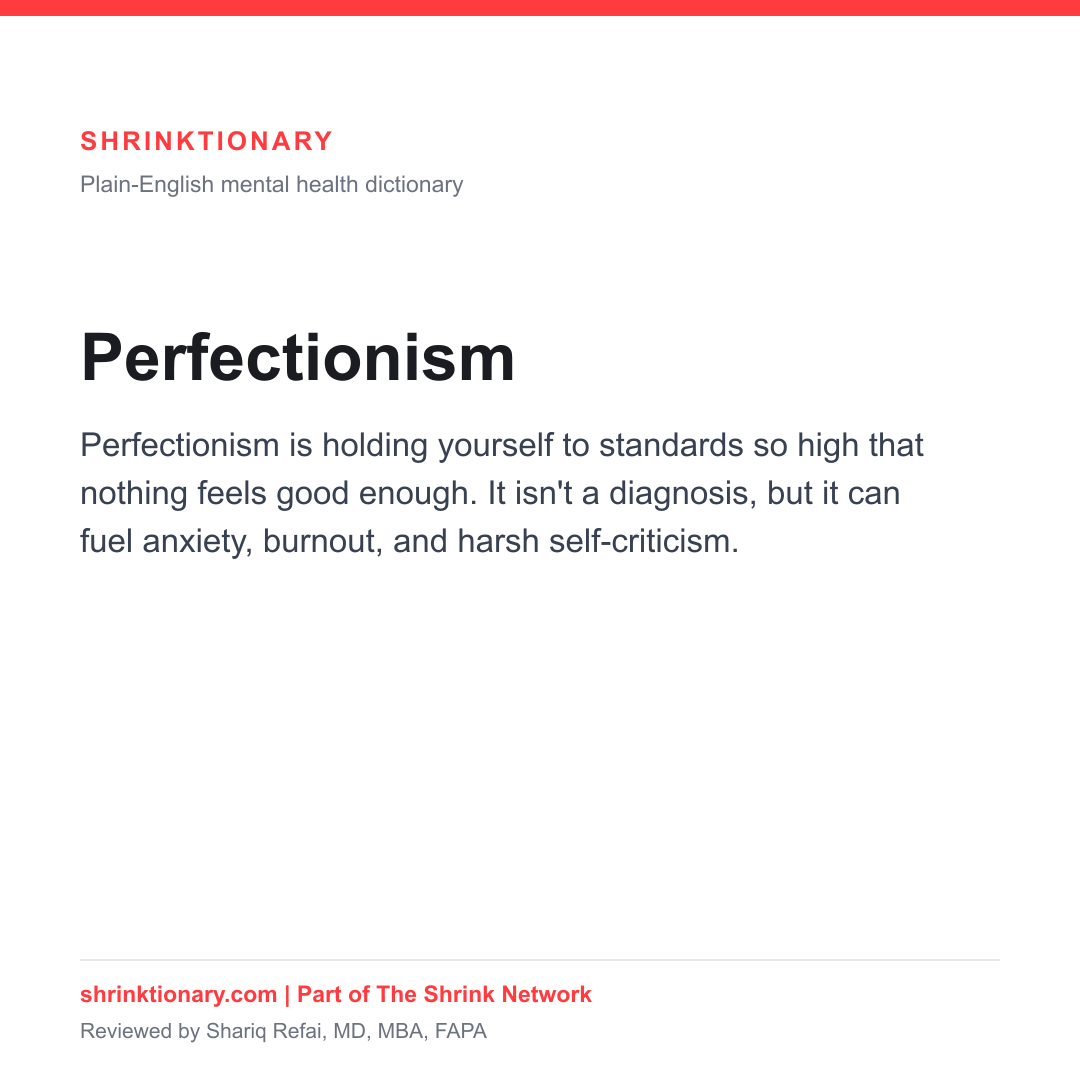
<p><strong>Perfectionism:</strong> Perfectionism is holding yourself to standards so high that nothing feels good enough. It isn't a diagnosis, but it can fuel anxiety, burnout, and harsh self-criticism.</p>
<p>— <a href="https://shrinktionary.com/terms/perfectionism/">Shrinktionary</a>, a plain-English mental health dictionary, medically reviewed by a board certified psychiatrist.</p>
</blockquote>Cite (APA)
Refai, S. (2026). Perfectionism. Shrinktionary. https://shrinktionary.com/terms/perfectionism/
Cite (MLA)
"Perfectionism." Shrinktionary, https://shrinktionary.com/terms/perfectionism/. Accessed September 27, 2026.
Your next step in The Shrink Network
You are here: Shrinktionary, the language layer of The Shrink Network.
Each site in the network has one job. No matter where you enter, we help you find the next step that makes sense.
Want to understand more first?
See how this connects to everything else in the Term Web →
Take it with you
Free printable references you can save or share. For education, not medical advice.