What OCD actually is
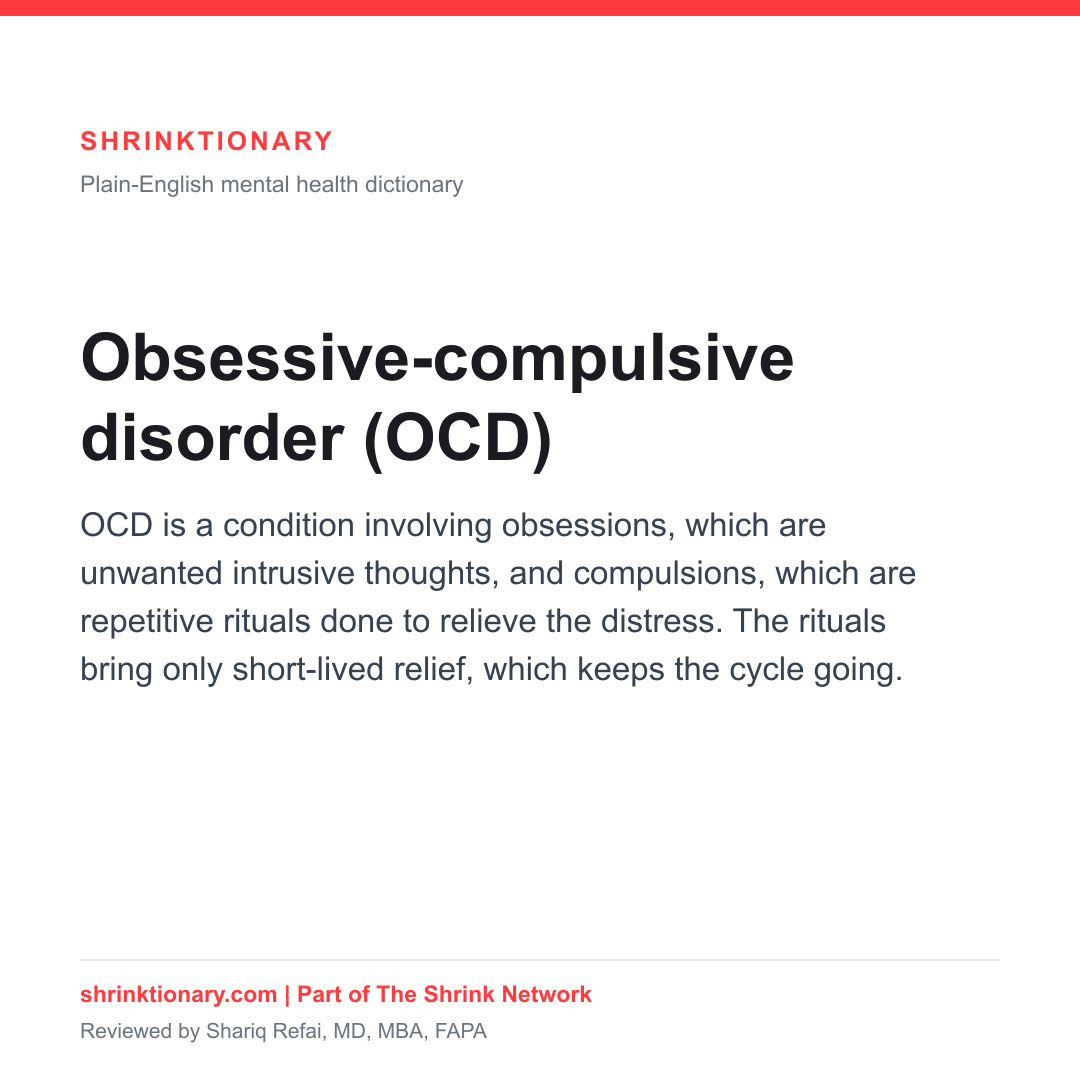
Obsessive-compulsive disorder, or OCD, has two core parts. Obsessions are unwanted, intrusive thoughts, images, or urges that show up over and over and cause real distress. Compulsions are repetitive behaviors or mental rituals a person feels driven to perform to ease that distress or to prevent something bad from happening.
Common obsessions include fears of contamination, doubts about safety like an unlocked door or a stove left on, unwanted taboo thoughts, or a need for things to feel exactly right. Compulsions might include washing, checking, counting, arranging, or silently repeating phrases. The relief a compulsion brings is brief, which is why the cycle repeats and often grows.
By clinical definition, these obsessions and compulsions are time-consuming, often taking more than an hour a day, and they interfere with daily life.
What OCD can feel like
People often describe being stuck in a loop they know doesn’t fully make sense but can’t easily stop. An intrusive thought arrives, anxiety spikes, and a ritual offers temporary calm, only for the thought to return. The exhausting part is the awareness that the fear may be exaggerated while still feeling unable to ignore it.
OCD can attach itself to whatever a person cares about most, which makes the thoughts feel especially upsetting. Many people feel shame about the content of their obsessions and hide their rituals, which can delay getting help.
What OCD isn’t
OCD isn’t being tidy, organized, or detail-oriented. Liking a clean desk or color-coded calendar isn’t a disorder. OCD involves distressing, unwanted thoughts and rituals that the person generally doesn’t want and that eat up time and energy.
The intrusive thoughts in OCD also don’t reflect a person’s true desires or character. Having a disturbing thought isn’t the same as wanting to act on it, and people with OCD are typically horrified by these thoughts rather than drawn to them.
A specific form of therapy called exposure and response prevention, or ERP, is considered a first-line treatment. It involves gradually facing the feared thought or situation while resisting the compulsion, which helps break the cycle over time.
Related terms you’ll see next
Intrusive thought is the unwanted thought at the heart of an obsession. Rumination describes the repetitive mental loops that overlap with OCD. Anxiety is the distress that fuels the urge to perform compulsions. Exposure therapy is the basis of ERP, the leading behavioral treatment.
When to seek professional care
If intrusive thoughts and rituals are taking up significant time or interfering with daily life, an evaluation is worthwhile. A clinician can confirm whether the pattern fits OCD and discuss ERP and medication options. OCD responds well to evidence-based treatment, and many people see meaningful improvement.
When evaluation may help
Not everyone reading about obsessive-compulsive disorder (ocd) needs treatment. If it's getting in the way of your day, your sleep, your work, or your relationships, or if it isn't easing on its own, a professional evaluation is a reasonable next step. Most people start with their primary care doctor or a therapist. A psychiatrist is the right call when medication may be involved or the picture is complicated, though waits can be long.
We keep an honest, no-commission rundown of the options, from primary care to telepsychiatry to crisis lines, on one page.
If you're in crisis or thinking about suicide, call or text 988 in the US, or go to the nearest emergency room.
When this word matters
Tidiness or double-checking crosses into OCD when obsessions and compulsions become time-consuming, distressing, and hard to resist, which sets the condition apart from everyday habits or the personality pattern OCPD.
Commonly confused with
Frequently asked questions
Does being neat or organized mean I have OCD?
No. Liking a clean desk or a color-coded calendar isn't a disorder. OCD involves distressing, unwanted obsessions and repetitive rituals that eat up significant time and interfere with daily life.
Do intrusive thoughts in OCD mean a person secretly wants to act on them?
No. The intrusive thoughts in OCD don't reflect a person's true desires or character, and having a disturbing thought isn't the same as wanting to act on it. People with OCD are typically horrified by these thoughts rather than drawn to them.
What is the most effective treatment for OCD?
A form of therapy called exposure and response prevention, or ERP, is considered a first-line treatment. It involves gradually facing the feared thought or situation while resisting the compulsion, which helps break the cycle over time, and OCD responds well to evidence-based care.
Related terms
Compare
Sources
- Obsessive-Compulsive Disorder (OCD) , National Institute of Mental Health
- Obsessive-Compulsive Disorder , MedlinePlus
- Diagnostic and Statistical Manual of Mental Disorders, Fifth Edition, Text Revision (DSM-5-TR) , American Psychiatric Association
Use or cite this definition
Free to reuse with attribution. Paste the block into your own page, or grab a citation.
Embed on your site
<blockquote>
<p><strong>Obsessive-compulsive disorder (OCD):</strong> OCD is a condition involving obsessions, which are unwanted intrusive thoughts, and compulsions, which are repetitive rituals done to relieve the distress. The rituals bring only short-lived relief, which keeps the cycle going.</p>
<p>— <a href="https://shrinktionary.com/terms/ocd/">Shrinktionary</a>, a plain-English mental health dictionary, medically reviewed by a board certified psychiatrist.</p>
</blockquote>Cite (APA)
Refai, S. (2026). Obsessive-compulsive disorder (OCD). Shrinktionary. https://shrinktionary.com/terms/ocd/
Cite (MLA)
"Obsessive-compulsive disorder (OCD)." Shrinktionary, https://shrinktionary.com/terms/ocd/. Accessed September 26, 2026.
Your next step in The Shrink Network
You are here: Shrinktionary, the language layer of The Shrink Network.
Each site in the network has one job. No matter where you enter, we help you find the next step that makes sense.
Want to understand more first?
See how this connects to everything else in the Term Web →
Take it with you
Free printable references you can save or share. For education, not medical advice.