What OCPD actually is
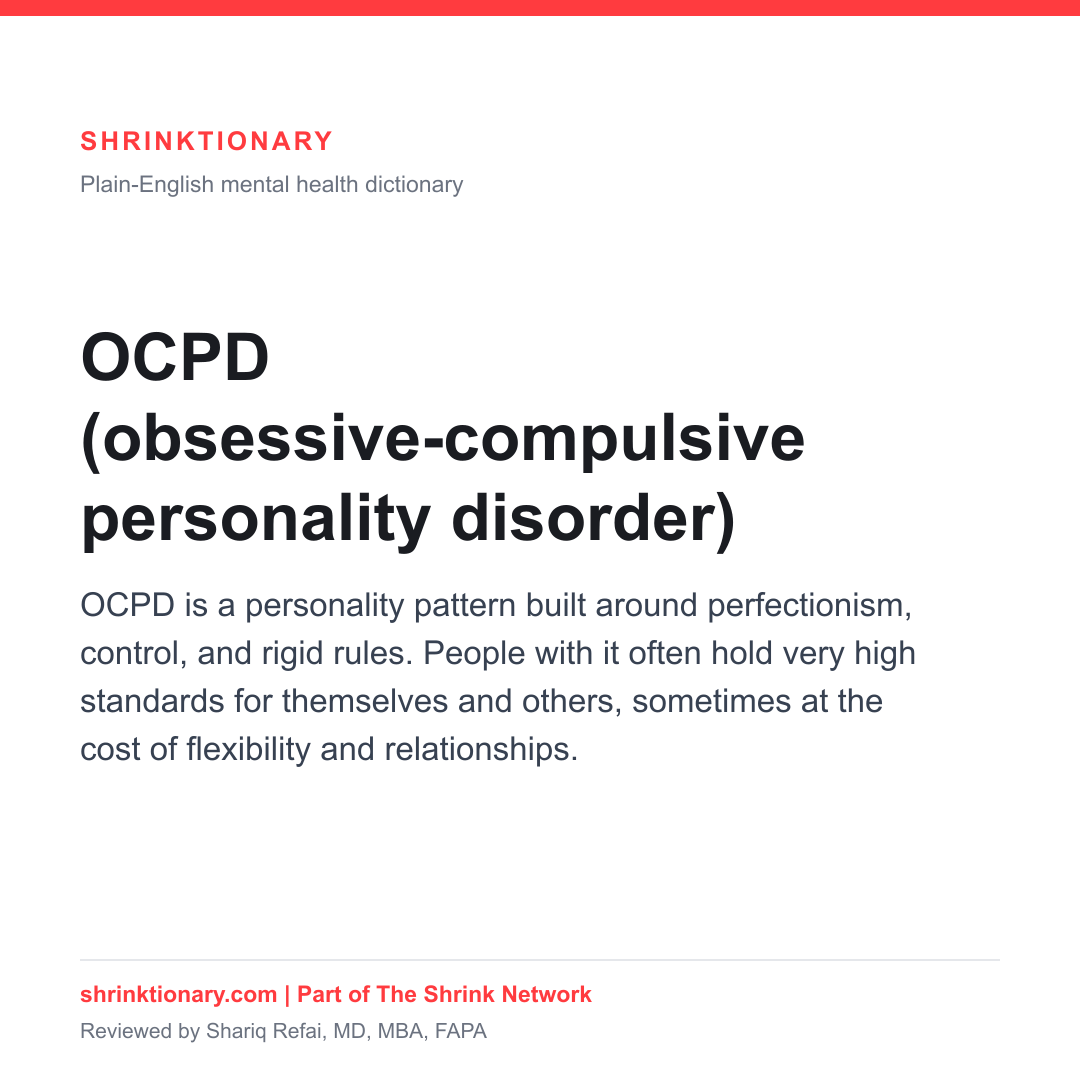
OCPD is a long-standing pattern of personality that centers on order, perfectionism, and a strong need for control. People with this pattern tend to value rules, lists, schedules, and doing things “the right way.” The pattern usually shows up by early adulthood and stays fairly consistent across different parts of life, from work to home.
It’s considered a personality disorder, which means it describes enduring traits rather than a sudden change in mood or thinking. The traits aren’t unusual on their own. Plenty of people are conscientious and detail-oriented. The pattern becomes a disorder when the rigidity causes real distress or gets in the way of finishing tasks, working with others, or feeling at ease.
How OCPD shows up
Day to day, OCPD can look like spending so long perfecting a task that it never quite gets done. It can show up as difficulty delegating because no one else will do it correctly, or as holding on to a strict moral or procedural standard that leaves little room for compromise.
People with this pattern often describe feeling tense when things are disorganized or when plans change. They may struggle to relax or take time off, and they can be hard on themselves when they fall short of their own standards. Others around them sometimes experience the rigidity as controlling, even when the person means well.
What OCPD isn’t
OCPD is not the same as OCD, even though the names overlap. In OCD, people have unwanted intrusive thoughts and feel driven to perform compulsions to ease anxiety, and they usually wish the thoughts would stop. In OCPD, the perfectionism and control feel like the right way to live, so the person is less likely to see them as a problem.
It also isn’t simply being tidy, organized, or hardworking. Those are ordinary traits, not a disorder. And it isn’t a character flaw or a sign that someone is a bad person. It’s a pattern that can be understood and worked with.
Related terms you’ll see next
When to seek professional care
It can help to talk with a professional when perfectionism or the need for control starts to cause real distress, strains relationships, or keeps important tasks from getting finished. A clinician can sort out whether the pattern fits OCPD, OCD, or something else, since they’re treated differently. Talk therapy can help people loosen rigid rules and build more flexibility, and support is available if these patterns are wearing you down.
When evaluation may help
Not everyone reading about ocpd (obsessive-compulsive personality disorder) needs treatment. If it's getting in the way of your day, your sleep, your work, or your relationships, or if it isn't easing on its own, a professional evaluation is a reasonable next step. Most people start with their primary care doctor or a therapist. A psychiatrist is the right call when medication may be involved or the picture is complicated, though waits can be long.
We keep an honest, no-commission rundown of the options, from primary care to telepsychiatry to crisis lines, on one page.
If you're in crisis or thinking about suicide, call or text 988 in the US, or go to the nearest emergency room.
When this word matters
Perfectionism becomes OCPD when it's a pervasive, long-standing pattern of rigidity and control that the person sees as reasonable, which separates it from OCD, where the rituals feel unwanted and distressing.
Commonly confused with
Frequently asked questions
What is OCPD?
OCPD is a long-standing personality pattern that centers on order, perfectionism, and a strong need for control. People with this pattern tend to value rules, lists, schedules, and doing things the right way.
What is the difference between OCPD and OCD?
In OCD, people have unwanted intrusive thoughts and feel driven to perform compulsions to ease anxiety, and they usually wish the thoughts would stop. In OCPD, the perfectionism and control feel like the right way to live, so the person is less likely to see them as a problem.
Is OCPD just being tidy or hardworking?
No, being organized or conscientious are ordinary traits, not a disorder. The pattern becomes a disorder only when the rigidity causes real distress or gets in the way of finishing tasks, working with others, or feeling at ease.
Related terms
Compare
Sources
- Personality Disorders , MedlinePlus
- What Are Personality Disorders? , American Psychiatric Association
Use or cite this definition
Free to reuse with attribution. Paste the block into your own page, or grab a citation.
Embed on your site
<blockquote>
<p><strong>OCPD (obsessive-compulsive personality disorder):</strong> OCPD is a personality pattern built around perfectionism, control, and rigid rules. People with it often hold very high standards for themselves and others, sometimes at the cost of flexibility and relationships.</p>
<p>— <a href="https://shrinktionary.com/terms/ocpd/">Shrinktionary</a>, a plain-English mental health dictionary, medically reviewed by a board certified psychiatrist.</p>
</blockquote>Cite (APA)
Refai, S. (2026). OCPD (obsessive-compulsive personality disorder). Shrinktionary. https://shrinktionary.com/terms/ocpd/
Cite (MLA)
"OCPD (obsessive-compulsive personality disorder)." Shrinktionary, https://shrinktionary.com/terms/ocpd/. Accessed September 26, 2026.
Your next step in The Shrink Network
You are here: Shrinktionary, the language layer of The Shrink Network.
Each site in the network has one job. No matter where you enter, we help you find the next step that makes sense.
Want to understand more first?
See how this connects to everything else in the Term Web →
Take it with you
Free printable references you can save or share. For education, not medical advice.