What acute stress disorder actually is
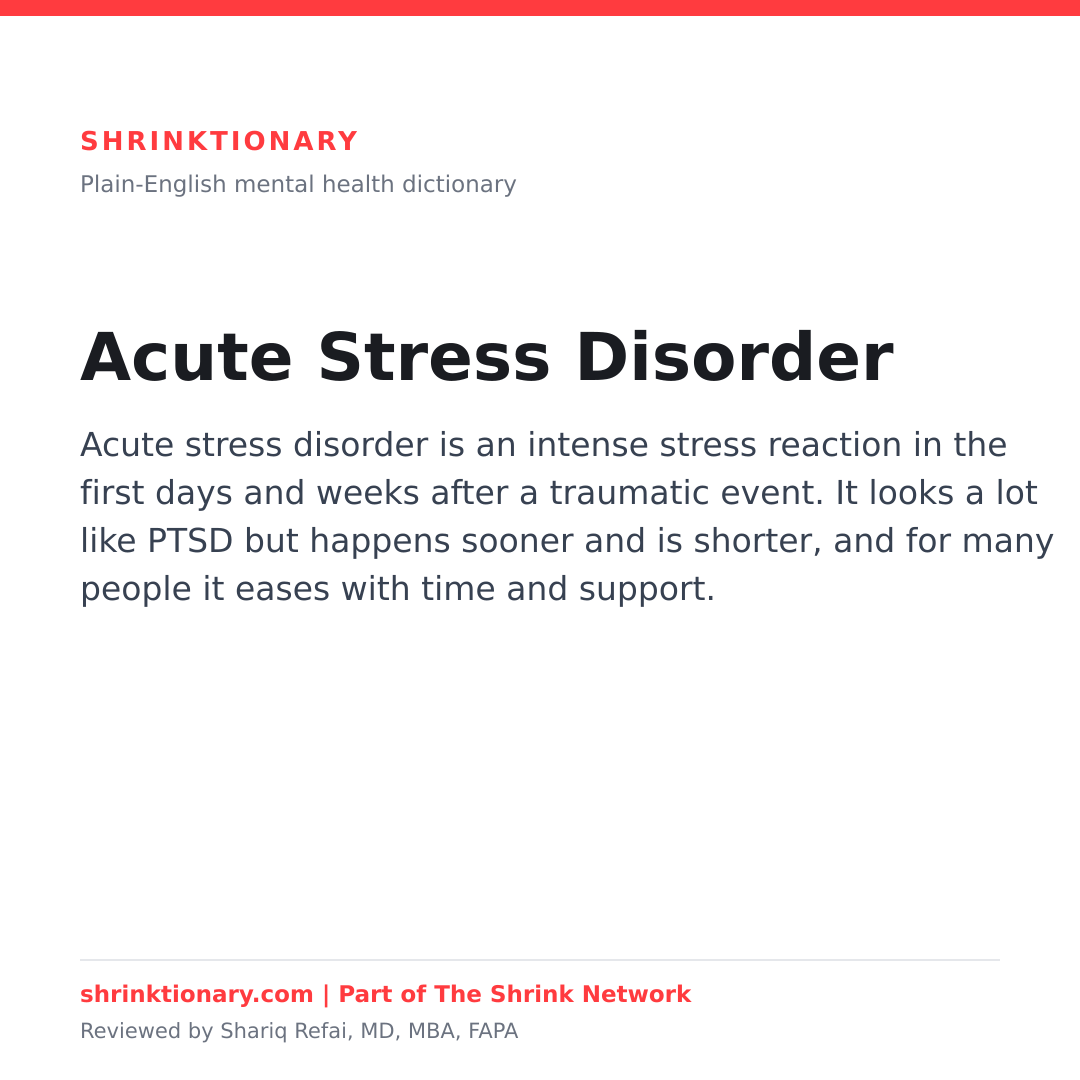
Acute stress disorder is an intense reaction to a traumatic event that shows up in the first days and weeks afterward. The event might be an accident, an assault, a disaster, a sudden loss, or witnessing something terrible. The mind and body respond to the shock in ways that can feel overwhelming.
It overlaps a great deal with post-traumatic stress disorder. The main difference is timing and duration. Acute stress disorder is diagnosed in the early window after a trauma, roughly from a few days up to about a month. If the symptoms continue beyond that window, clinicians may look at whether PTSD is developing.
How acute stress disorder shows up
People often describe intrusive memories or flashbacks, distressing dreams, and a strong urge to avoid reminders of what happened. The nervous system tends to stay on high alert, making sleep, concentration, and calm hard to come by. Strong anxiety and irritability are common.
A hallmark of acute stress disorder is dissociation, a sense of being detached or numb. The world can feel unreal or far away, time can feel strange, and parts of the event may be hard to remember. These reactions are the mind’s way of protecting itself in the immediate aftermath of something overwhelming.
What acute stress disorder isn’t
Acute stress disorder isn’t a sign that a person is weak or handling things badly. It’s a recognized, understandable response to a serious shock. Having it doesn’t mean a person will definitely go on to develop PTSD. Many people recover as the early period passes.
It also isn’t the same as ordinary stress from a hard week. Acute stress disorder follows a genuinely traumatic event and brings significant distress and disruption in the days that follow.
Related terms you’ll see next
When to seek professional care
If you’ve been through something traumatic and the days afterward feel unbearable, reaching out early can help. Support and trauma-focused therapy in this window can ease distress and may lower the chance that symptoms harden into longer-term difficulties.
Get help sooner rather than later if you can’t function, if the distress is severe, or if you have thoughts of self-harm. In the US you can call or text 988 any time.
When evaluation may help
Not everyone reading about acute stress disorder needs treatment. If it's getting in the way of your day, your sleep, your work, or your relationships, or if it isn't easing on its own, a professional evaluation is a reasonable next step. Most people start with their primary care doctor or a therapist. A psychiatrist is the right call when medication may be involved or the picture is complicated, though waits can be long.
We keep an honest, no-commission rundown of the options, from primary care to telepsychiatry to crisis lines, on one page.
If you're in crisis or thinking about suicide, call or text 988 in the US, or go to the nearest emergency room.
When this word matters
It matters in the first days to about a month after a traumatic event, when an intense stress reaction gets in the way of functioning rather than easing on its own. The timing is what separates it from PTSD, which is diagnosed when symptoms last longer than a month.
Commonly confused with
Frequently asked questions
What is the difference between acute stress disorder and PTSD?
Both involve intense reactions to trauma, like flashbacks, avoidance, and being on high alert. The main difference is timing. Acute stress disorder is diagnosed in the early window after a trauma, roughly a few days up to about a month, while PTSD is considered when symptoms continue beyond that window.
Does acute stress disorder always turn into PTSD?
No. Having acute stress disorder doesn't mean a person will definitely go on to develop PTSD. Many people recover as the early period passes, especially with support and trauma-focused care.
How is acute stress disorder treated?
Support and trauma-focused therapy in the early window can ease distress and may lower the chance that symptoms harden into longer-term difficulties. Reaching out early can help, particularly if you can't function or the distress is severe.
Related terms
In these language clusters
Sources
- Post-Traumatic Stress Disorder , National Institute of Mental Health
- Coping With Traumatic Events , National Institute of Mental Health
- Diagnostic and Statistical Manual of Mental Disorders, Fifth Edition, Text Revision (DSM-5-TR) , American Psychiatric Association
Use or cite this definition
Free to reuse with attribution. Paste the block into your own page, or grab a citation.
Embed on your site
<blockquote>
<p><strong>Acute Stress Disorder:</strong> Acute stress disorder is an intense stress reaction in the first days and weeks after a traumatic event. It looks a lot like PTSD but happens sooner and is shorter, and for many people it eases with time and support.</p>
<p>— <a href="https://shrinktionary.com/terms/acute-stress-disorder/">Shrinktionary</a>, a plain-English mental health dictionary, medically reviewed by a board certified psychiatrist.</p>
</blockquote>Cite (APA)
Refai, S. (2026). Acute Stress Disorder. Shrinktionary. https://shrinktionary.com/terms/acute-stress-disorder/
Cite (MLA)
"Acute Stress Disorder." Shrinktionary, https://shrinktionary.com/terms/acute-stress-disorder/. Accessed September 26, 2026.
Your next step in The Shrink Network
You are here: Shrinktionary, the language layer of The Shrink Network.
Each site in the network has one job. No matter where you enter, we help you find the next step that makes sense.
Want to understand more first?
See how this connects to everything else in the Term Web →
Take it with you
Free printable references you can save or share. For education, not medical advice.