What PTSD actually is
Post-traumatic stress disorder, or PTSD, can develop after someone experiences or witnesses a traumatic event, such as a serious accident, assault, combat, disaster, or abuse. It reflects a lasting change in how the brain and body process safety and danger after that event.
Clinicians describe four main groups of symptoms. Intrusion symptoms include unwanted memories, nightmares, or flashbacks that can feel like the event is happening again. Avoidance means steering clear of reminders, including places, people, or conversations. Negative changes in mood and thinking can include persistent fear, guilt, shame, numbness, or feeling cut off from others. Changes in arousal include being easily startled, on guard, irritable, or struggling to sleep.
For a PTSD diagnosis, these symptoms last more than a month and interfere with daily life. Some symptoms in the first weeks after trauma are a normal stress response, not necessarily PTSD.
What PTSD can feel like
People often describe feeling stuck in the past while trying to live in the present. A sound, smell, or offhand reminder can pull them back into the event with full intensity. Sleep is frequently disrupted by nightmares, and the body can stay braced for threat, a state related to hypervigilance.
Some people feel emotionally flat or detached, as if watching life from behind glass, which can overlap with dissociation. Others feel constantly on edge. Many work hard to avoid anything that might trigger a memory, which can shrink their world over time.
What PTSD isn’t
PTSD isn’t a sign of weakness or an inability to cope. It’s a recognized response to overwhelming experiences, and it can affect anyone regardless of strength or background.
It also isn’t the same as the normal distress most people feel right after something terrible happens. Many people have intense reactions in the first days and weeks and then gradually recover. PTSD is diagnosed when symptoms persist beyond a month and keep interfering with life.
Related terms you’ll see next
Hypervigilance describes the on-guard state that’s common in PTSD. Dissociation captures the sense of feeling detached or unreal. Intrusive thought overlaps with the unwanted memories of trauma. Exposure therapy is part of several evidence-based trauma treatments.
When to seek professional care
If trauma-related symptoms have lasted more than a month and are interfering with daily life, sleep, or relationships, an evaluation is worthwhile. A clinician can confirm whether the pattern fits PTSD and discuss trauma-focused therapies and medication. PTSD is treatable, and many people recover with care. If you’re in crisis, call or text 988 in the United States.
When evaluation may help
Not everyone reading about post-traumatic stress disorder (ptsd) needs treatment. If it's getting in the way of your day, your sleep, your work, or your relationships, or if it isn't easing on its own, a professional evaluation is a reasonable next step. Most people start with their primary care doctor or a therapist. A psychiatrist is the right call when medication may be involved or the picture is complicated, though waits can be long.
We keep an honest, no-commission rundown of the options, from primary care to telepsychiatry to crisis lines, on one page.
If you're in crisis or thinking about suicide, call or text 988 in the US, or go to the nearest emergency room.
When this word matters
It crosses into a clinical diagnosis when trauma symptoms like intrusive memories, avoidance, negative shifts in mood, and a body stuck on high alert persist well beyond the event and disrupt daily life. It overlaps with depression and anxiety, and it's distinct from a normal stress reaction that fades on its own.
Commonly confused with
Frequently asked questions
What are the main symptoms of PTSD?
Clinicians describe four main groups: intrusion symptoms like unwanted memories, nightmares, or flashbacks; avoidance of reminders; negative changes in mood and thinking such as fear, guilt, or numbness; and changes in arousal like being easily startled or on guard. For a diagnosis these last more than a month and interfere with daily life.
Does everyone who goes through trauma develop PTSD?
No. Many people have intense reactions in the first days and weeks after something terrible happens and then gradually recover, which is a normal stress response. PTSD is diagnosed when symptoms persist beyond a month and keep interfering with life, and recurring symptoms deserve an evaluation.
Can PTSD be treated?
Yes. PTSD is treatable and many people recover with care. A clinician can confirm the diagnosis and discuss trauma-focused therapies and medication, and if you're in crisis you can call or text 988 in the United States.
Related terms
In these language clusters
Compare
Sources
- Post-Traumatic Stress Disorder (PTSD) , National Institute of Mental Health
- Post-Traumatic Stress Disorder , MedlinePlus
- Diagnostic and Statistical Manual of Mental Disorders, Fifth Edition, Text Revision (DSM-5-TR) , American Psychiatric Association
Use or cite this definition
Free to reuse with attribution. Paste the block into your own page, or grab a citation.
Embed on your site
<blockquote>
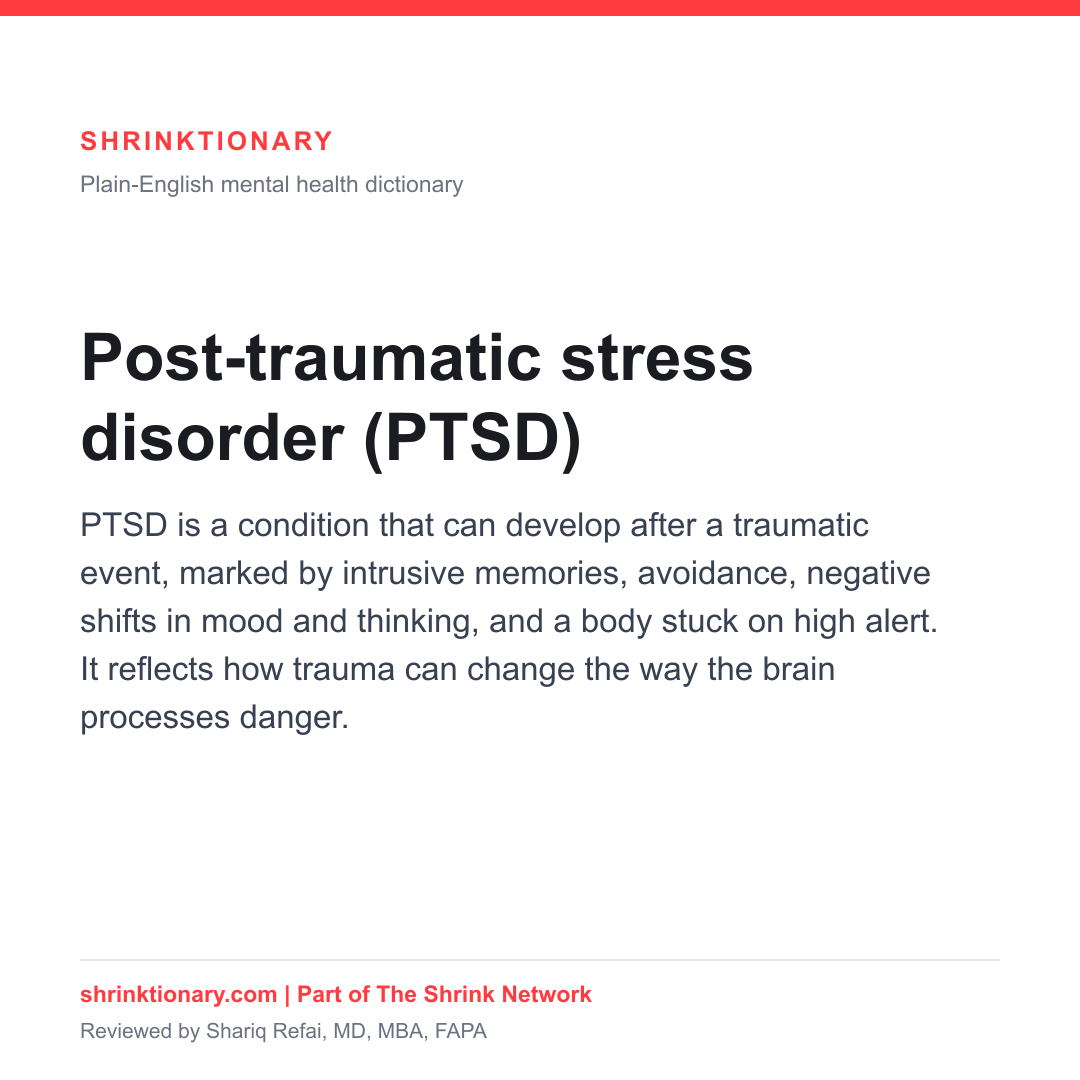
<p><strong>Post-traumatic stress disorder (PTSD):</strong> PTSD is a condition that can develop after a traumatic event, marked by intrusive memories, avoidance, negative shifts in mood and thinking, and a body stuck on high alert. It reflects how trauma can change the way the brain processes danger.</p>
<p>— <a href="https://shrinktionary.com/terms/ptsd/">Shrinktionary</a>, a plain-English mental health dictionary, medically reviewed by a board certified psychiatrist.</p>
</blockquote>Cite (APA)
Refai, S. (2026). Post-traumatic stress disorder (PTSD). Shrinktionary. https://shrinktionary.com/terms/ptsd/
Cite (MLA)
"Post-traumatic stress disorder (PTSD)." Shrinktionary, https://shrinktionary.com/terms/ptsd/. Accessed September 26, 2026.
Your next step in The Shrink Network
You are here: Shrinktionary, the language layer of The Shrink Network.
Each site in the network has one job. No matter where you enter, we help you find the next step that makes sense.
Want to understand more first?
See how this connects to everything else in the Term Web →
Take it with you
Free printable references you can save or share. For education, not medical advice.