What panic disorder actually is
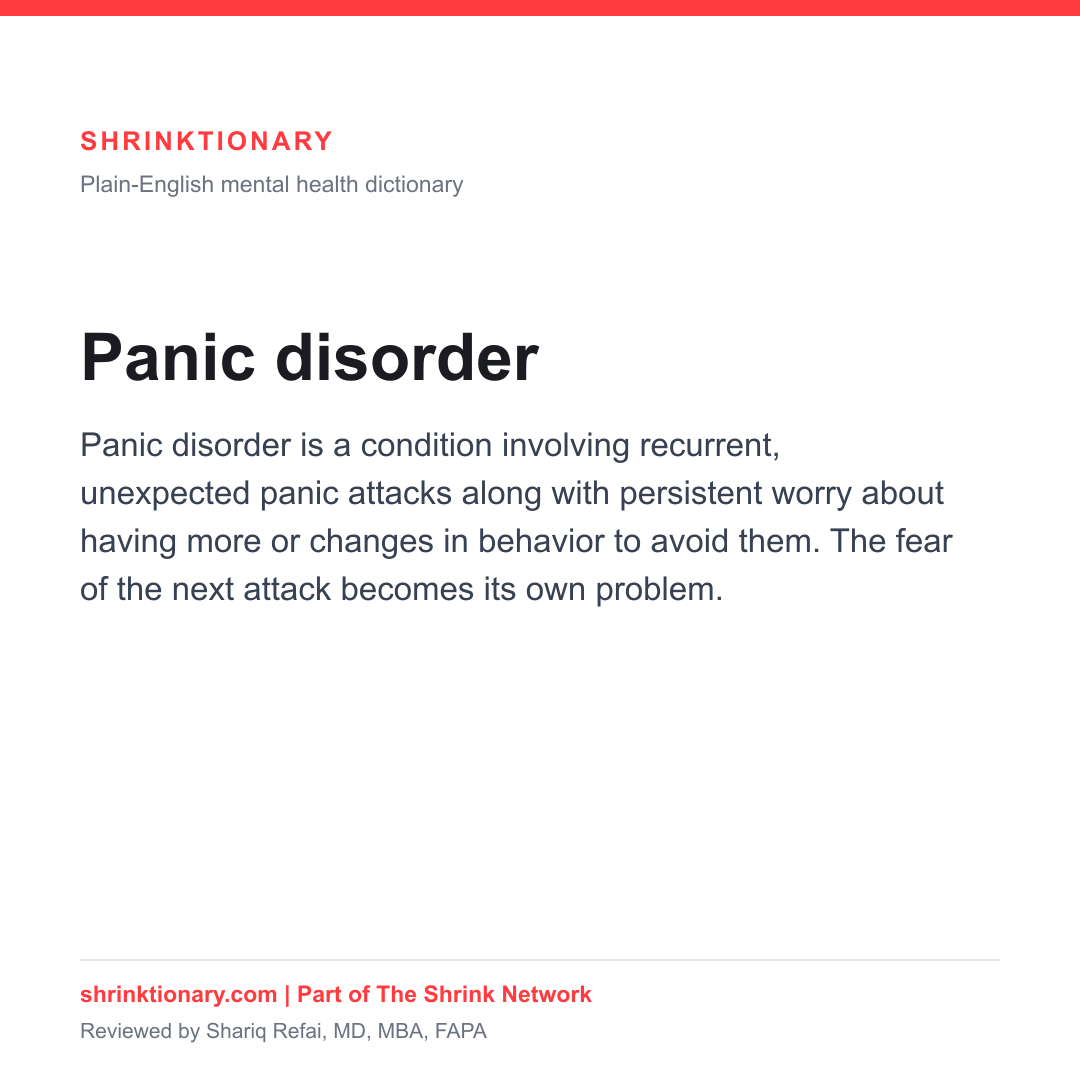
Panic disorder is a condition defined by recurrent, unexpected panic attacks, which are sudden surges of intense fear that peak within minutes and bring strong physical symptoms. In panic disorder, these attacks happen repeatedly and at least some of them arrive out of the blue, without an obvious trigger.
What turns isolated attacks into a disorder is what happens between them. People develop persistent worry about having another attack, concern about what the attacks mean, or changes in behavior meant to prevent them. By clinical definition, this ongoing worry or avoidance lasts a month or more.
That avoidance can grow over time. Someone might stop driving, skip the gym, or avoid crowded places where an attack once happened, which can narrow daily life considerably.
What panic disorder can feel like
People often describe living in fear of fear itself. The attacks are frightening enough, but the dread of the next one can be just as draining. Many become watchful of their own bodies, noticing every skipped heartbeat or wave of dizziness and bracing for it to spiral, a pattern related to hypervigilance.
Between attacks, life can feel constrained. People may map out exits, avoid being far from home, or insist on having a trusted person nearby. The world can start to feel smaller as the list of avoided situations grows.
What panic disorder isn’t
Having a single panic attack isn’t panic disorder. Many people have one attack and never have another. The diagnosis requires recurrent unexpected attacks plus the ongoing worry or avoidance that follows.
It also isn’t a sign of weakness or a character flaw, and the attacks themselves aren’t medically dangerous to most people, even though they feel that way. A first attack should be evaluated to rule out medical causes.
Related terms you’ll see next
Panic attack is the core event that defines this disorder. Fight-or-flight is the body’s threat response that drives the symptoms. Hypervigilance describes the watchfulness that often develops between attacks. Exposure therapy is among the most evidence-based treatments.
When to seek professional care
If panic attacks are recurring, or if you’re worrying between them or avoiding places where one happened, an evaluation for panic disorder is the right next step. A clinician can first rule out medical causes, then discuss therapy and medication options. Most people improve with treatment.
When evaluation may help
Not everyone reading about panic disorder needs treatment. If it's getting in the way of your day, your sleep, your work, or your relationships, or if it isn't easing on its own, a professional evaluation is a reasonable next step. Most people start with their primary care doctor or a therapist. A psychiatrist is the right call when medication may be involved or the picture is complicated, though waits can be long.
We keep an honest, no-commission rundown of the options, from primary care to telepsychiatry to crisis lines, on one page.
If you're in crisis or thinking about suicide, call or text 988 in the US, or go to the nearest emergency room.
When this word matters
Having panic attacks isn't the same as panic disorder, which is diagnosed when the attacks are recurrent and unexpected and the worry about future attacks or avoidance becomes a problem in its own right.
Commonly confused with
Frequently asked questions
What's the difference between a panic attack and panic disorder?
Having a single panic attack isn't panic disorder, and many people have one attack and never have another. The diagnosis requires recurrent, unexpected attacks plus ongoing worry about having more or changes in behavior to avoid them, lasting a month or more.
Is panic disorder dangerous?
The attacks themselves aren't medically dangerous to most people, even though they feel that way, and panic disorder isn't a sign of weakness or a character flaw. A first attack should be evaluated to rule out medical causes.
How is panic disorder treated?
Panic disorder has well-studied, effective treatments, including therapy approaches like CBT and exposure therapy along with medications. A clinician can first rule out medical causes, then discuss options, and most people improve with treatment.
Related terms
In these language clusters
Compare
Sources
- Panic Disorder: When Fear Overwhelms , National Institute of Mental Health
- Panic Disorder , MedlinePlus
- Diagnostic and Statistical Manual of Mental Disorders, Fifth Edition, Text Revision (DSM-5-TR) , American Psychiatric Association
Use or cite this definition
Free to reuse with attribution. Paste the block into your own page, or grab a citation.
Embed on your site
<blockquote>
<p><strong>Panic disorder:</strong> Panic disorder is a condition involving recurrent, unexpected panic attacks along with persistent worry about having more or changes in behavior to avoid them. The fear of the next attack becomes its own problem.</p>
<p>— <a href="https://shrinktionary.com/terms/panic-disorder/">Shrinktionary</a>, a plain-English mental health dictionary, medically reviewed by a board certified psychiatrist.</p>
</blockquote>Cite (APA)
Refai, S. (2026). Panic disorder. Shrinktionary. https://shrinktionary.com/terms/panic-disorder/
Cite (MLA)
"Panic disorder." Shrinktionary, https://shrinktionary.com/terms/panic-disorder/. Accessed September 26, 2026.
Your next step in The Shrink Network
You are here: Shrinktionary, the language layer of The Shrink Network.
Each site in the network has one job. No matter where you enter, we help you find the next step that makes sense.
Want to understand more first?
See how this connects to everything else in the Term Web →
Take it with you
Free printable references you can save or share. For education, not medical advice.