What a panic attack actually is
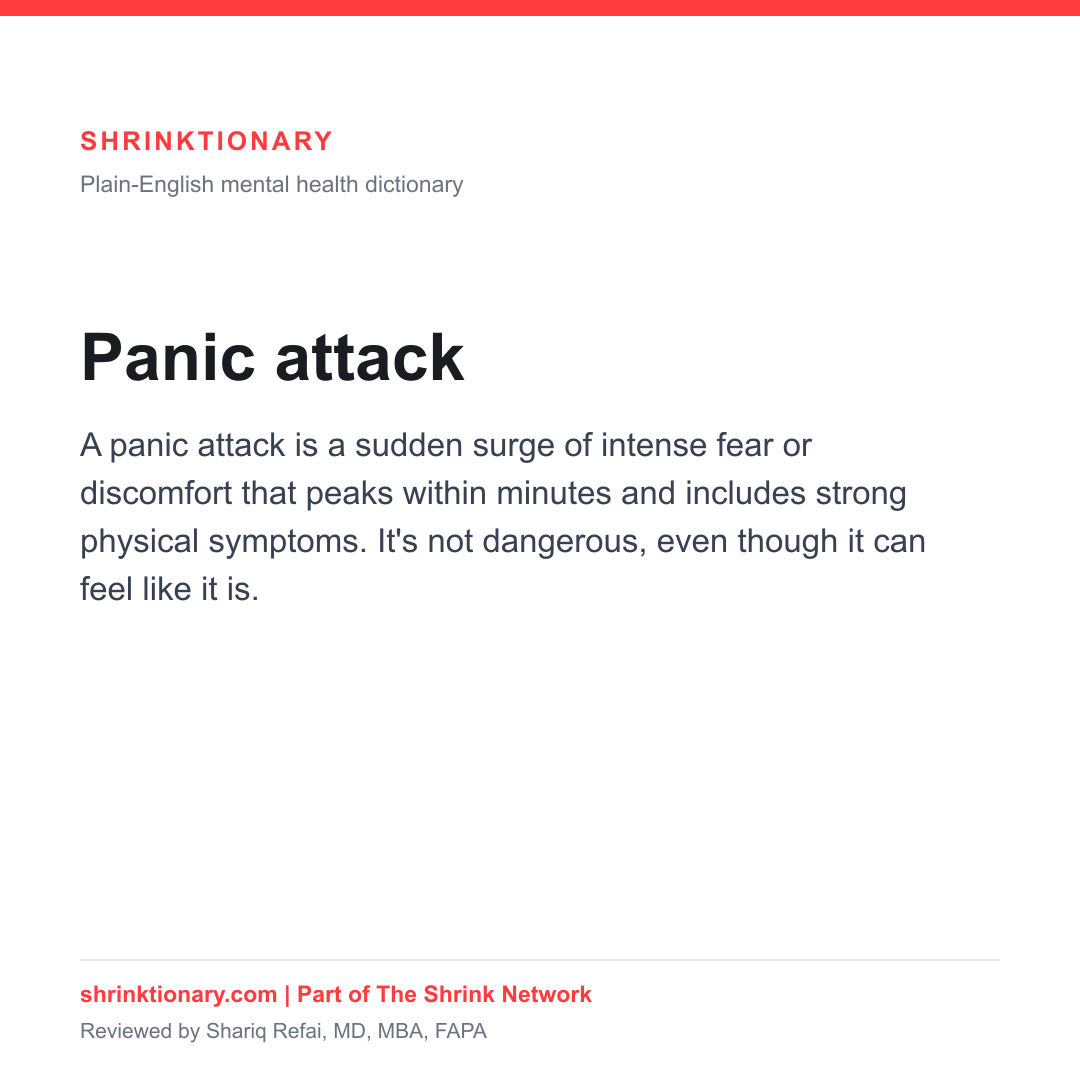
A panic attack is a sudden, intense surge of fear or physical discomfort that peaks within about ten minutes and then fades. The body’s threat system, sometimes called the fight-or-flight response, switches on all at once. Adrenaline floods the system. Heart rate jumps. Breathing speeds up. Vision narrows. The brain interprets the surge as “something is very wrong,” even when nothing in the environment is dangerous.
By clinical definition, a panic attack involves at least four of the following: racing heart, sweating, trembling, shortness of breath, feeling of choking, chest pain, nausea, dizziness, chills or heat, numbness or tingling, feelings of unreality or detachment, fear of losing control, or fear of dying.
Most attacks last between five and twenty minutes. They aren’t medically dangerous to most people, even though they feel that way in the moment.
What a panic attack can feel like
People often describe it as “I thought I was dying.” The body’s signals are loud enough that the mind reaches for the most alarming explanation. Common interpretations include heart attack, stroke, suffocation, and “losing my mind.” None of those is actually what’s happening, but the experience is so physical that the conclusion feels obvious.
After the attack passes, people often feel exhausted, shaky, and embarrassed. Many start avoiding the place or situation where the attack happened, which is how panic disorder takes hold.
What a panic attack isn’t
A panic attack isn’t a heart attack, isn’t a stroke, and isn’t a sign you’re going crazy. It’s also not the same as ordinary anxiety. Anxiety builds gradually and lingers. A panic attack arrives suddenly and peaks quickly.
The first attack should be evaluated by a clinician to rule out medical causes. After that’s done, recurring attacks usually indicate panic disorder, which has well-studied, effective treatments.
Related terms you’ll see next
Fight-or-flight is the underlying physiological response. Hyperventilation is the breathing pattern that fuels the symptoms. Exposure therapy is the most evidence-based behavioral treatment for panic disorder.
When to seek professional care
After a first attack, see a clinician to rule out other causes. If attacks are recurring, or if you’re avoiding places where one happened, an evaluation for panic disorder is the right next step. Most people improve with treatment.
Once a clinician has ruled out other causes, you can practice what to do in the moment with the Panic Reset, a step-by-step guide to stopping a panic attack on shrinkMD. shrinkMD is part of The Shrink Network, founded by Shariq Refai, MD.
When this word matters
A single panic attack is common and not dangerous, but it matters clinically when attacks recur and lead to ongoing fear or avoidance, which can point to panic disorder or another anxiety condition.
Commonly confused with
Frequently asked questions
Are panic attacks dangerous?
Panic attacks aren't medically dangerous to most people, even though the symptoms feel alarming in the moment. The body's threat system switches on all at once, but it isn't a heart attack, a stroke, or a sign you're going crazy.
How long does a panic attack last?
A panic attack peaks within about ten minutes and most last between five and twenty minutes before fading. Afterward people often feel exhausted, shaky, and embarrassed.
What's the difference between a panic attack and anxiety?
Anxiety builds gradually and lingers, while a panic attack arrives suddenly and peaks quickly. A first attack should be evaluated by a clinician to rule out medical causes, and recurring attacks deserve an evaluation since they often point to panic disorder, which has effective treatments.
Related terms
In these language clusters
Compare
Sources
- Panic Disorder , National Institute of Mental Health
- Panic Attacks and Panic Disorder , Mayo Clinic
- Diagnostic and Statistical Manual of Mental Disorders, Fifth Edition, Text Revision (DSM-5-TR) , American Psychiatric Association
Use or cite this definition
Free to reuse with attribution. Paste the block into your own page, or grab a citation.
Embed on your site
<blockquote>
<p><strong>Panic attack:</strong> A panic attack is a sudden surge of intense fear or discomfort that peaks within minutes and includes strong physical symptoms. It's not dangerous, even though it can feel like it is.</p>
<p>— <a href="https://shrinktionary.com/terms/panic-attack/">Shrinktionary</a>, a plain-English mental health dictionary, medically reviewed by a board certified psychiatrist.</p>
</blockquote>Cite (APA)
Refai, S. (2026). Panic attack. Shrinktionary. https://shrinktionary.com/terms/panic-attack/
Cite (MLA)
"Panic attack." Shrinktionary, https://shrinktionary.com/terms/panic-attack/. Accessed September 26, 2026.
Your next step in The Shrink Network
You are here: Shrinktionary, the language layer of The Shrink Network.
Each site in the network has one job. No matter where you enter, we help you find the next step that makes sense.
Want to understand more first?
See how this connects to everything else in the Term Web →
Take it with you
Free printable references you can save or share. For education, not medical advice.