What hyperventilation actually is
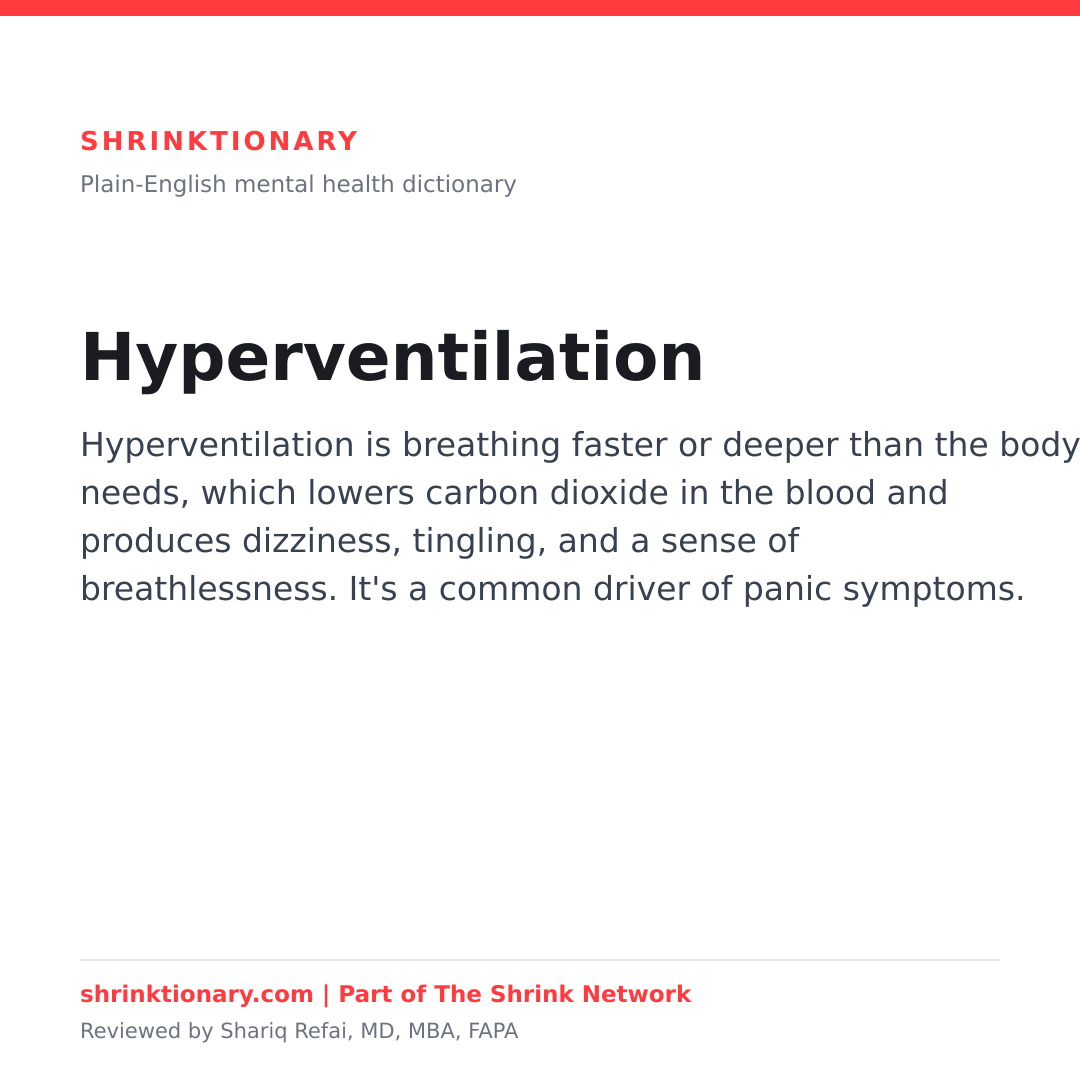
Hyperventilation is breathing that runs ahead of what the body needs. When you breathe too fast or too deeply, you blow off more carbon dioxide than usual, and the level of CO2 in your blood drops. That drop is what produces the strange physical feelings people notice: lightheadedness, tingling in the hands or lips, a racing heart, and the paradoxical sense that you can’t get enough air even though you’re breathing plenty.
It often happens automatically during fear or stress, as part of the body’s threat response. Most people don’t notice they’re doing it. They notice the symptoms it causes and reach for an alarming explanation.
What hyperventilation can feel like
People describe it as not being able to take a satisfying breath, as if the air isn’t going deep enough. That feeling drives them to breathe harder, which lowers CO2 further, which makes the symptoms worse. It’s a loop, and it’s a big part of why a panic attack escalates so fast.
The dizziness, tingling, and chest tightness can feel like a medical emergency. They aren’t dangerous in a healthy person, but the body’s signals are loud enough that the mind reaches for the scariest interpretation.
What hyperventilation isn’t
Hyperventilation isn’t a sign that you’re suffocating, and it isn’t usually a lung or heart problem. In the setting of anxiety or panic, it’s the breathing pattern itself producing the symptoms, not a lack of oxygen. A first episode with breathing trouble should still be checked by a clinician to rule out medical causes.
Related terms you’ll see next
A panic attack is the surge of fear that hyperventilation often fuels. Fight-or-flight is the underlying response that switches the breathing pattern on. Anxiety is the broader state it tends to show up in.
When to seek professional care
If overbreathing is part of recurring panic attacks, or you’re avoiding places where it happened, an evaluation for panic disorder is worthwhile. Breathing techniques and exposure-based therapy reduce it directly, and most people improve with treatment.
When this word matters
Hyperventilation matters when it's part of recurring panic attacks or you start avoiding places where it happened, which points toward panic disorder. A first episode with breathing trouble should still be checked to rule out medical causes.
Commonly confused with
Frequently asked questions
Why does hyperventilation make you feel like you can't breathe?
Breathing too fast or deeply blows off more carbon dioxide than usual, and the drop in blood CO2 produces lightheadedness, tingling, and the paradoxical sense that you can't get enough air even though you're breathing plenty.
Is hyperventilation dangerous?
In a healthy person during anxiety or panic, it isn't dangerous and usually isn't a lung or heart problem. The breathing pattern itself produces the symptoms, not a lack of oxygen. A first episode should still be checked by a clinician to rule out medical causes.
How is hyperventilation linked to panic attacks?
It can become a loop, where the feeling of not getting a satisfying breath drives harder breathing, which lowers CO2 further and worsens symptoms. That's a big part of why a panic attack escalates so fast.
Related terms
In these language clusters
Compare
Sources
- Panic Disorder: When Fear Overwhelms , National Institute of Mental Health
- Anxiety , MedlinePlus, U.S. National Library of Medicine
Use or cite this definition
Free to reuse with attribution. Paste the block into your own page, or grab a citation.
Embed on your site
<blockquote>
<p><strong>Hyperventilation:</strong> Hyperventilation is breathing faster or deeper than the body needs, which lowers carbon dioxide in the blood and produces dizziness, tingling, and a sense of breathlessness. It's a common driver of panic symptoms.</p>
<p>— <a href="https://shrinktionary.com/terms/hyperventilation/">Shrinktionary</a>, a plain-English mental health dictionary, medically reviewed by a board certified psychiatrist.</p>
</blockquote>Cite (APA)
Refai, S. (2026). Hyperventilation. Shrinktionary. https://shrinktionary.com/terms/hyperventilation/
Cite (MLA)
"Hyperventilation." Shrinktionary, https://shrinktionary.com/terms/hyperventilation/. Accessed September 26, 2026.
Your next step in The Shrink Network
You are here: Shrinktionary, the language layer of The Shrink Network.
Each site in the network has one job. No matter where you enter, we help you find the next step that makes sense.
Want to understand more first?
See how this connects to everything else in the Term Web →
Take it with you
Free printable references you can save or share. For education, not medical advice.