What intergenerational trauma actually is
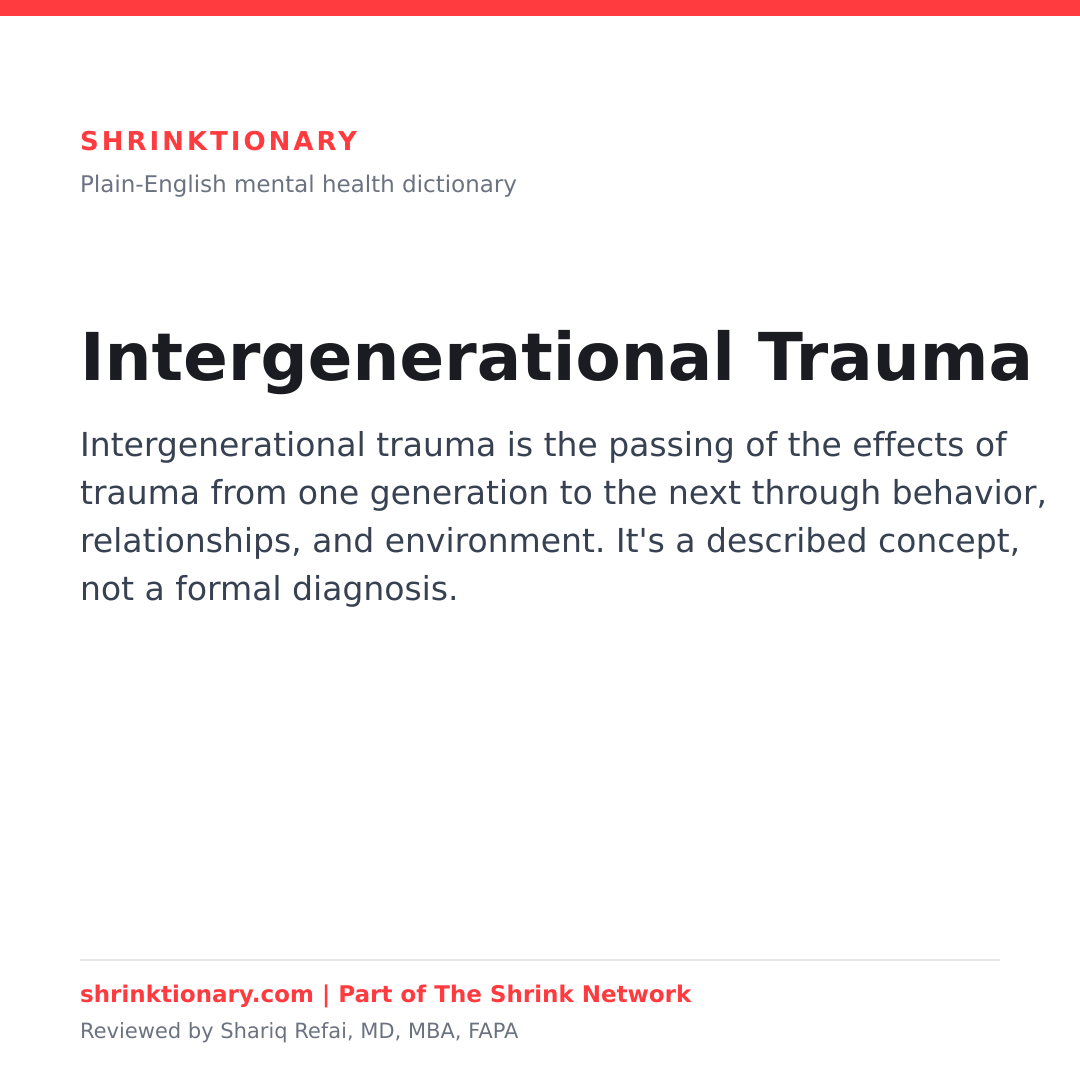
Intergenerational trauma is the idea that the effects of trauma can be passed down from one generation to the next. A parent or grandparent lives through something overwhelming, and the marks it leaves shape how they relate, parent, and cope. Those patterns can then influence children who never experienced the original event themselves. The trauma itself doesn’t travel, but its echoes can.
This is a described concept rather than a formal diagnosis. You won’t find intergenerational trauma listed as a disorder in the DSM-5-TR. It’s a framework that researchers, clinicians, and families use to make sense of how hardship in one generation can affect the next. The transmission is thought to happen mainly through relationships, learned behavior, communication styles, and environment, with ongoing research also examining biological and stress-related pathways.
How it tends to show up
It often appears as patterns that don’t quite match a person’s own life story. Someone may carry a deep sense of threat, mistrust, or hypervigilance without a clear personal cause, having absorbed it from a parent who lived through war, displacement, abuse, or severe loss. Family rules about silence, emotion, or safety can pass down quietly, shaping how love and stress get handled.
It can also show up in attachment patterns, where a parent who never felt safe struggles to offer steady security, and the child grows up with their own version of that struggle. Communities that have endured collective trauma, such as forced displacement or systemic violence, may carry shared effects across generations. None of this is deterministic. Many people break these cycles, and naming the pattern is often part of how they do it.
What intergenerational trauma isn’t
It isn’t a way of blaming parents or grandparents, most of whom were doing their best with what they survived. It also isn’t a fixed sentence. Recognizing inherited patterns is usually a step toward changing them, not proof that nothing can change.
It isn’t a clinical diagnosis on its own, and it isn’t an excuse that removes personal responsibility. It’s a lens for understanding where certain patterns came from so they can be worked with directly.
Related terms you’ll see next
Complex PTSD describes the kind of long-term trauma response that can ripple across generations. Attachment names the relationship patterns through which a lot of this transmission is thought to happen. Inner child is a concept often used in therapy when people work to heal patterns carried from childhood and earlier generations.
Why it matters
This concept matters because it helps people understand patterns that otherwise feel mysterious or shameful. Seeing a struggle as something inherited, rather than a personal defect, can reduce self-blame and open the door to change. It also points toward useful work in therapy, where people can grieve what happened, learn new patterns, and parent differently than they were parented. If inherited patterns are interfering with relationships or daily life, working with a clinician who understands trauma can help.
When this word matters
It matters when patterns of fear, mistrust, silence, or difficulty with closeness don't quite match a person's own life story and seem to have been carried from earlier generations. Seeing a struggle as inherited rather than a personal defect can reduce self-blame and open the door to change in therapy.
Commonly confused with
Frequently asked questions
Is intergenerational trauma a diagnosis?
No. It's a described concept rather than a formal diagnosis, and you won't find it listed as a disorder in the DSM-5-TR. It's a framework for understanding how the effects of trauma in one generation can affect the next.
How is intergenerational trauma passed down?
The transmission is thought to happen mainly through relationships, learned behavior, communication styles, and environment, with ongoing research also examining biological and stress-related pathways. The original event doesn't travel, but its echoes can.
Can cycles of intergenerational trauma be broken?
Yes. None of this is deterministic, and many people break these cycles. Recognizing inherited patterns is often a step toward changing them, and working with a clinician who understands trauma can help when these patterns interfere with daily life.
Related terms
In these language clusters
Sources
- Coping With Traumatic Events , National Institute of Mental Health
- Post-Traumatic Stress Disorder (PTSD) , Cleveland Clinic
Use or cite this definition
Free to reuse with attribution. Paste the block into your own page, or grab a citation.
Embed on your site
<blockquote>
<p><strong>Intergenerational Trauma:</strong> Intergenerational trauma is the passing of the effects of trauma from one generation to the next through behavior, relationships, and environment. It's a described concept, not a formal diagnosis.</p>
<p>— <a href="https://shrinktionary.com/terms/intergenerational-trauma/">Shrinktionary</a>, a plain-English mental health dictionary, medically reviewed by a board certified psychiatrist.</p>
</blockquote>Cite (APA)
Refai, S. (2026). Intergenerational Trauma. Shrinktionary. https://shrinktionary.com/terms/intergenerational-trauma/
Cite (MLA)
"Intergenerational Trauma." Shrinktionary, https://shrinktionary.com/terms/intergenerational-trauma/. Accessed September 26, 2026.
Your next step in The Shrink Network
You are here: Shrinktionary, the language layer of The Shrink Network.
Each site in the network has one job. No matter where you enter, we help you find the next step that makes sense.
Want to understand more first?
See how this connects to everything else in the Term Web →
Take it with you
Free printable references you can save or share. For education, not medical advice.