What EMDR actually is
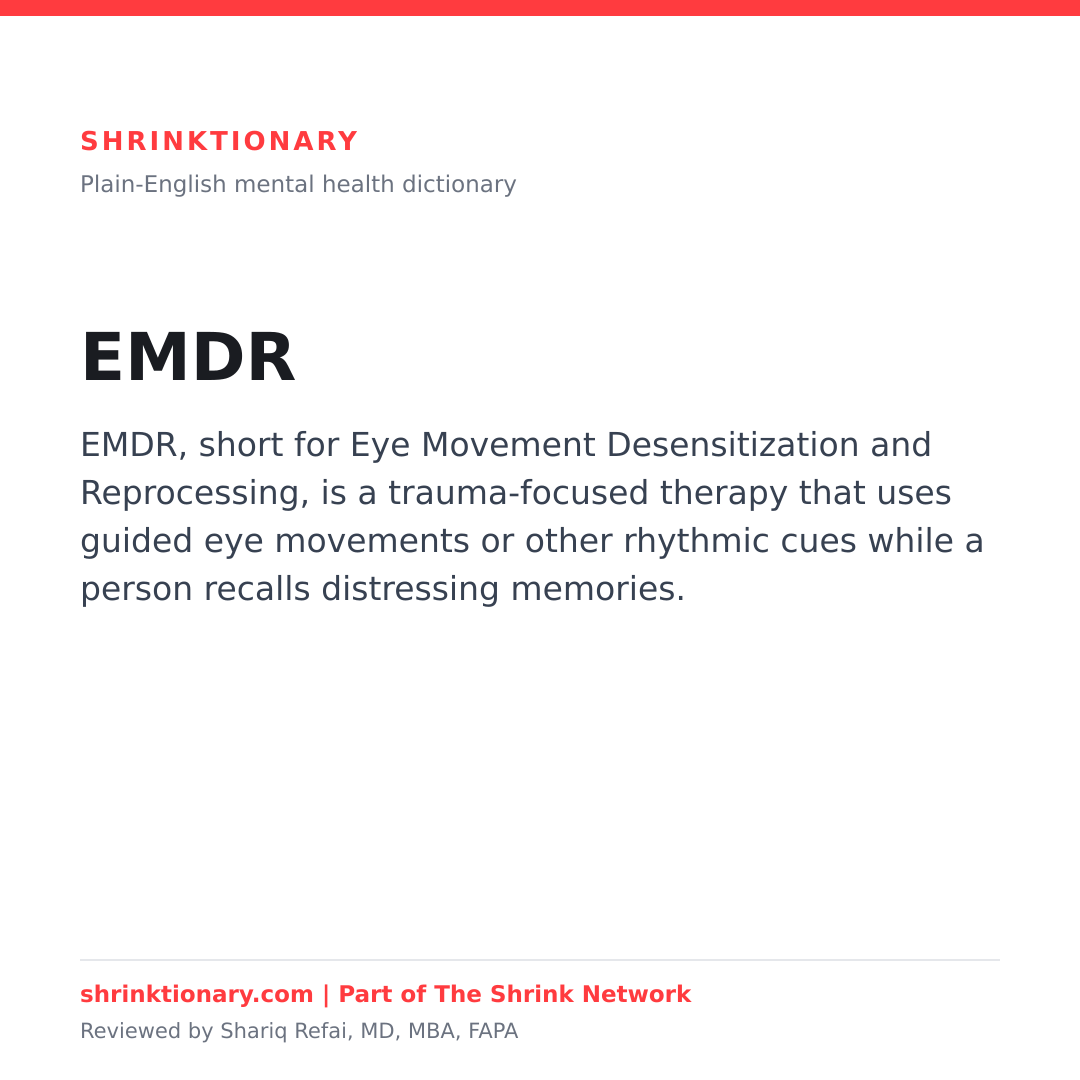
EMDR stands for Eye Movement Desensitization and Reprocessing. It’s a structured, trauma-focused therapy developed to help people recover from disturbing memories, most often in post-traumatic stress disorder. The distinctive piece is bilateral stimulation, usually side-to-side eye movements, but sometimes taps or tones, that a person follows while they briefly bring a painful memory to mind.
The idea behind EMDR is that trauma can leave a memory stored in a raw, unprocessed way, so it keeps triggering strong reactions long after the event. By recalling the memory in short doses alongside the guided movements, a person can process it more fully, so it loses some of its emotional charge and feels more like a memory of the past than a threat in the present.
What EMDR looks like in practice
EMDR follows a set of phases. Early on, the therapist takes a history and teaches grounding and calming skills, so the person has tools before any hard memories come up. Then, in the processing phase, the person holds a target memory in mind, notices the images, thoughts, and body sensations tied to it, and follows the therapist’s hand or another rhythmic cue in short sets.
Between sets, the therapist checks in on what shifted. Over time, the distress linked to the memory tends to drop, and a more balanced belief, like “I’m safe now,” can take the place of an old one like “It was my fault.” Unlike some therapies, EMDR doesn’t require a person to describe the trauma in detail or to do homework between sessions, which some people find more bearable.
What EMDR isn’t
EMDR isn’t hypnosis, and it doesn’t put a person in a trance or take away their control. The person stays awake, aware, and in charge throughout.
It also isn’t a way to erase memories. The memory stays. What changes is how much it hurts to recall it. And the eye movements themselves aren’t magic. EMDR is a full, structured therapy delivered by a trained professional, not just moving your eyes back and forth.
Related terms you’ll see next
When to seek professional care
Anyone living with the aftermath of trauma, including flashbacks, nightmares, being easily startled, or avoiding reminders of what happened, may benefit from a trauma-focused therapy like EMDR. It should be done with a licensed clinician trained in the approach, who can pace the work safely. If trauma symptoms feel overwhelming, or a person has thoughts of harming themselves, reach out for help right away by calling or texting 988 in the US to reach the Suicide and Crisis Lifeline.
When this word matters
EMDR matters as an evidence-based, trauma-focused therapy, mainly for PTSD, and it differs from exposure therapy and CBT in that it doesn't require describing the trauma in detail or doing homework. It isn't hypnosis and it doesn't erase memories, it changes how much they hurt to recall.
Commonly confused with
Frequently asked questions
Is EMDR the same as hypnosis?
No. EMDR isn't hypnosis and doesn't put you in a trance or take away your control. You stay awake, aware, and in charge throughout the whole process.
Does EMDR erase traumatic memories?
No. The memory stays. What changes is how much it hurts to recall it, so it starts to feel more like a memory of the past than a threat in the present.
What conditions is EMDR used to treat?
EMDR is a trauma-focused therapy used most often for post-traumatic stress disorder. It can help people recover from disturbing memories, including symptoms like flashbacks, nightmares, and being easily startled.
Related terms
In these language clusters
Compare
Sources
- Psychotherapies , National Institute of Mental Health
- Eye Movement Desensitization and Reprocessing (EMDR) Therapy , American Psychological Association
Use or cite this definition
Free to reuse with attribution. Paste the block into your own page, or grab a citation.
Embed on your site
<blockquote>
<p><strong>EMDR:</strong> EMDR, short for Eye Movement Desensitization and Reprocessing, is a trauma-focused therapy that uses guided eye movements or other rhythmic cues while a person recalls distressing memories.</p>
<p>— <a href="https://shrinktionary.com/terms/emdr/">Shrinktionary</a>, a plain-English mental health dictionary, medically reviewed by a board certified psychiatrist.</p>
</blockquote>Cite (APA)
Refai, S. (2026). EMDR. Shrinktionary. https://shrinktionary.com/terms/emdr/
Cite (MLA)
"EMDR." Shrinktionary, https://shrinktionary.com/terms/emdr/. Accessed September 26, 2026.
Your next step in The Shrink Network
You are here: Shrinktionary, the language layer of The Shrink Network.
Each site in the network has one job. No matter where you enter, we help you find the next step that makes sense.
Want to understand more first?
See how this connects to everything else in the Term Web →
Take it with you
Free printable references you can save or share. For education, not medical advice.