What interpersonal therapy actually is
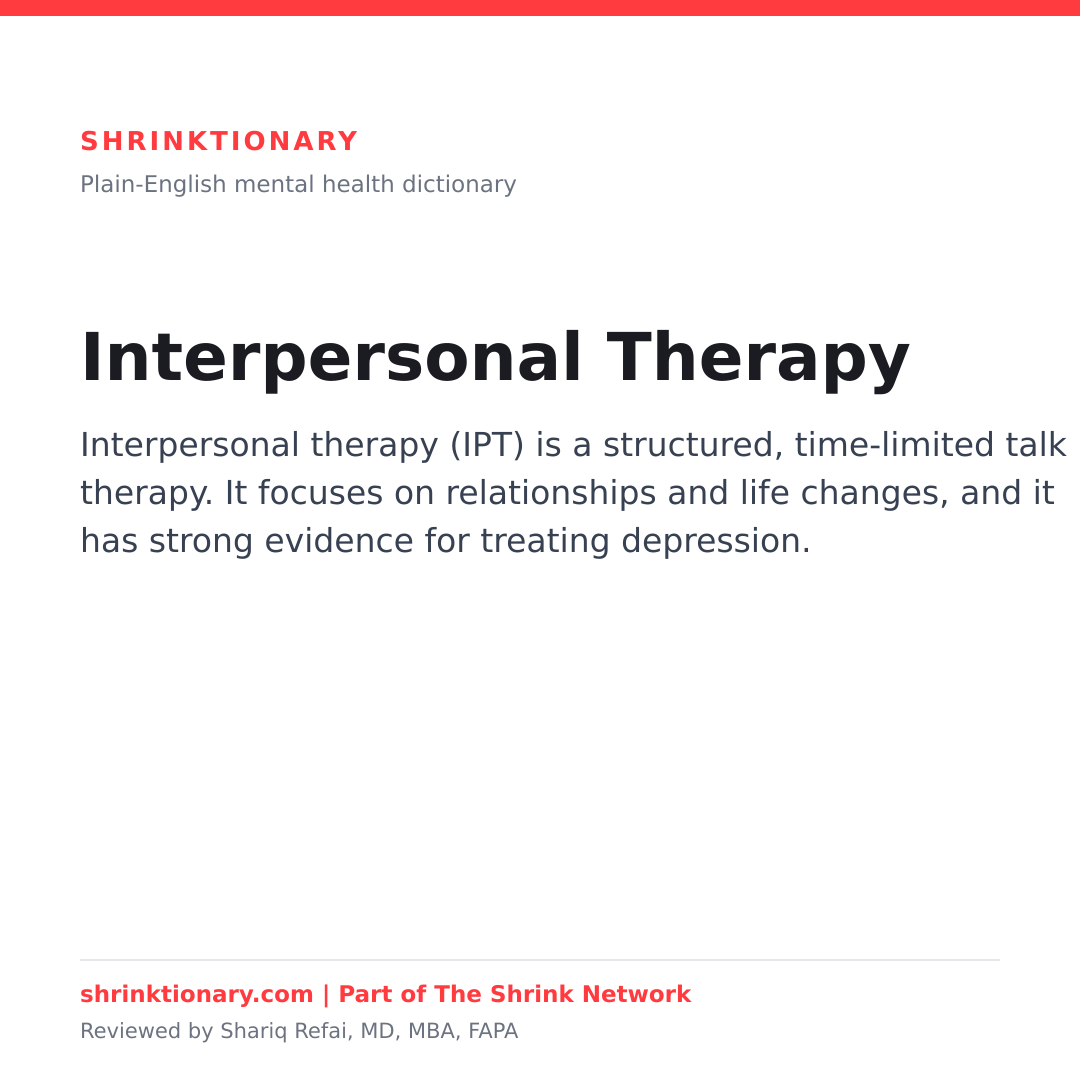
Interpersonal therapy, usually shortened to IPT, is a structured form of talk therapy built on a simple observation. The way we’re doing in our relationships and the way we’re feeling are tightly linked. When a relationship is in trouble or a big life change hits, mood often suffers, and a low mood can strain relationships in return.
IPT works on that link. Rather than digging deep into childhood or focusing mainly on thought patterns, it looks at what’s happening in your current relationships and life circumstances, and it works to improve those.
What it looks like in practice
IPT is time-limited, often running around twelve to sixteen weekly sessions. Early on, you and the therapist map out your relationships and pick a focus area. IPT usually centers on one of a few common themes: grief after a loss, conflict in an important relationship, a major role change like a new job or becoming a parent, or difficulty connecting with others.
From there, the work is practical. You might practice communicating a need more directly, work through a loss, or build a support network during a transition. There’s strong research evidence that IPT helps with depression, including depression after childbirth, and it’s also been studied for other conditions.
What it isn’t
IPT isn’t couples therapy, even though it deals with relationships. The work happens with you, focused on how you handle and respond to the people in your life. It also isn’t open-ended. The time limit and clear focus are part of the design.
And it isn’t the same as CBT. Both are structured and evidence-based, but CBT centers on thoughts and behaviors while IPT centers on relationships and roles. Some people respond better to one than the other.
Related terms you’ll see next
When to seek professional care
If your low mood seems tied to a loss, a relationship conflict, or a major life change, IPT may be worth asking about. A licensed therapist can tell you whether it fits your situation. If depression is severe, or if you’re having thoughts of harming yourself, don’t wait for an appointment. Contact a professional or a crisis line right away.
When this word matters
IPT matters when low mood seems tied to a loss, a relationship conflict, or a major life change, since it works on that link in a time-limited, focused way. It has strong evidence for depression, including depression after childbirth.
Commonly confused with
Frequently asked questions
What does interpersonal therapy focus on?
IPT focuses on the link between relationships and mood. It usually centers on one of a few themes such as grief after a loss, conflict in an important relationship, a major role change, or difficulty connecting with others.
How long does interpersonal therapy take?
IPT is time-limited and structured, often running around twelve to sixteen weekly sessions. The time limit and clear focus are part of its design.
Is interpersonal therapy the same as CBT?
No. Both are structured and evidence-based, but CBT centers on thoughts and behaviors while IPT centers on relationships and roles. Some people respond better to one than the other.
Related terms
In these language clusters
Sources
- Psychotherapies , National Institute of Mental Health
- Psychotherapy , American Psychiatric Association
Use or cite this definition
Free to reuse with attribution. Paste the block into your own page, or grab a citation.
Embed on your site
<blockquote>
<p><strong>Interpersonal Therapy:</strong> Interpersonal therapy (IPT) is a structured, time-limited talk therapy. It focuses on relationships and life changes, and it has strong evidence for treating depression.</p>
<p>— <a href="https://shrinktionary.com/terms/interpersonal-therapy/">Shrinktionary</a>, a plain-English mental health dictionary, medically reviewed by a board certified psychiatrist.</p>
</blockquote>Cite (APA)
Refai, S. (2026). Interpersonal Therapy. Shrinktionary. https://shrinktionary.com/terms/interpersonal-therapy/
Cite (MLA)
"Interpersonal Therapy." Shrinktionary, https://shrinktionary.com/terms/interpersonal-therapy/. Accessed September 26, 2026.
Your next step in The Shrink Network
You are here: Shrinktionary, the language layer of The Shrink Network.
Each site in the network has one job. No matter where you enter, we help you find the next step that makes sense.
Want to understand more first?
See how this connects to everything else in the Term Web →
Take it with you
Free printable references you can save or share. For education, not medical advice.