What group therapy actually is
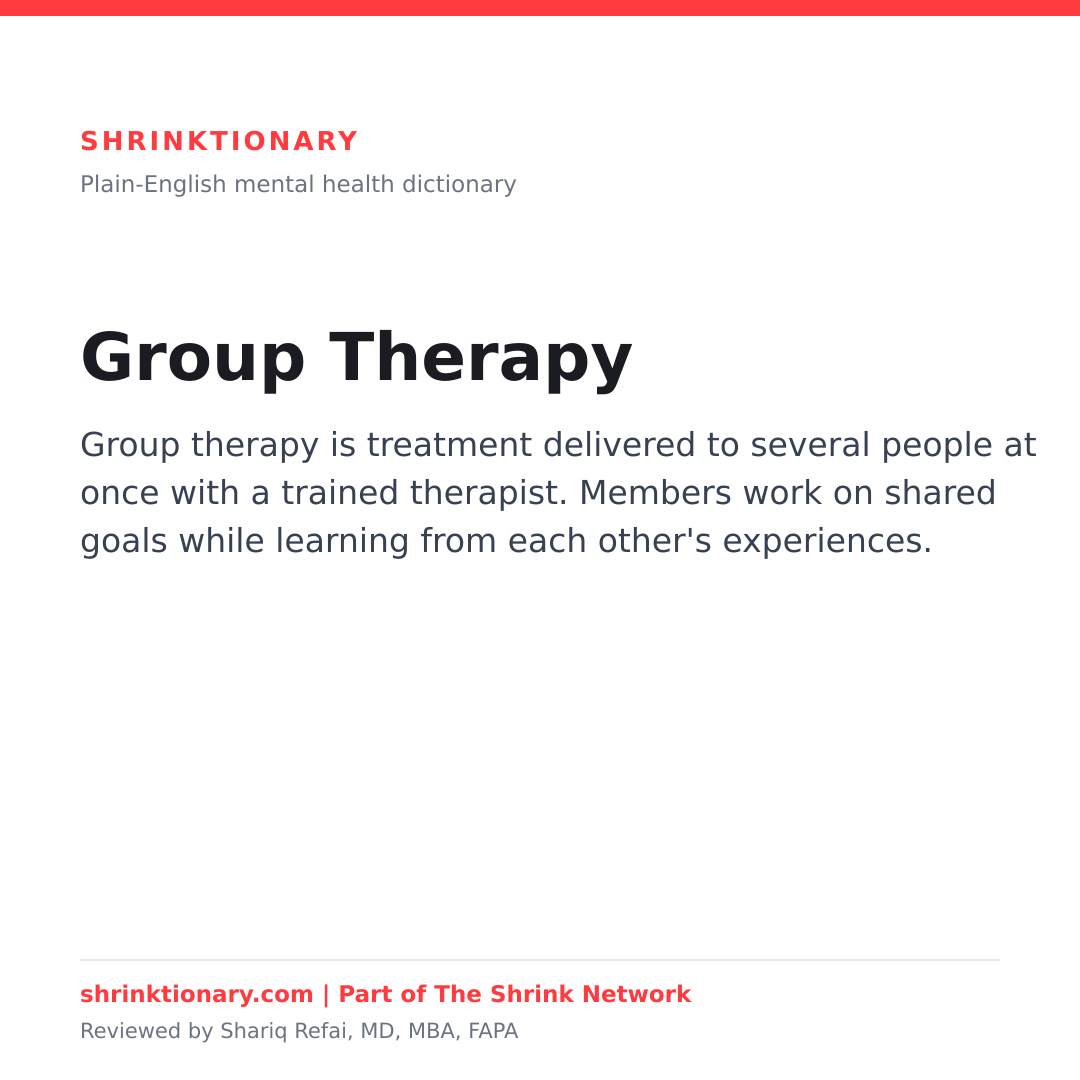
Group therapy is a form of psychotherapy where one or two therapists work with several people at the same time, usually somewhere between five and twelve members. Everyone meets on a regular schedule, often weekly, and the group becomes a setting where people can talk through problems, practice new skills, and get feedback.
Some groups focus on a single issue, like depression, grief, or substance use. Others are more open and let members bring whatever’s on their mind. The therapist guides the conversation, keeps it safe and on track, and makes sure everyone has space to take part.
How group therapy works
A lot of the value comes from the group itself, not just the therapist. Hearing other people describe struggles that sound like your own can ease the sense of being alone with a problem. Members also model coping strategies for each other, and the group gives people a place to try out new ways of relating to others in real time.
Therapists often use a structured approach inside the group. A skills-based group might teach and practice techniques from cognitive behavioral therapy week by week. A process-oriented group pays more attention to how members interact, using those interactions as material to work on. Confidentiality is a ground rule. What’s said in the room stays in the room.
Group therapy can be used on its own or alongside individual therapy and medication. Research supports it for a wide range of conditions, and it often costs less than one-on-one sessions.
What group therapy isn’t
Group therapy isn’t a support group, though the two can look similar. Support groups are usually peer-led and free, while group therapy is run by a licensed clinician and is a formal treatment. It also isn’t a place where members are forced to share before they’re ready. Participation builds over time.
It isn’t a sign that someone’s problem is less serious than one that gets individual treatment. For many conditions, group formats are a first-line, well-studied option, not a downgrade.
Related terms you’ll see next
People reading about group therapy often look into psychoeducation, which is frequently delivered in group settings, along with CBT, interpersonal therapy, and DBT, all of which offer group-based versions.
When to seek professional care
Group therapy is worth asking about when someone wants treatment but also wants connection, when isolation is part of the problem, or when a specific issue like grief or addiction has dedicated groups available. A primary care provider or mental health clinician can help match a person to the right kind of group and confirm it fits their needs.
When this word matters
Group therapy matters because much of the value comes from the group itself, easing the sense of being alone and letting members model coping and practice new ways of relating in real time. It differs from a support group in that a trained therapist guides it, and it can run on its own or alongside individual therapy and medication.
Commonly confused with
Frequently asked questions
What is group therapy?
Group therapy is a form of psychotherapy where one or two therapists work with several people at the same time, usually somewhere between five and twelve members. The group meets on a regular schedule to talk through problems, practice new skills, and get feedback.
How is group therapy different from a support group?
Support groups are usually peer-led and free, while group therapy is run by a licensed clinician and is a formal treatment. Group therapy also isn't a place where members are forced to share before they're ready.
Is group therapy as effective as individual therapy?
It isn't a sign that someone's problem is less serious. For many conditions, group formats are a well-studied, first-line option, and group therapy can be used on its own or alongside individual therapy and medication.
Related terms
In these language clusters
Sources
- Psychotherapies , National Institute of Mental Health
- Mental Health , MedlinePlus
Use or cite this definition
Free to reuse with attribution. Paste the block into your own page, or grab a citation.
Embed on your site
<blockquote>
<p><strong>Group Therapy:</strong> Group therapy is treatment delivered to several people at once with a trained therapist. Members work on shared goals while learning from each other's experiences.</p>
<p>— <a href="https://shrinktionary.com/terms/group-therapy/">Shrinktionary</a>, a plain-English mental health dictionary, medically reviewed by a board certified psychiatrist.</p>
</blockquote>Cite (APA)
Refai, S. (2026). Group Therapy. Shrinktionary. https://shrinktionary.com/terms/group-therapy/
Cite (MLA)
"Group Therapy." Shrinktionary, https://shrinktionary.com/terms/group-therapy/. Accessed September 26, 2026.
Your next step in The Shrink Network
You are here: Shrinktionary, the language layer of The Shrink Network.
Each site in the network has one job. No matter where you enter, we help you find the next step that makes sense.
Want to understand more first?
See how this connects to everything else in the Term Web →
Take it with you
Free printable references you can save or share. For education, not medical advice.