What family therapy actually is
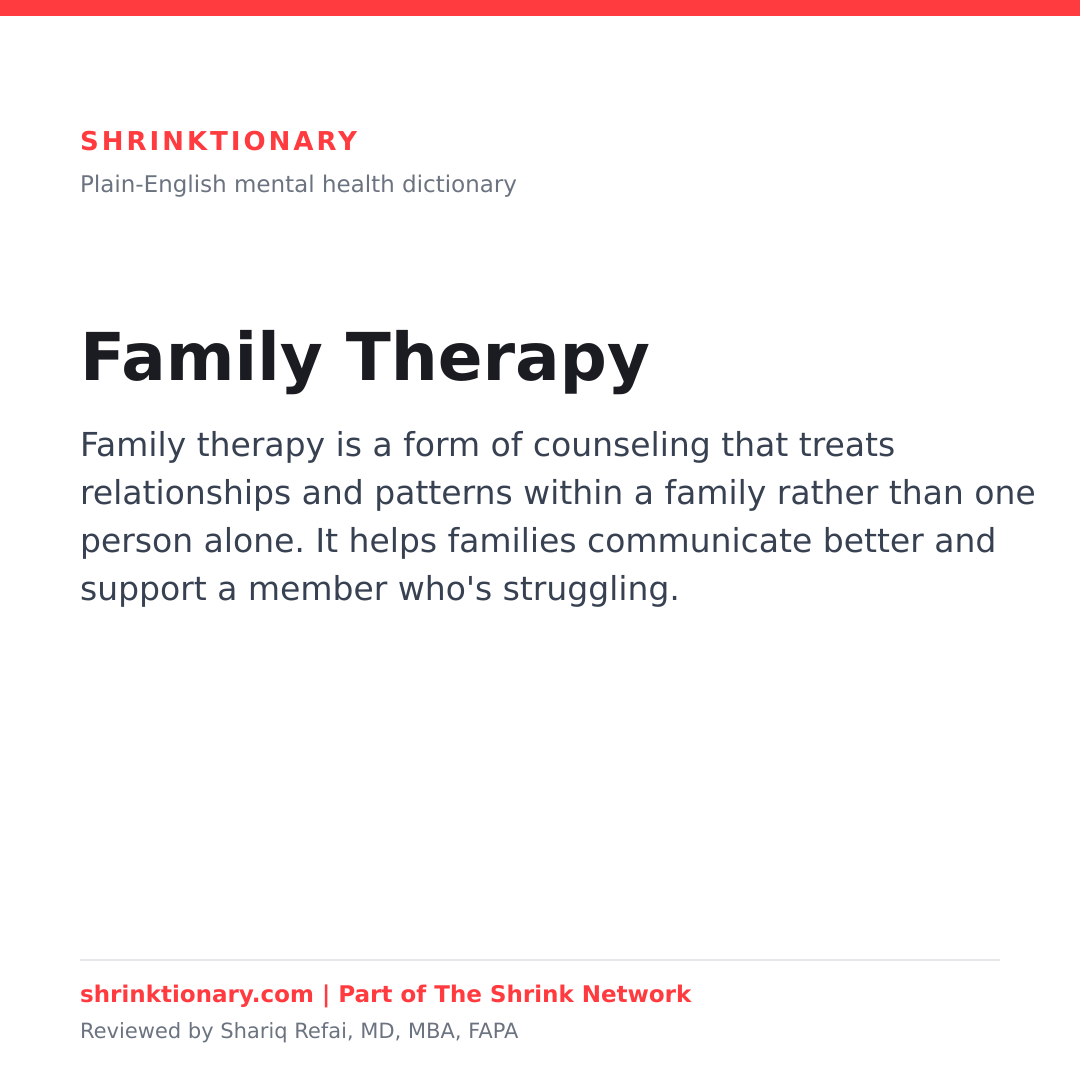
Family therapy is a type of psychotherapy that focuses on the relationships within a family rather than on one individual. The therapist works with parents, children, siblings, or whoever makes up the household, treating the family as a system where each person affects the others.
The core idea is that problems often live in patterns of interaction, not just inside one person. By looking at how the family talks, reacts, and supports each other, the therapist helps everyone shift unhelpful patterns together.
What it looks like in practice
Sessions usually include several family members in the room at once, though the therapist may also meet with people individually. The therapist watches how the family communicates and gently points out patterns, like one person always smoothing over conflict or two people who keep talking past each other.
A family might come in because a teenager is struggling, because a major change has shaken the household, or because constant arguments have worn everyone down. The therapist helps them listen, set clearer expectations, and find new ways to respond. The goal is rarely to find someone to blame; it’s to help the family work as a team.
What it isn’t
Family therapy isn’t a session where the therapist takes sides or decides who’s right. It also isn’t only for families in crisis. Plenty of families use it to handle a transition or simply communicate better.
It isn’t the same as individual therapy with relatives sitting in. The family relationships themselves are the focus of treatment.
Related terms you’ll see next
When to seek professional care
Consider family therapy when ongoing conflict, a major life change, or one member’s mental health struggles are straining the whole household and the family can’t seem to break the pattern on their own. A licensed family therapist can help. If anyone in the family is in crisis or thinking about self-harm, call or text 988 in the United States or go to the nearest emergency room.
When this word matters
Family therapy matters when problems live in patterns of interaction rather than inside one person, and it's used for transitions and communication, not just crises. It differs from individual therapy with relatives sitting in, because the relationships themselves are the focus.
Commonly confused with
Frequently asked questions
Who takes part in family therapy?
Sessions usually include several family members at once, such as parents, children, or siblings, though the therapist may also meet with people individually. The family is treated as a system where each person affects the others.
Does the therapist take sides in family therapy?
No. Family therapy isn't a session where the therapist decides who's right, and the goal is rarely to find someone to blame. The aim is to help the family work as a team and shift unhelpful patterns together.
Is family therapy only for families in crisis?
No. Plenty of families use it to handle a transition or simply communicate better. It can help with ongoing conflict, a major life change, or supporting a member who's struggling.
Related terms
Sources
- Psychotherapies , National Institute of Mental Health
- Psychotherapy , American Psychological Association
Use or cite this definition
Free to reuse with attribution. Paste the block into your own page, or grab a citation.
Embed on your site
<blockquote>
<p><strong>Family Therapy:</strong> Family therapy is a form of counseling that treats relationships and patterns within a family rather than one person alone. It helps families communicate better and support a member who's struggling.</p>
<p>— <a href="https://shrinktionary.com/terms/family-therapy/">Shrinktionary</a>, a plain-English mental health dictionary, medically reviewed by a board certified psychiatrist.</p>
</blockquote>Cite (APA)
Refai, S. (2026). Family Therapy. Shrinktionary. https://shrinktionary.com/terms/family-therapy/
Cite (MLA)
"Family Therapy." Shrinktionary, https://shrinktionary.com/terms/family-therapy/. Accessed September 26, 2026.
Your next step in The Shrink Network
You are here: Shrinktionary, the language layer of The Shrink Network.
Each site in the network has one job. No matter where you enter, we help you find the next step that makes sense.
Want to understand more first?
See how this connects to everything else in the Term Web →
Take it with you
Free printable references you can save or share. For education, not medical advice.