What the inner child actually is
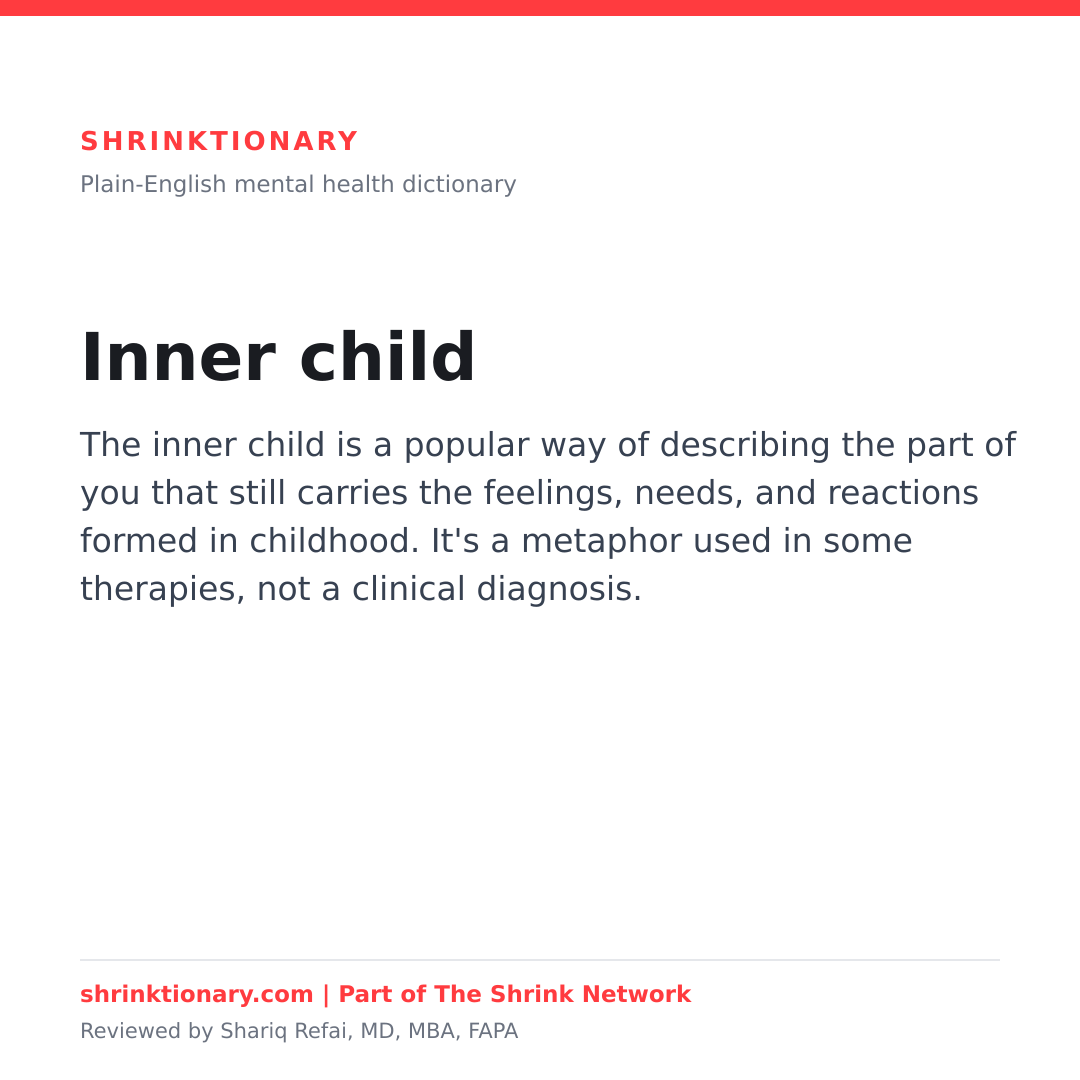
The inner child is a popular metaphor, not a clinical diagnosis or a literal part of the brain. It’s a way of talking about the part of you that still holds the emotions, needs, and learned reactions from your early years. The idea is that experiences from childhood, both warm and painful, leave patterns that keep shaping how you feel and respond as an adult.
Several therapy approaches use the concept as a working tool. The point isn’t that there’s an actual child inside you. It’s that revisiting old feelings and unmet needs with compassion can help you understand reactions that seem too big for the present moment. When something today triggers an outsized response, the metaphor invites you to ask what younger version of you is reacting and what they needed.
What inner child work can feel like
People often describe moments where a current situation sparks a feeling that seems older or deeper than the event itself. A small rejection lands like abandonment. A criticism feels like it questions your whole worth. The inner child framing gives language to that mismatch.
The work tends to feel tender. It can mean noticing a wave of childhood emotion, treating it with kindness rather than judgment, and giving yourself something that was missing back then, like reassurance or permission to rest. For some people it’s moving and helpful. For others the metaphor doesn’t click, and that’s fine too. It’s one lens among many.
What the inner child isn’t
The inner child isn’t a separate personality, a medical condition, or a sign that something is split inside you. It shouldn’t be confused with dissociative conditions, which are clinically distinct. The phrase is a metaphor meant to make childhood patterns easier to work with, not a literal description of how the mind is built.
It also isn’t a way to blame parents or stay stuck in the past. Used well, the idea points toward understanding and self-compassion in the present, not endless rumination about what went wrong.
Related terms you’ll see next
Self-compassion is central to the work, since the whole point is meeting old pain with kindness. Attachment describes the early bonds that shape these patterns. Schema therapy is a structured approach that works directly with long-standing patterns rooted in childhood.
When it helps to get support
If childhood experiences keep echoing into your adult relationships, reactions, or sense of worth, working with a therapist can help you make sense of them. Inner child work is best done with a trained professional, especially when difficult memories are involved. If past trauma is surfacing in ways that feel overwhelming, a clinical evaluation is a reasonable next step.
When this word matters
It matters when current situations spark feelings that seem older or bigger than the event, because that mismatch can point to childhood patterns worth understanding. The concept is a metaphor and a therapy tool, not a literal part of the mind.
Commonly confused with
Frequently asked questions
What is the inner child?
The inner child is a popular metaphor for the part of you that still carries the feelings, needs, and reactions formed in childhood. It is a tool used in some therapies, not a clinical diagnosis or a literal part of the brain.
Is the inner child the same as dissociation?
No. The inner child is a metaphor for childhood patterns, while dissociative conditions are clinically distinct experiences. The phrase is meant to make old patterns easier to work with, not to describe a split or separate personality.
Does inner child work actually help?
For many people, meeting old feelings and unmet needs with compassion helps make sense of reactions that seem too big for the present. It is best done with a trained therapist, especially when difficult memories are involved, and the metaphor does not click for everyone.
Related terms
Sources
- Psychotherapies , National Institute of Mental Health
- Child Development , MedlinePlus
Use or cite this definition
Free to reuse with attribution. Paste the block into your own page, or grab a citation.
Embed on your site
<blockquote>
<p><strong>Inner child:</strong> The inner child is a popular way of describing the part of you that still carries the feelings, needs, and reactions formed in childhood. It's a metaphor used in some therapies, not a clinical diagnosis.</p>
<p>— <a href="https://shrinktionary.com/terms/inner-child/">Shrinktionary</a>, a plain-English mental health dictionary, medically reviewed by a board certified psychiatrist.</p>
</blockquote>Cite (APA)
Refai, S. (2026). Inner child. Shrinktionary. https://shrinktionary.com/terms/inner-child/
Cite (MLA)
"Inner child." Shrinktionary, https://shrinktionary.com/terms/inner-child/. Accessed September 26, 2026.
Your next step in The Shrink Network
You are here: Shrinktionary, the language layer of The Shrink Network.
Each site in the network has one job. No matter where you enter, we help you find the next step that makes sense.
Want to understand more first?
See how this connects to everything else in the Term Web →
Take it with you
Free printable references you can save or share. For education, not medical advice.