What doomscrolling actually is
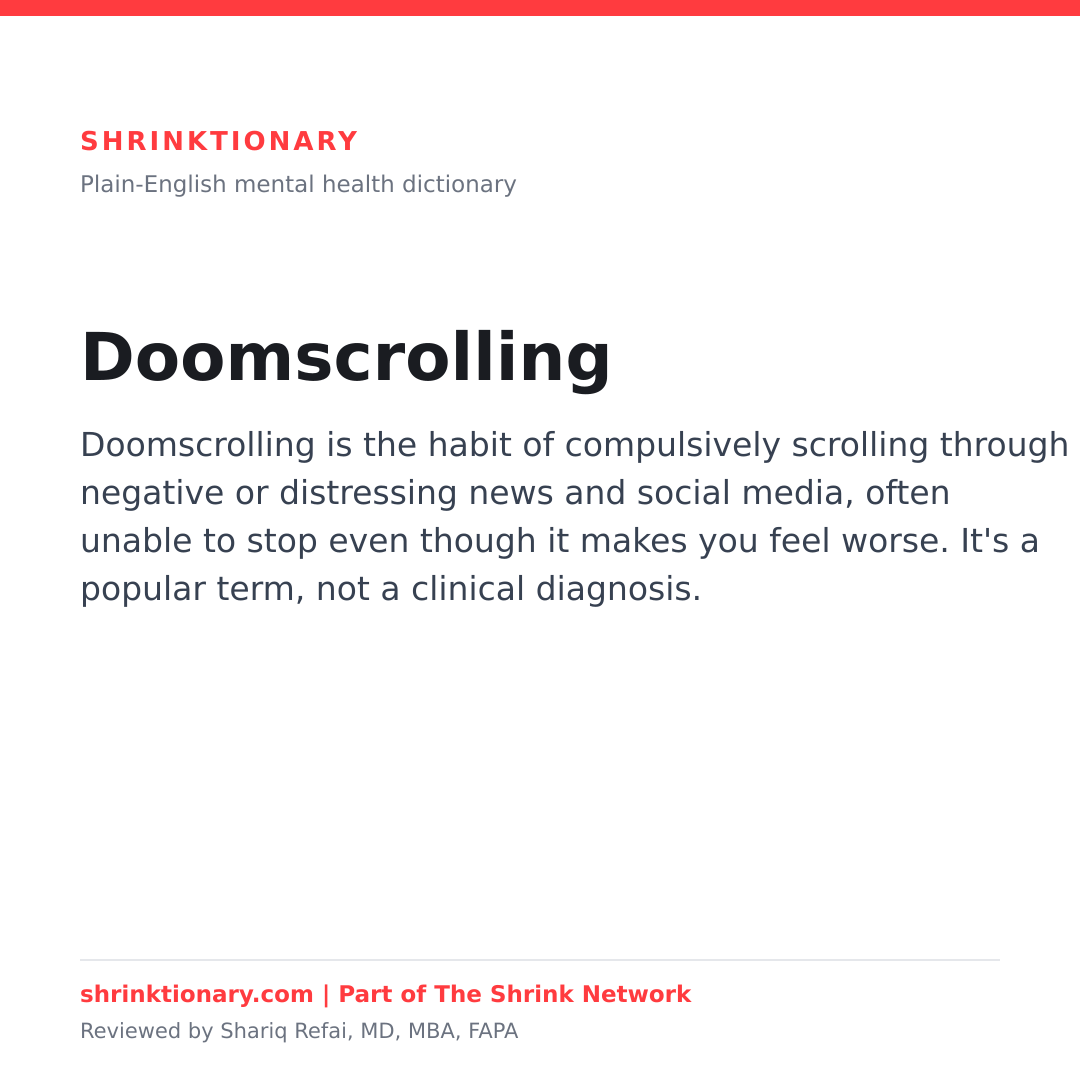
Doomscrolling is a popular term, not a clinical diagnosis. It describes the habit of scrolling through a stream of bad news or distressing posts and finding it hard to stop, even when it leaves you feeling worse. The word became common during long stretches of unsettling headlines, when many people noticed themselves refreshing feeds for hours looking for something, reassurance, control, or an end to the dread, that never quite arrived.
Part of what drives it is how feeds are built. Endless scroll, unpredictable updates, and content that grabs attention through alarm all keep the eyes moving. The brain treats threatening information as urgent, so checking can feel productive even when it just deepens the unease. The behavior is the loop, the compulsive checking that doesn’t resolve anything, not simply staying informed.
What doomscrolling can feel like
It often feels like you can’t look away. There’s a pull to keep going, a sense that the next post might settle the anxiety, and a let-down when it doesn’t. People describe losing track of time, feeling wound up or hopeless afterward, and reaching for the phone again soon after putting it down.
The aftermath tends to include trouble sleeping, a low hum of dread, and a sense of being more overwhelmed than informed. The strange part is that it rarely feels good in the moment either. It’s more like a compulsion than a pleasure, which is part of why it’s hard to break.
What doomscrolling isn’t
Doomscrolling isn’t the same as staying informed or reading the news with purpose. Keeping up with the world is reasonable, and being engaged isn’t a problem. The marker is the compulsive, distressing loop, scrolling that you can’t easily stop and that consistently leaves you worse off.
It also isn’t a clinical diagnosis or a moral failing. It’s a common habit shaped partly by how platforms are designed. Naming it is meant to help you notice the pattern, not to shame anyone for falling into it.
Related terms you’ll see next
Anxiety is both a driver and a result of the loop, since worry pulls you in and the scrolling feeds it back. Rumination is the related mental habit of circling the same distressing thoughts. Overstimulation describes the flooded, overwhelmed state that a constant stream of alarming content can create.
When it helps to get support
If scrolling distressing content has become hard to control and is affecting your sleep, mood, or daily life, it’s worth taking seriously. Simple steps like time limits and screen-free routines help many people. If anxiety or low mood is persistent underneath the habit, talking with a mental health professional can address what’s fueling the pull, not just the scrolling itself.
When this word matters
It matters when compulsive scrolling of distressing content is hard to stop and starts affecting sleep, mood, or daily life, because the loop tends to deepen anxiety rather than resolve it. Staying informed is fine; the compulsive loop is the issue.
Commonly confused with
Frequently asked questions
What is doomscrolling?
Doomscrolling is the habit of compulsively scrolling through negative news and social media and finding it hard to stop, even when it makes you feel worse. It is a popular term, not a clinical diagnosis, and the compulsive loop is what defines it.
Why is doomscrolling so hard to stop?
Feeds are built with endless scroll and attention-grabbing content, and the brain treats threatening information as urgent, so checking feels productive even when it deepens unease. There is often a pull that the next post will settle the anxiety, and a let-down when it does not.
How can I cut back on doomscrolling?
Simple steps like setting time limits, turning off alerts, and keeping screen-free routines around sleep help many people. If persistent anxiety or low mood is fueling the habit, talking with a mental health professional can address what is driving the pull.
Related terms
Sources
- Caring for Your Mental Health , National Institute of Mental Health
- Coping with Traumatic Events , National Institute of Mental Health
Use or cite this definition
Free to reuse with attribution. Paste the block into your own page, or grab a citation.
Embed on your site
<blockquote>
<p><strong>Doomscrolling:</strong> Doomscrolling is the habit of compulsively scrolling through negative or distressing news and social media, often unable to stop even though it makes you feel worse. It's a popular term, not a clinical diagnosis.</p>
<p>— <a href="https://shrinktionary.com/terms/doomscrolling/">Shrinktionary</a>, a plain-English mental health dictionary, medically reviewed by a board certified psychiatrist.</p>
</blockquote>Cite (APA)
Refai, S. (2026). Doomscrolling. Shrinktionary. https://shrinktionary.com/terms/doomscrolling/
Cite (MLA)
"Doomscrolling." Shrinktionary, https://shrinktionary.com/terms/doomscrolling/. Accessed September 29, 2026.
Your next step in The Shrink Network
You are here: Shrinktionary, the language layer of The Shrink Network.
Each site in the network has one job. No matter where you enter, we help you find the next step that makes sense.
Want to understand more first?
See how this connects to everything else in the Term Web →
Take it with you
Free printable references you can save or share. For education, not medical advice.