What self-sabotage actually is
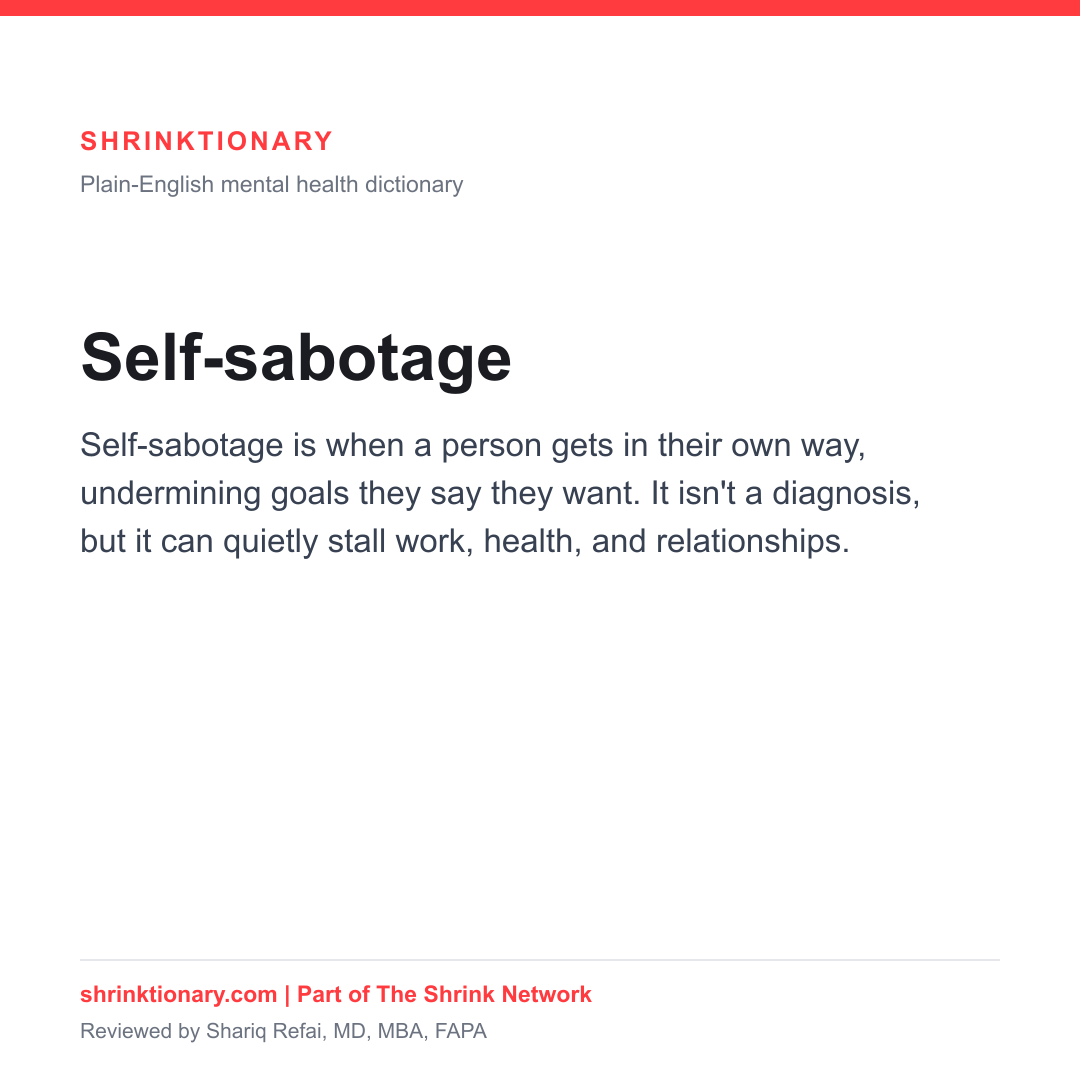
Self-sabotage is a pattern of acting against your own stated goals. Someone says they want the promotion, the relationship, or the healthier routine, and then does things that quietly work against it. They miss the deadline they had time for. They pick a fight the week things start going well. They put off the appointment they asked for. The behavior and the goal point in opposite directions.
It isn’t a clinical diagnosis. It’s a way of describing a habit, and it usually isn’t deliberate. Most people who self-sabotage aren’t trying to fail. The behavior often grows out of fear, old beliefs about not deserving good things, or a wish to avoid the risk of trying and falling short. Self-sabotage can overlap with perfectionism, low self-esteem, and anxiety.
What self-sabotage can feel like
From the inside, it rarely feels like sabotage. It feels like a good reason in the moment. There’s always a believable story for why now isn’t the time, why this opportunity wasn’t right anyway, or why the other person would have left eventually. People often notice the pattern only in hindsight, when they look back and see the same kind of exit showing up again and again.
It can feel like relief mixed with regret. Backing out lowers the immediate pressure, and then a heavier feeling sets in later. Some people describe a sense of watching themselves do the thing they swore they wouldn’t, without quite being able to stop.
What self-sabotage isn’t
Self-sabotage isn’t laziness or a character flaw, and it isn’t proof that someone secretly wants to fail. It’s usually a protective habit that made sense at some earlier point and now gets in the way. Calling it sabotage can sound harsh, when the gentler and more accurate read is often fear doing the steering.
It also isn’t a formal condition a clinician diagnoses. It can be a feature of conditions like depression or anxiety, but on its own it’s a description of behavior, not a label that explains the whole picture.
Related terms you’ll see next
Perfectionism often feeds self-sabotage, since impossible standards make starting feel pointless. Self-compassion is frequently raised as a counterweight, because harsh self-talk tends to keep the cycle going. Overthinking is a close cousin that shows up in many of the same moments.
When it helps to get support
Self-sabotage on its own isn’t a reason to worry, but a steady pattern that keeps blocking the things a person genuinely wants is worth taking seriously. If the same self-defeating moves keep showing up across work, health, and relationships, or if they come with low mood, anxiety, or hopelessness, a therapist can help trace where the pattern comes from. There’s no promised fix, but understanding the fear underneath often makes it easier to act differently.
When this word matters
It matters when the same self-defeating moves keep blocking things a person genuinely wants across work, health, and relationships, especially if they come with low mood, anxiety, or hopelessness. A one-off setback is ordinary; a steady pattern is worth understanding.
Commonly confused with
Frequently asked questions
Why do people self-sabotage?
Self-sabotage usually isn't deliberate. It often grows out of fear, old beliefs about not deserving good things, or a wish to avoid the risk of trying and falling short. Backing out lowers the pressure in the moment, even when it works against what the person actually wants.
Is self-sabotage a mental illness?
No. Self-sabotage isn't a clinical diagnosis. It's a way of describing a pattern of behavior. It can show up alongside conditions like depression or anxiety, but on its own it's a description, not a disorder.
How do you stop self-sabotaging?
There's no single fix, but noticing the pattern is a useful start. Many people find it helps to look at the fear underneath, ease up on harsh self-talk, and break goals into smaller steps. A therapist can help trace where the pattern comes from when it keeps blocking important goals.
Related terms
Sources
- Caring for Your Mental Health , National Institute of Mental Health
- Mental Health , MedlinePlus
Use or cite this definition
Free to reuse with attribution. Paste the block into your own page, or grab a citation.
Embed on your site
<blockquote>
<p><strong>Self-sabotage:</strong> Self-sabotage is when a person gets in their own way, undermining goals they say they want. It isn't a diagnosis, but it can quietly stall work, health, and relationships.</p>
<p>— <a href="https://shrinktionary.com/terms/self-sabotage/">Shrinktionary</a>, a plain-English mental health dictionary, medically reviewed by a board certified psychiatrist.</p>
</blockquote>Cite (APA)
Refai, S. (2026). Self-sabotage. Shrinktionary. https://shrinktionary.com/terms/self-sabotage/
Cite (MLA)
"Self-sabotage." Shrinktionary, https://shrinktionary.com/terms/self-sabotage/. Accessed September 26, 2026.
Your next step in The Shrink Network
You are here: Shrinktionary, the language layer of The Shrink Network.
Each site in the network has one job. No matter where you enter, we help you find the next step that makes sense.
Want to understand more first?
See how this connects to everything else in the Term Web →
Take it with you
Free printable references you can save or share. For education, not medical advice.