What emotional labor actually is
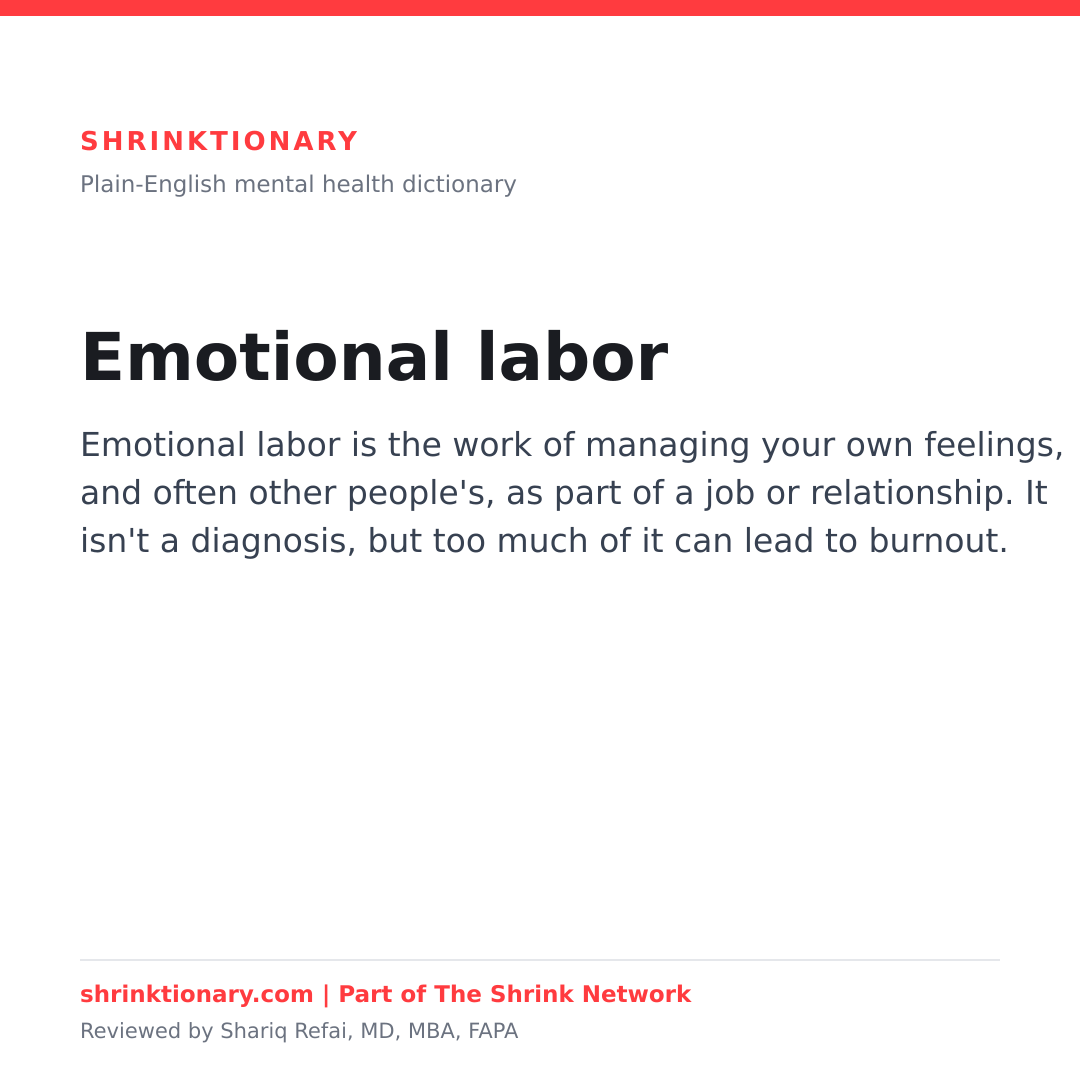
Emotional labor is the effort of managing feelings as part of a role. The term started in research on jobs that require workers to show certain emotions on demand, like a flight attendant staying warm under pressure or a nurse staying calm with a frightened patient. The work isn’t only the task in front of them. It’s also the steady effort of shaping how they feel and appear.
In everyday use the term has widened. People now use it for the often invisible work of keeping relationships and households running smoothly, remembering birthdays, smoothing over tension, checking in on how everyone’s doing, and carrying the mental load of who needs what. It isn’t a clinical diagnosis. It’s a way of naming work that’s real and tiring even though it doesn’t always look like work.
What emotional labor can feel like
It can feel like being the one who always holds things together. The person doing it is tracking other people’s moods, anticipating problems, and staying composed even when they’re stretched thin. Because the effort is internal, it often goes unnoticed by everyone except the person doing it.
Over time it can feel like depletion. Someone might be praised for being so calm or so reliable while quietly running on empty. The mismatch between how much is being carried and how little of it is seen is part of what makes emotional labor wearing.
What emotional labor isn’t
Emotional labor isn’t simply having feelings or caring about people. Feeling sad, happy, or worried is just being human. The labor part is the managing, the ongoing work of regulating and performing emotion to meet what a job or relationship seems to ask. It also isn’t always a bad thing. Plenty of it is part of caring for others and doing it willingly.
It isn’t a diagnosis. It’s a concept for understanding a kind of effort, not a condition. When it’s chronically one-sided or unacknowledged, though, it can feed real problems like resentment and burnout.
Related terms you’ll see next
Burnout is a common result when emotional labor goes on too long without rest or recognition. Boundaries are often the practical antidote, a way of deciding how much a person can carry. People-pleasing can pile on extra emotional labor by making it hard to say no.
When it helps to get support
Carrying some emotional labor is normal. It’s worth a closer look when the load feels constant, unfair, and never quite seen, especially if it comes with exhaustion, resentment, or a sense of losing yourself in everyone else’s needs. A therapist can help sort out what’s reasonable to carry and what isn’t, and how to set limits without guilt. There’s no guarantee others will share the load, but naming the work is often the first step toward changing it.
When this word matters
It matters when the load feels constant, unfair, and never quite seen, especially if it comes with exhaustion, resentment, or a sense of losing yourself in everyone else's needs. Some emotional labor is normal; a chronically one-sided load is worth a closer look.
Commonly confused with
Frequently asked questions
What is emotional labor?
Emotional labor is the effort of managing feelings as part of a role. It started in research on jobs that require workers to show certain emotions on demand, and in everyday use it now also covers the often invisible work of keeping relationships and households running smoothly.
Is emotional labor the same as having feelings?
No. Having feelings is just being human. The labor part is the managing, the ongoing work of regulating and performing emotion to meet what a job or relationship seems to ask. That effort is real and tiring even though it doesn't always look like work.
Can emotional labor lead to burnout?
It can, especially when it's constant, one-sided, and unacknowledged. Carrying a lot of emotional labor without rest or recognition can feed resentment and exhaustion. Setting boundaries and naming the work are common first steps people take.
Related terms
Sources
- Caring for Your Mental Health , National Institute of Mental Health
- Mental Health , MedlinePlus
Use or cite this definition
Free to reuse with attribution. Paste the block into your own page, or grab a citation.
Embed on your site
<blockquote>
<p><strong>Emotional labor:</strong> Emotional labor is the work of managing your own feelings, and often other people's, as part of a job or relationship. It isn't a diagnosis, but too much of it can lead to burnout.</p>
<p>— <a href="https://shrinktionary.com/terms/emotional-labor/">Shrinktionary</a>, a plain-English mental health dictionary, medically reviewed by a board certified psychiatrist.</p>
</blockquote>Cite (APA)
Refai, S. (2026). Emotional labor. Shrinktionary. https://shrinktionary.com/terms/emotional-labor/
Cite (MLA)
"Emotional labor." Shrinktionary, https://shrinktionary.com/terms/emotional-labor/. Accessed September 26, 2026.
Your next step in The Shrink Network
You are here: Shrinktionary, the language layer of The Shrink Network.
Each site in the network has one job. No matter where you enter, we help you find the next step that makes sense.
Want to understand more first?
See how this connects to everything else in the Term Web →
Take it with you
Free printable references you can save or share. For education, not medical advice.