What people-pleasing actually is
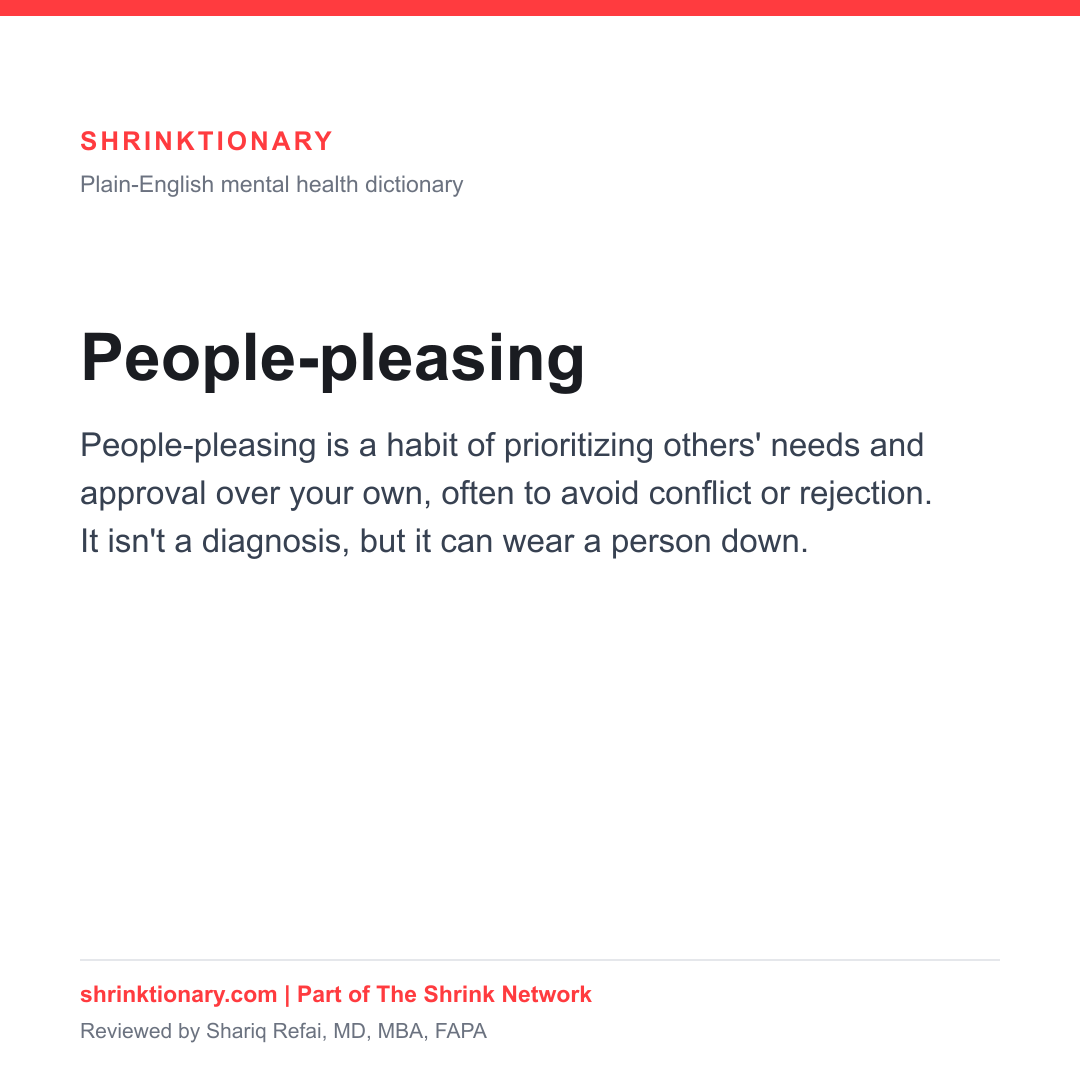
People-pleasing is a pattern of putting other people’s needs, comfort, and approval ahead of one’s own, often to avoid conflict, criticism, or rejection. A people-pleaser tends to say yes when they want to say no, smooth things over at their own expense, and stay tuned to what others want at the cost of their own needs.
It isn’t a clinical diagnosis. It’s a behavior pattern, and it often grows out of a wish to feel safe, accepted, or valued. People-pleasing can overlap with low self-esteem and anxiety, and over time it can leave a person drained, resentful, or unsure of what they actually want.
What people usually mean
When people use the term, they usually mean someone who has a hard time disappointing others. They might agree to plans they don’t want, take on more than they can handle, or avoid saying how they really feel to keep the peace. The driving thought is often some version of “if I keep everyone happy, things will be okay.”
In everyday use, people-pleasing is sometimes described with warmth, as in being helpful or easygoing. The clinical concern is when the pattern is automatic and costly, when a person consistently overrides their own needs and the habit starts to harm their wellbeing or relationships.
What it isn’t
People-pleasing isn’t the same as being kind, generous, or considerate. Healthy giving comes from choice and still leaves room for one’s own needs. People-pleasing is driven more by fear of disapproval, and it tends to crowd out the person’s own limits.
It also isn’t a permanent trait. Like other learned patterns, people-pleasing can be unlearned. Building boundaries, practicing saying no, and working on the beliefs underneath it, often in therapy, can shift the pattern over time.
Related terms you’ll see next
Why the distinction matters
Separating people-pleasing from genuine kindness helps people see what’s actually going on. Kindness adds to a person’s life, while chronic people-pleasing slowly drains it, often leading to resentment, burnout, and a loss of touch with one’s own needs. Naming the pattern is often the first step toward setting boundaries and giving from choice rather than fear, which is a common and workable focus in therapy.
When this word matters
People-pleasing isn't a diagnosis, but it matters when the habit becomes so automatic that someone ignores their own needs and burns out, which can overlap with anxiety, low self-esteem, or shaky boundaries.
Commonly confused with
Frequently asked questions
Is people-pleasing a mental health diagnosis?
No, people-pleasing isn't a clinical diagnosis. It's a learned behavior pattern of prioritizing others' approval over your own needs, and it can overlap with low self-esteem and anxiety.
What's the difference between people-pleasing and just being kind?
Kindness comes from choice and still leaves room for your own needs, while people-pleasing is driven more by fear of disapproval and tends to crowd out your own limits. One adds to your life, the other can slowly drain it.
Can people-pleasing be changed?
Yes, because it's a learned pattern rather than a fixed trait, it can be unlearned over time. Building boundaries, practicing saying no, and working on the beliefs underneath it, often in therapy, can shift the pattern.
Related terms
Sources
- Caring for Your Mental Health , National Institute of Mental Health
- Mental Health , MedlinePlus
Use or cite this definition
Free to reuse with attribution. Paste the block into your own page, or grab a citation.
Embed on your site
<blockquote>
<p><strong>People-pleasing:</strong> People-pleasing is a habit of prioritizing others' needs and approval over your own, often to avoid conflict or rejection. It isn't a diagnosis, but it can wear a person down.</p>
<p>— <a href="https://shrinktionary.com/terms/people-pleasing/">Shrinktionary</a>, a plain-English mental health dictionary, medically reviewed by a board certified psychiatrist.</p>
</blockquote>Cite (APA)
Refai, S. (2026). People-pleasing. Shrinktionary. https://shrinktionary.com/terms/people-pleasing/
Cite (MLA)
"People-pleasing." Shrinktionary, https://shrinktionary.com/terms/people-pleasing/. Accessed September 26, 2026.
Your next step in The Shrink Network
You are here: Shrinktionary, the language layer of The Shrink Network.
Each site in the network has one job. No matter where you enter, we help you find the next step that makes sense.
Want to understand more first?
See how this connects to everything else in the Term Web →
Take it with you
Free printable references you can save or share. For education, not medical advice.