What self-care actually is
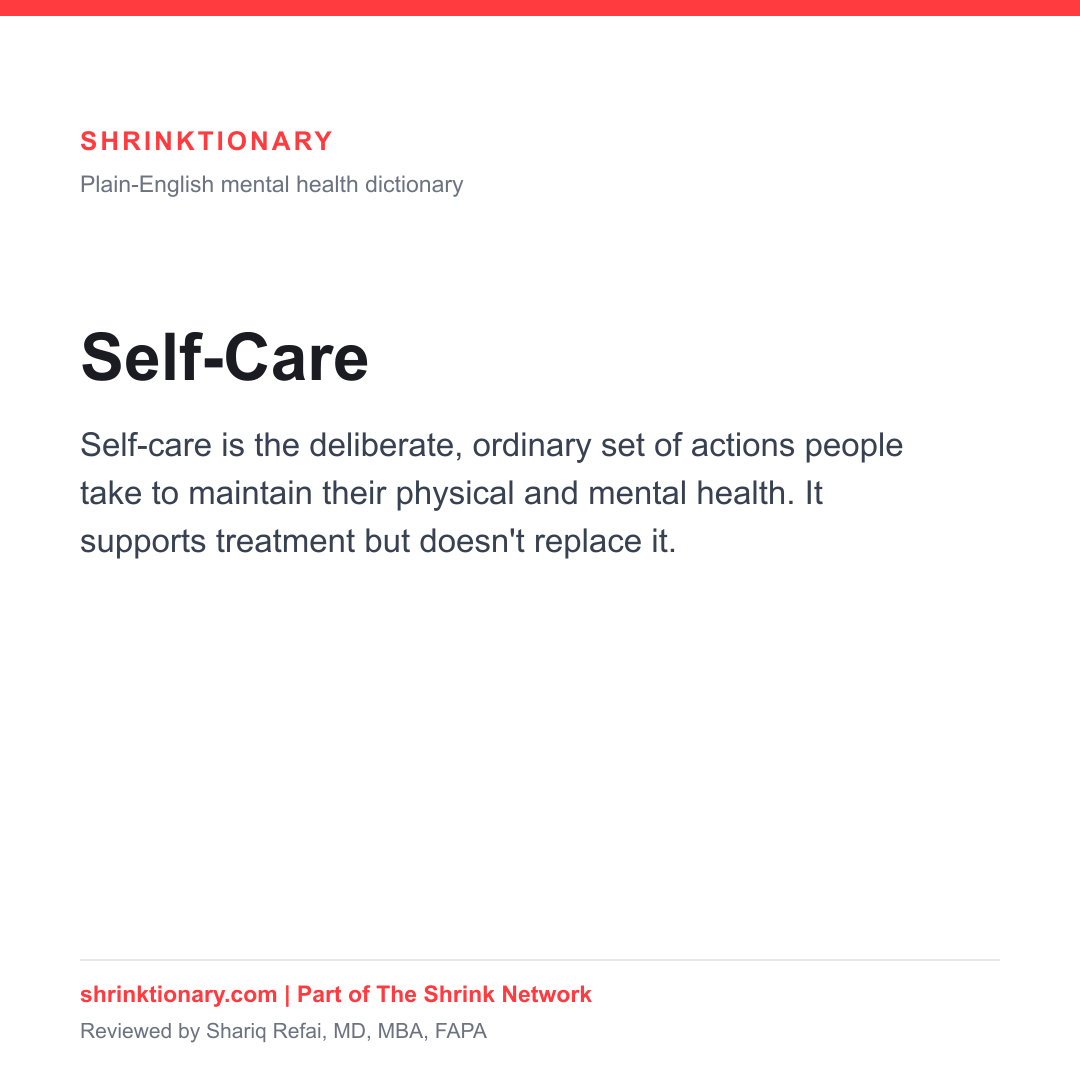
Self-care is the set of everyday choices that keep your body and mind in decent working order. Sleeping enough. Eating in a way that doesn’t leave you running on empty. Moving your body. Staying connected to people. Taking breaks before you’re wrecked instead of after.
The word has gotten fancy, but the idea is plain. It’s maintenance. The same way a car needs oil changes, a person needs rest, food, movement, and connection to keep functioning well.
What people usually mean
In everyday talk, self-care often means treating yourself to something pleasant. A bath, a quiet evening, a day off. There’s nothing wrong with that, and small comforts can genuinely help.
But the version that actually moves the needle is usually less glamorous. It’s the boring, repeatable stuff: a regular sleep schedule, limiting alcohol, showing up for exercise you don’t feel like doing, and asking for help when you need it. The treat is the easy part. The habits are where the real benefit lives.
What it isn’t
Self-care isn’t a cure. It supports mental health, but it doesn’t replace treatment for a real condition. Telling someone with clinical depression to take a bubble bath misses the point and can make them feel dismissed.
It also isn’t selfishness, and it isn’t an excuse to avoid responsibilities. And it isn’t a product. You don’t have to buy anything to take care of yourself. Most of what works is free.
Related terms you’ll see next
Coping is the broader set of strategies for handling stress, and self-care is part of it. Stress is the demand that self-care helps buffer. Burnout is what tends to happen when self-care runs dry for too long. Boundaries are the limits that protect your time and energy.
Why the distinction matters
Self-care works best when you’re honest about what it can and can’t do. As a habit, it builds resilience and helps prevent small problems from becoming big ones. But if you’re struggling with something that doesn’t lift no matter what you do, that’s a sign to see a clinician. Self-care and professional treatment aren’t competitors. They work together.
When this word matters
The distinction matters because self-care is ordinary maintenance like sleep, food, movement, and connection that supports treatment, not a substitute for it. It's worth separating from the marketed idea of treating yourself, and from the expectation that it can fix a clinical condition on its own.
Commonly confused with
Frequently asked questions
What is self-care really?
Self-care is the set of everyday choices that keep your body and mind in decent working order, like sleeping enough, eating well, moving your body, staying connected to people, and taking breaks before you're wrecked. The idea is plain; it's maintenance.
Is self-care just treating yourself to something nice?
Small comforts like a bath or a day off can genuinely help, but the version that moves the needle is usually the boring, repeatable stuff: a regular sleep schedule, limiting alcohol, showing up for exercise, and asking for help. The habits are where the real benefit lives.
Can self-care replace treatment for a mental health condition?
No. Self-care supports mental health but doesn't replace treatment for a real condition. If you're struggling with something that doesn't lift no matter what you do, that's a sign to see a clinician, and self-care and professional treatment work together rather than compete.
Related terms
Sources
- Caring for Your Mental Health , National Institute of Mental Health
- Healthy Lifestyle , MedlinePlus
Use or cite this definition
Free to reuse with attribution. Paste the block into your own page, or grab a citation.
Embed on your site
<blockquote>
<p><strong>Self-Care:</strong> Self-care is the deliberate, ordinary set of actions people take to maintain their physical and mental health. It supports treatment but doesn't replace it.</p>
<p>— <a href="https://shrinktionary.com/terms/self-care/">Shrinktionary</a>, a plain-English mental health dictionary, medically reviewed by a board certified psychiatrist.</p>
</blockquote>Cite (APA)
Refai, S. (2026). Self-Care. Shrinktionary. https://shrinktionary.com/terms/self-care/
Cite (MLA)
"Self-Care." Shrinktionary, https://shrinktionary.com/terms/self-care/. Accessed September 26, 2026.
Your next step in The Shrink Network
You are here: Shrinktionary, the language layer of The Shrink Network.
Each site in the network has one job. No matter where you enter, we help you find the next step that makes sense.
Want to understand more first?
See how this connects to everything else in the Term Web →
Take it with you
Free printable references you can save or share. For education, not medical advice.