What stress actually is
Stress is what happens when life makes a demand and your body gears up to meet it. A deadline, a near miss in traffic, a hard conversation. The brain reads the situation as something to handle, and the body responds with a jolt of alertness, faster heart rate, and a release of hormones that get you ready to act.
This is normal and built in. It’s the same machinery that helped our ancestors react to danger, and it still helps you rise to a challenge today. The trouble starts when the demand never eases and the body never gets to stand down.
What people usually mean
When people say they’re stressed, they usually mean they feel pressured, stretched thin, or like there’s too much to do and not enough room to do it. It can show up in the body as headaches, tense muscles, an upset stomach, or trouble sleeping. It can show up in the mind as irritability, trouble concentrating, or a constant sense of being behind.
Some stress is short-lived and clears once the situation passes. That kind is rarely a problem. What wears people down is chronic stress, the kind that hangs around for weeks or months with no off switch.
What it isn’t
Stress isn’t the same as anxiety, even though they overlap. Stress is the response to a real, present demand. Anxiety can show up without a clear cause and linger after the demand is gone.
Stress also isn’t automatically bad. A manageable amount can sharpen focus and motivate action. And feeling stressed isn’t a sign you can’t cope. It’s a signal worth listening to, not a verdict on your character.
Related terms you’ll see next
Cortisol is one of the main hormones the body releases under stress. The fight-or-flight response is the rapid mobilization that stress sets off. Burnout is the exhaustion that builds when stress goes unrelieved for too long. Coping covers the strategies people use to manage it.
Why the distinction matters
Knowing the difference between a passing stressor and chronic stress helps you decide what to do. Short-term stress usually just needs the situation to resolve. Long-term stress raises real health risks and deserves attention, whether that’s changing what’s driving it, building better coping habits, or talking with a clinician. Stress that’s interfering with sleep, mood, or daily life is a good reason to seek support.
When this word matters
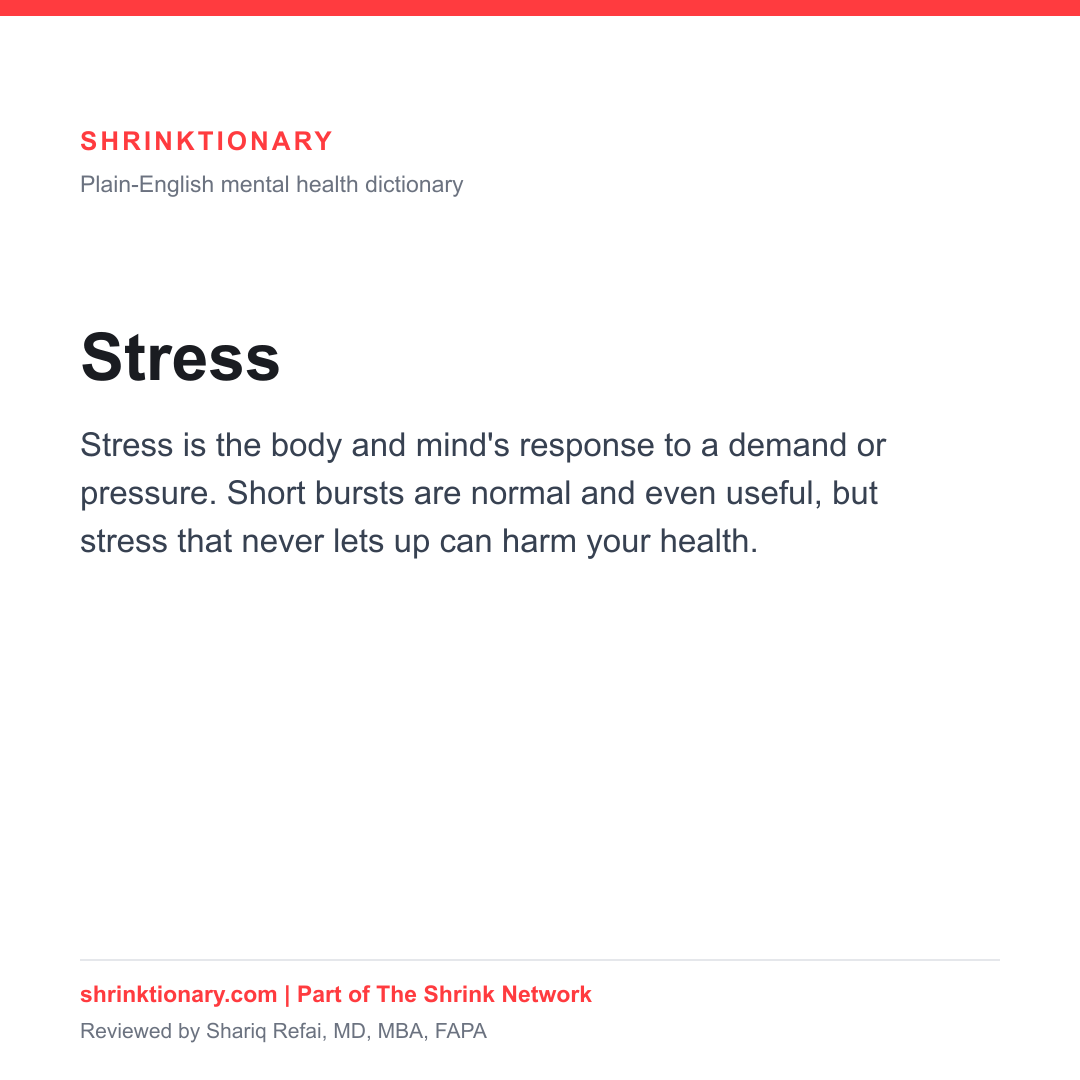
Short bursts of stress are normal and even useful, but stress matters clinically when it never lets up and starts to disrupt sleep, mood, concentration, or physical health, or tips into an anxiety, depressive, or adjustment disorder. Notice when pressure stops easing once the demand passes.
Commonly confused with
Frequently asked questions
What is stress?
Stress is what happens when life makes a demand and your body gears up to meet it, like a deadline or a hard conversation. The brain reads the situation as something to handle, and the body responds with alertness, a faster heart rate, and a release of hormones that get you ready to act.
Is all stress bad for you?
No. Short bursts of stress are normal and built in, and a manageable amount can sharpen focus and motivate action. What wears people down is chronic stress, the kind that hangs around for weeks or months with no off switch.
What is the difference between stress and anxiety?
Stress is the response to a real, present demand and usually clears once the situation passes. Anxiety can show up without a clear cause and linger after the demand is gone, even though the two overlap.
Related terms
Compare
Sources
- I'm So Stressed Out! Fact Sheet , National Institute of Mental Health
- Stress , MedlinePlus
Use or cite this definition
Free to reuse with attribution. Paste the block into your own page, or grab a citation.
Embed on your site
<blockquote>
<p><strong>Stress:</strong> Stress is the body and mind's response to a demand or pressure. Short bursts are normal and even useful, but stress that never lets up can harm your health.</p>
<p>— <a href="https://shrinktionary.com/terms/stress/">Shrinktionary</a>, a plain-English mental health dictionary, medically reviewed by a board certified psychiatrist.</p>
</blockquote>Cite (APA)
Refai, S. (2026). Stress. Shrinktionary. https://shrinktionary.com/terms/stress/
Cite (MLA)
"Stress." Shrinktionary, https://shrinktionary.com/terms/stress/. Accessed September 26, 2026.
Your next step in The Shrink Network
You are here: Shrinktionary, the language layer of The Shrink Network.
Each site in the network has one job. No matter where you enter, we help you find the next step that makes sense.
Want to understand more first?
See how this connects to everything else in the Term Web →
Take it with you
Free printable references you can save or share. For education, not medical advice.