What adjustment disorder actually is
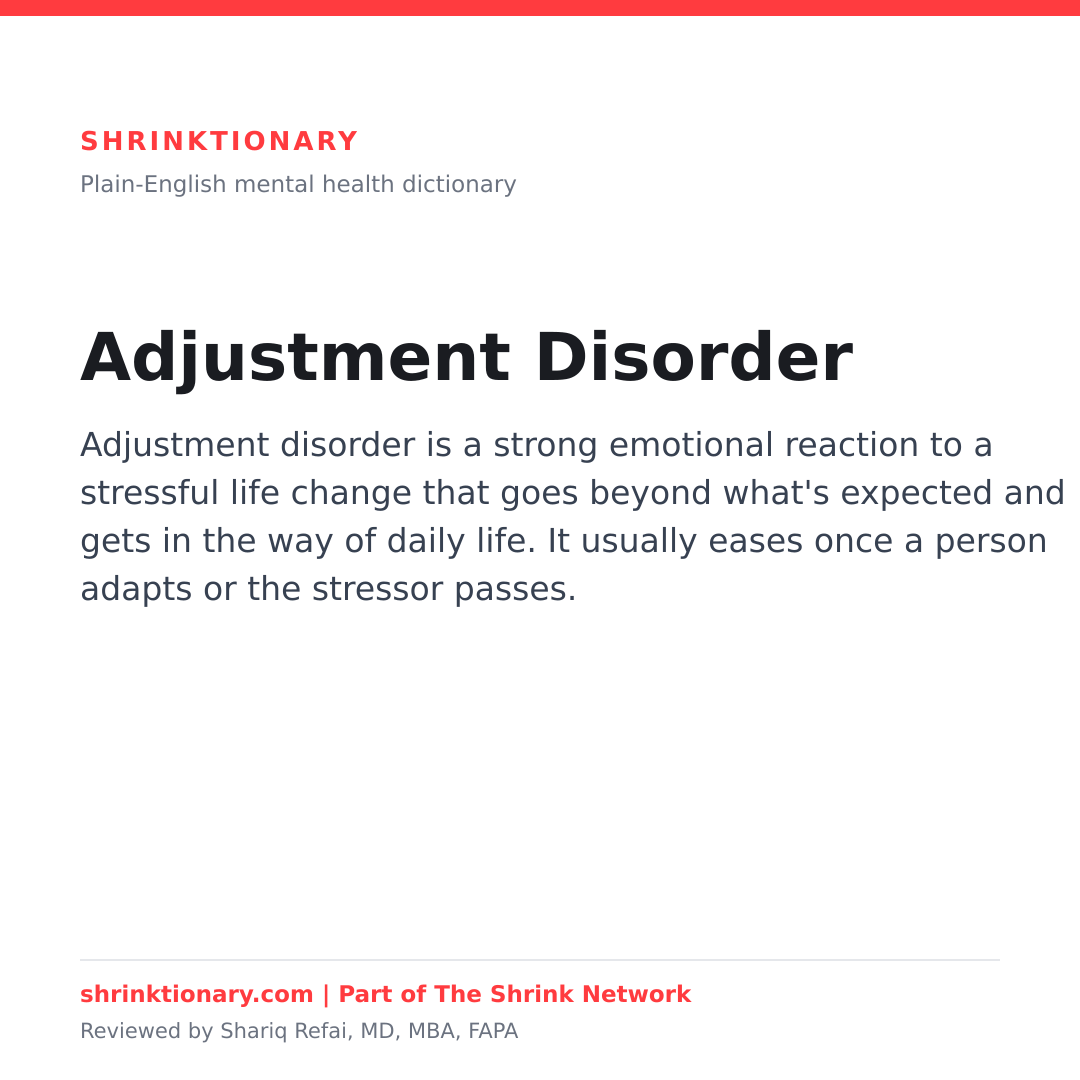
Adjustment disorder is a recognized emotional reaction to a specific stressful event or life change. The stressor might be a job loss, a divorce, a move, a health scare, a breakup, or any major shift. What makes it a disorder is that the reaction is stronger than people would generally expect and clearly gets in the way of daily life.
Clinicians look at two things. First, the distress feels out of proportion to the situation. Second, it disrupts work, relationships, or functioning. By definition, the reaction begins within a few months of the stressor and tends to ease once the person adapts or the stressor resolves.
How adjustment disorder shows up
It can look like low mood, frequent crying, and a sense of hopelessness. It can also look like anxiety, worry, and feeling on edge. For some people it’s a mix of both. Sleep, appetite, and concentration often take a hit, and some people pull back from activities or relationships they used to enjoy.
The thread running through it is the connection to a specific stressor. The feelings track back to a clear event or change, and they tend to lift as the person finds their footing again. That link is part of what sets it apart from other conditions.
What adjustment disorder isn’t
Adjustment disorder isn’t a character weakness or an overreaction in the dismissive sense. It’s a real, recognized response to life stress that’s causing genuine impairment. It also isn’t the same as major depression, even though they can look similar. Adjustment disorder is tied to an identifiable stressor and is usually more time limited.
Ordinary stress and sadness after a hard event, the kind that doesn’t derail daily life, is a normal part of being human and isn’t a disorder. The line is drawn at the intensity and the impact on functioning.
Related terms you’ll see next
When to seek professional care
If a recent stressor has thrown your life off balance and you can’t seem to recover, short-term therapy can make a real difference. Talking it through with a professional helps you process the change and rebuild coping skills.
Reach out sooner if the distress is severe, if it isn’t lifting, or if you have any thoughts of self-harm. In the US you can call or text 988 any time.
When evaluation may help
Not everyone reading about adjustment disorder needs treatment. If it's getting in the way of your day, your sleep, your work, or your relationships, or if it isn't easing on its own, a professional evaluation is a reasonable next step. Most people start with their primary care doctor or a therapist. A psychiatrist is the right call when medication may be involved or the picture is complicated, though waits can be long.
We keep an honest, no-commission rundown of the options, from primary care to telepsychiatry to crisis lines, on one page.
If you're in crisis or thinking about suicide, call or text 988 in the US, or go to the nearest emergency room.
When this word matters
It matters when the emotional reaction to a specific stressor like a job loss or breakup is clearly stronger than expected and disrupts daily life, yet doesn't meet the full criteria for depression or an anxiety disorder. It usually eases once the person adapts or the stressor passes.
Commonly confused with
Frequently asked questions
What does adjustment disorder mean?
Adjustment disorder is a strong emotional reaction to a specific stressful event or life change, such as a job loss, divorce, or move. What makes it a disorder is that the reaction is stronger than people would generally expect and clearly gets in the way of daily life.
What is the difference between adjustment disorder and depression?
They can look similar, but adjustment disorder is tied to an identifiable stressor and is usually more time limited. It tends to ease once the person adapts or the stressor resolves, while major depression isn't necessarily linked to a single clear event.
How is adjustment disorder treated?
Short-term therapy can make a real difference by helping a person process the change and rebuild coping skills. It's worth reaching out sooner if the distress is severe, isn't lifting, or includes any thoughts of self-harm.
Related terms
Sources
- Mental Health , MedlinePlus
- Diagnostic and Statistical Manual of Mental Disorders, Fifth Edition, Text Revision (DSM-5-TR) , American Psychiatric Association
Use or cite this definition
Free to reuse with attribution. Paste the block into your own page, or grab a citation.
Embed on your site
<blockquote>
<p><strong>Adjustment Disorder:</strong> Adjustment disorder is a strong emotional reaction to a stressful life change that goes beyond what's expected and gets in the way of daily life. It usually eases once a person adapts or the stressor passes.</p>
<p>— <a href="https://shrinktionary.com/terms/adjustment-disorder/">Shrinktionary</a>, a plain-English mental health dictionary, medically reviewed by a board certified psychiatrist.</p>
</blockquote>Cite (APA)
Refai, S. (2026). Adjustment Disorder. Shrinktionary. https://shrinktionary.com/terms/adjustment-disorder/
Cite (MLA)
"Adjustment Disorder." Shrinktionary, https://shrinktionary.com/terms/adjustment-disorder/. Accessed September 26, 2026.
Your next step in The Shrink Network
You are here: Shrinktionary, the language layer of The Shrink Network.
Each site in the network has one job. No matter where you enter, we help you find the next step that makes sense.
Want to understand more first?
See how this connects to everything else in the Term Web →
Take it with you
Free printable references you can save or share. For education, not medical advice.