What autism spectrum disorder actually is
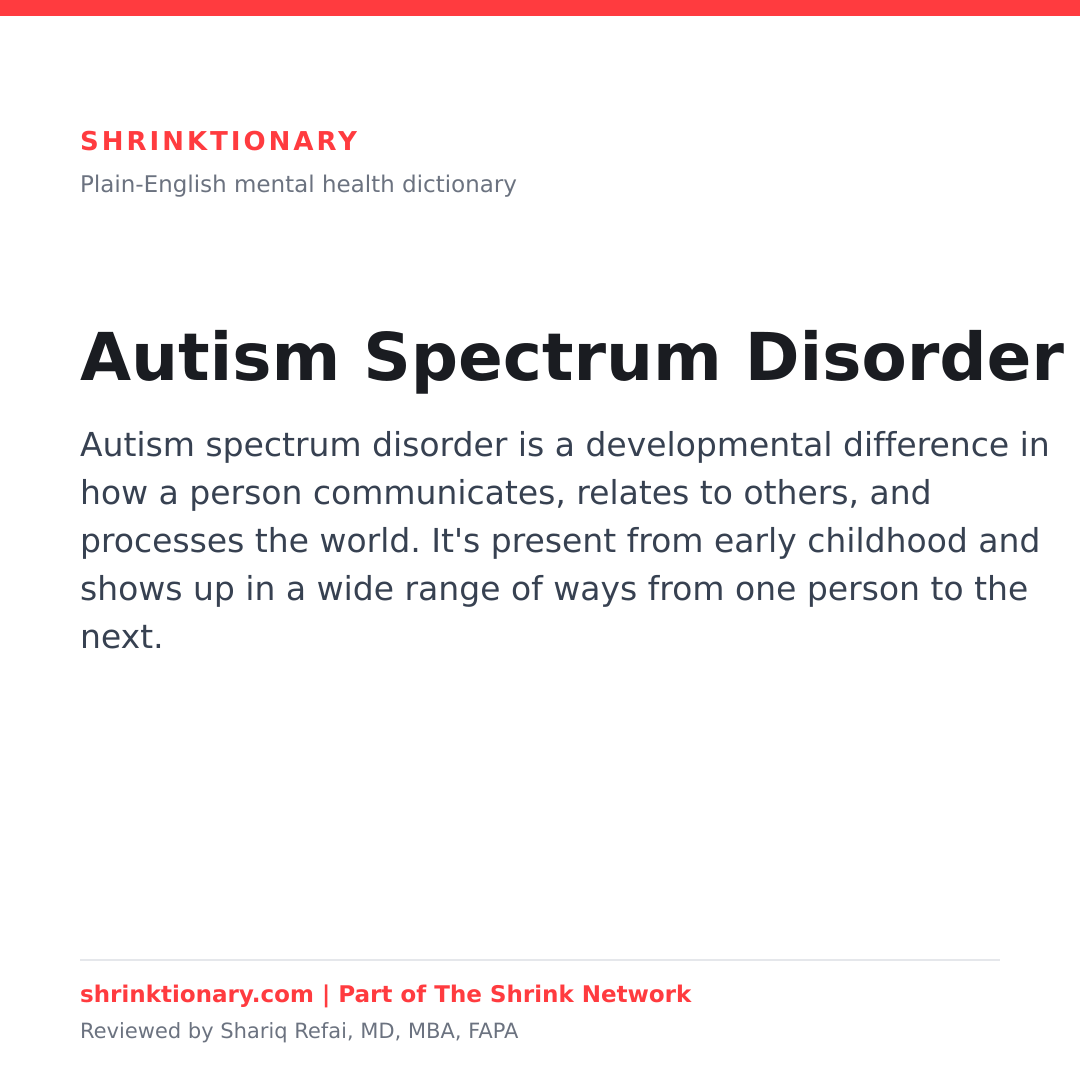
Autism spectrum disorder is a developmental difference in how the brain is wired. It affects how a person communicates, builds relationships, and takes in sensory information. It’s present from early childhood, even when it isn’t recognized until later in life.
Clinicians describe two core areas. The first is social communication, which covers things like back-and-forth conversation, reading social cues, and sharing interests. The second is patterns of behavior and interest, which can include repetitive movements, a strong need for routine, deep focus on specific topics, and sensitivity to sound, light, or texture. The word “spectrum” matters here. Two autistic people can look very different from each other.
How autism spectrum disorder shows up
Some people speak fluently and have advanced vocabularies, while others speak little or not at all. Some make easy eye contact, and some find it uncomfortable. A person might love deep, focused conversation about a favorite subject but feel lost in small talk. Sudden changes in plans can feel genuinely distressing, not just annoying.
Sensory experiences are a big part of it for many people. A noisy room, a scratchy shirt, or a flickering light can be overwhelming in a way that’s hard to explain to someone who doesn’t experience it. Routines and predictability often help the nervous system feel safe.
What autism spectrum disorder isn’t
Autism is not caused by parenting, vaccines, or anything a person did. Decades of research have settled that question. It’s also not a disease to be cured. It’s a way of being wired that comes with both challenges and strengths.
Autism isn’t the same as an intellectual disability, though the two can occur together. Many autistic people have average or above-average intelligence. And being shy, introverted, or socially awkward is not the same as being autistic. Autism is a specific developmental pattern that a trained clinician evaluates.
Related terms you’ll see next
When to seek professional care
If you wonder whether you or your child might be autistic, a formal evaluation by a psychologist, psychiatrist, or developmental specialist can bring clarity. An accurate understanding often opens the door to support, accommodations, and self-acceptance.
Autism itself isn’t treated like an illness, but related challenges such as anxiety, attention difficulties, or sensory overload can be supported. If distress, depression, or thoughts of self-harm come up, reach out to a professional. In the US you can call or text 988 any time.
When evaluation may help
Not everyone reading about autism spectrum disorder needs treatment. If it's getting in the way of your day, your sleep, your work, or your relationships, or if it isn't easing on its own, a professional evaluation is a reasonable next step. Most people start with their primary care doctor or a therapist. A psychiatrist is the right call when medication may be involved or the picture is complicated, though waits can be long.
We keep an honest, no-commission rundown of the options, from primary care to telepsychiatry to crisis lines, on one page.
If you're in crisis or thinking about suicide, call or text 988 in the US, or go to the nearest emergency room.
When this word matters
It matters as a developmental difference present from early childhood that shapes communication, social relating, and sensory processing, and it shows up in a wide range of ways from one person to the next. Recognizing it matters because traits can be masked, and it often overlaps with ADHD and anxiety.
Commonly confused with
Frequently asked questions
What does autism spectrum disorder mean?
Autism spectrum disorder is a developmental difference in how the brain is wired that affects how a person communicates, builds relationships, and takes in sensory information. It's present from early childhood and shows up in a wide range of ways from one person to the next.
Do vaccines cause autism?
No. Autism is not caused by vaccines, parenting, or anything a person did. Decades of research have settled that question.
Is autism the same as an intellectual disability?
No, though the two can occur together. Many autistic people have average or above-average intelligence. Being shy, introverted, or socially awkward also isn't the same as being autistic, which is a specific developmental pattern a trained clinician evaluates.
Related terms
Compare
Sources
- Autism Spectrum Disorder , National Institute of Mental Health
- Autism Spectrum Disorder , MedlinePlus
- Diagnostic and Statistical Manual of Mental Disorders, Fifth Edition, Text Revision (DSM-5-TR) , American Psychiatric Association
Use or cite this definition
Free to reuse with attribution. Paste the block into your own page, or grab a citation.
Embed on your site
<blockquote>
<p><strong>Autism Spectrum Disorder:</strong> Autism spectrum disorder is a developmental difference in how a person communicates, relates to others, and processes the world. It's present from early childhood and shows up in a wide range of ways from one person to the next.</p>
<p>— <a href="https://shrinktionary.com/terms/autism-spectrum-disorder/">Shrinktionary</a>, a plain-English mental health dictionary, medically reviewed by a board certified psychiatrist.</p>
</blockquote>Cite (APA)
Refai, S. (2026). Autism Spectrum Disorder. Shrinktionary. https://shrinktionary.com/terms/autism-spectrum-disorder/
Cite (MLA)
"Autism Spectrum Disorder." Shrinktionary, https://shrinktionary.com/terms/autism-spectrum-disorder/. Accessed September 26, 2026.
Your next step in The Shrink Network
You are here: Shrinktionary, the language layer of The Shrink Network.
Each site in the network has one job. No matter where you enter, we help you find the next step that makes sense.
Want to understand more first?
See how this connects to everything else in the Term Web →
Take it with you
Free printable references you can save or share. For education, not medical advice.