What sensory overload actually is
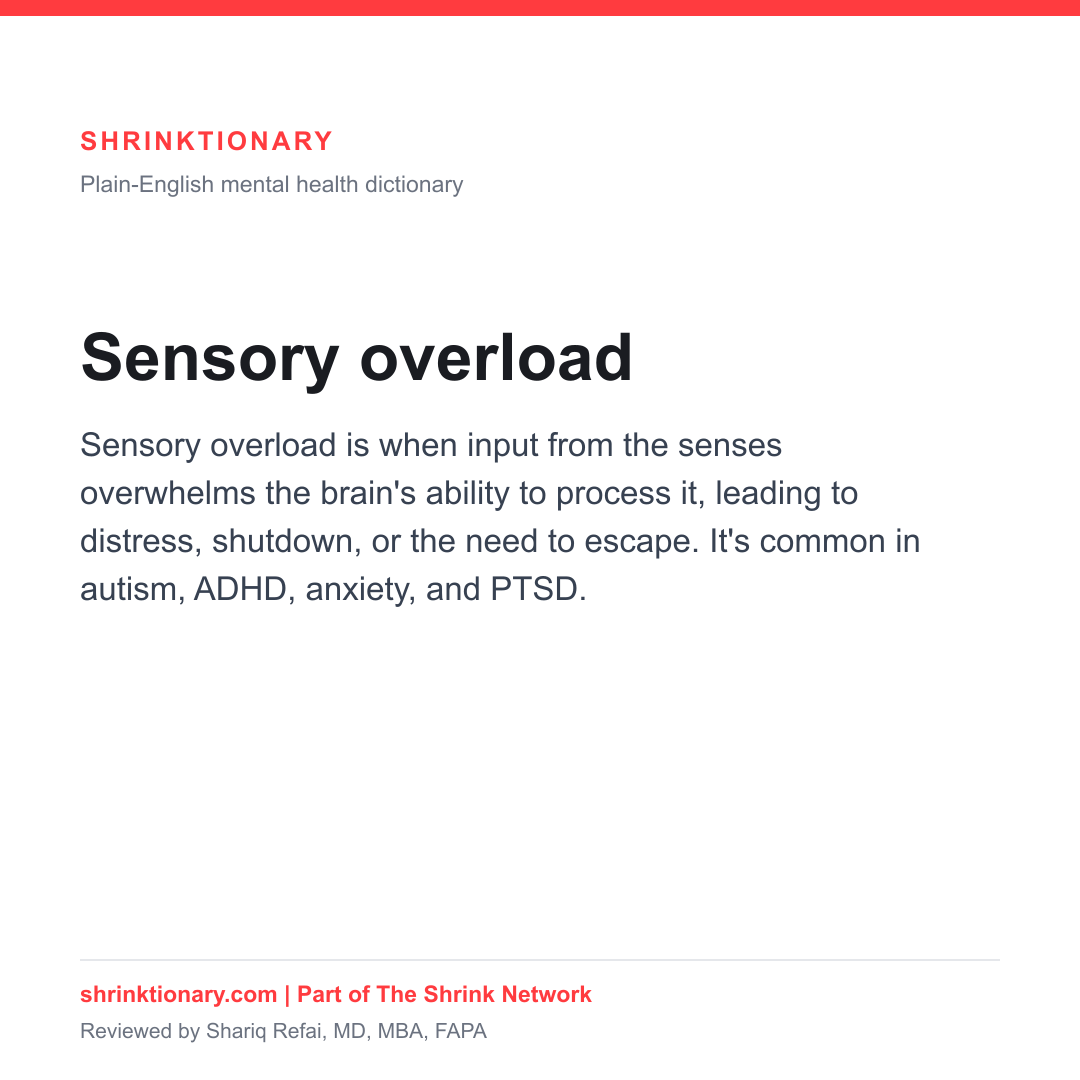
Sensory overload happens when the amount or intensity of sensory input outpaces the brain’s ability to sort and process it. The senses keep delivering information, sight, sound, touch, smell, taste, and the internal sense of the body, and at some point the system can’t keep up. What follows is a flood that the person can’t filter or tune out.
Most of the time, the brain quietly filters out a huge amount of background input so that only what matters reaches awareness. In sensory overload, that filter struggles. The hum of a fluorescent light, the texture of a tag, several conversations at once, a bright room, all of it competes for attention with equal force, and the result is overwhelming.
Sensory overload is especially common in autistic people, whose sensory processing often differs, and in people with ADHD. It also shows up with anxiety, with PTSD, with migraines, and in many people during periods of stress or exhaustion. It isn’t unique to any one condition, but it’s a frequent and important part of some.
What sensory overload can feel like
People describe it as too much, all at once. Sounds get sharper and harder to ignore. Lights feel harsh. Textures grate. The urge to cover the ears, close the eyes, or get out of the room can become urgent. Thinking clearly becomes difficult because so much processing power is going to the input itself.
The response can take different forms. Some people become agitated, irritable, or panicked. Others shut down, going quiet and withdrawn as a way to limit further input. In autistic people, overload can contribute to a meltdown or a shutdown. Across the board, the experience is distressing and can be hard to explain to people who aren’t feeling it.
Afterward, many people feel drained and need time alone in a calmer environment to recover. The aftermath can be as significant as the episode itself.
What sensory overload isn’t
Sensory overload isn’t being dramatic, picky, or overly sensitive in a character sense. The nervous system is genuinely receiving and struggling to process more than it can manage. Treating it as an overreaction misses what’s actually happening at the level of perception.
It also isn’t the same as simply disliking noise or crowds, although those can be triggers. Overload is the point at which input exceeds processing capacity and tips into distress or shutdown. And it isn’t a sign of weakness. The threshold differs from person to person, and a lower threshold reflects how a particular nervous system works, not a flaw.
Related terms you’ll see next
Overstimulation is a closely related term, often used interchangeably, for too much input at once. Hyperarousal describes a keyed-up nervous system that can lower the threshold for overload. Masking is the effort some people put into hiding distress, which can make overload harder to spot from outside.
When to seek professional care
Sensory overload itself is a common experience, not necessarily a sign of a disorder. It’s worth seeking professional input when overload happens often, interferes with work, school, relationships, or daily life, or comes with other signs that point toward an underlying condition such as autism, ADHD, or an anxiety disorder. A clinician can help identify what’s driving it and suggest practical accommodations and coping strategies.
When this word matters
It matters when overload happens often, interferes with work, school, relationships, or daily life, or comes with other signs that point toward an underlying condition such as autism, ADHD, or an anxiety disorder. A clinician can help identify what's driving it and suggest accommodations and coping strategies.
Commonly confused with
Frequently asked questions
What is sensory overload?
Sensory overload is when input from the senses outpaces the brain's ability to sort and process it. The usual filter that screens out background input struggles, so sights, sounds, and textures all compete at once and become overwhelming.
Who experiences sensory overload?
It's especially common in autistic people and people with ADHD, whose sensory processing often differs. It also shows up with anxiety, PTSD, migraines, and during periods of stress or exhaustion, so it isn't unique to any one condition.
How do people cope with sensory overload?
Many people reduce input by getting to a quieter, dimmer space, covering the ears or eyes, and taking time alone to recover afterward. If overload happens often or interferes with daily life, a clinician can suggest accommodations and coping strategies.
Related terms
Compare
Sources
- Autism Spectrum Disorder , National Institute of Mental Health
- Autism Spectrum Disorder , MedlinePlus
Use or cite this definition
Free to reuse with attribution. Paste the block into your own page, or grab a citation.
Embed on your site
<blockquote>
<p><strong>Sensory overload:</strong> Sensory overload is when input from the senses overwhelms the brain's ability to process it, leading to distress, shutdown, or the need to escape. It's common in autism, ADHD, anxiety, and PTSD.</p>
<p>— <a href="https://shrinktionary.com/terms/sensory-overload/">Shrinktionary</a>, a plain-English mental health dictionary, medically reviewed by a board certified psychiatrist.</p>
</blockquote>Cite (APA)
Refai, S. (2026). Sensory overload. Shrinktionary. https://shrinktionary.com/terms/sensory-overload/
Cite (MLA)
"Sensory overload." Shrinktionary, https://shrinktionary.com/terms/sensory-overload/. Accessed September 26, 2026.
Your next step in The Shrink Network
You are here: Shrinktionary, the language layer of The Shrink Network.
Each site in the network has one job. No matter where you enter, we help you find the next step that makes sense.
Want to understand more first?
See how this connects to everything else in the Term Web →
Take it with you
Free printable references you can save or share. For education, not medical advice.