What rejection sensitive dysphoria actually is
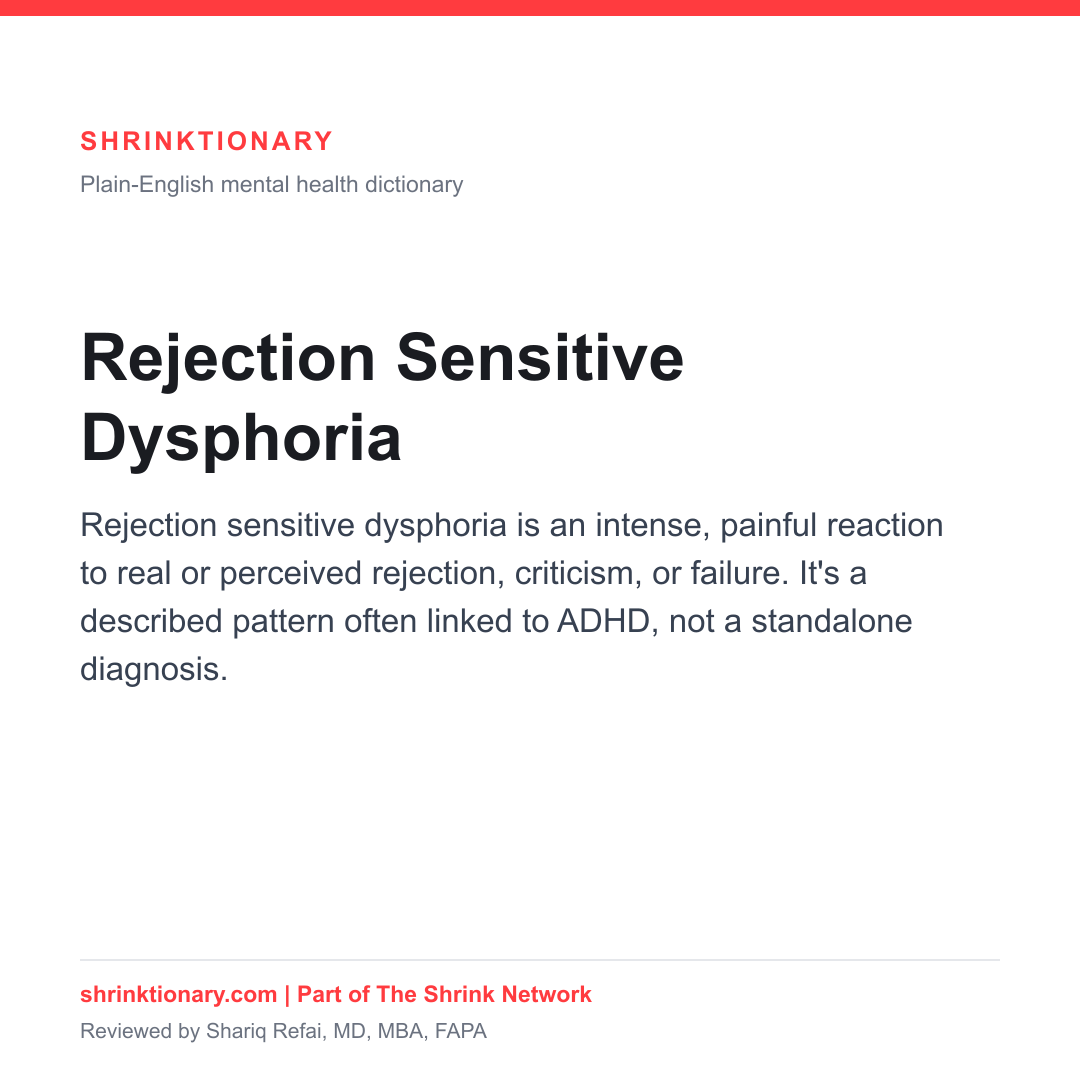
Rejection sensitive dysphoria is an intense emotional reaction to the sense of being rejected, criticized, or falling short. The feeling tends to arrive fast and hit hard, often out of proportion to what actually happened. A short reply to a text, a piece of feedback at work, or the idea that someone is disappointed can trigger a wave of shame, hurt, or anger that’s difficult to talk down.
It’s worth being clear about its status. Rejection sensitive dysphoria isn’t a formal diagnosis in the DSM-5-TR. It’s a described pattern, most often discussed in connection with ADHD, that clinicians and people with lived experience use to name a very real experience. Calling it a pattern rather than a disorder doesn’t make it less painful. It just means the term describes how something tends to show up rather than serving as an official clinical label.
How it tends to show up
People who relate to this pattern often describe a kind of emotional sunburn. The reaction can be turned inward, showing up as sudden shame, a spiral of self-criticism, or the belief that they’ve ruined a relationship over something small. It can also turn outward as irritability or anger at the person who seemed to do the rejecting.
Because the feeling is so uncomfortable, it often shapes behavior in advance. Some people become intense people-pleasers, working hard to avoid any hint of disapproval. Others avoid risks entirely, skipping opportunities where they might be judged or turned down. The reaction can be tied to real events or to imagined ones, and the body often responds before the thinking mind has a chance to weigh in.
What rejection sensitive dysphoria isn’t
It isn’t the same as ordinary disappointment, and it isn’t simply being oversensitive or dramatic. The intensity is a real feature of how some nervous systems process social pain, not a character flaw.
It also isn’t a separate mental illness on its own. It overlaps with anxiety, low self-esteem, and mood symptoms, and it’s frequently part of the picture in ADHD. A clinician looks at the whole pattern rather than treating the term as a diagnosis by itself.
Related terms you’ll see next
Emotional dysregulation describes the broader difficulty managing the size and timing of emotions that rejection sensitive dysphoria sits inside. ADHD is the condition this pattern is most often linked to. Self-compassion names a skill set that can soften the self-critical spiral the reaction tends to set off.
Why it matters
Naming this pattern can be a relief. People who’ve spent years assuming they were too needy or too thin-skinned often find that having language for the experience reduces the shame around it. It also points toward useful next steps, since strategies that help with emotional regulation, ADHD, and self-criticism tend to help here too. If the reactions are interfering with work, relationships, or daily life, an evaluation can clarify what’s driving them and what kind of support fits.
When this word matters
It matters when reactions to perceived rejection or criticism are intense, fast, and out of proportion to what happened, and when they start shaping behavior through people-pleasing or avoiding risks. Because it's a described pattern rather than a diagnosis, naming it helps point toward support for the conditions it often sits inside, such as ADHD and anxiety.
Commonly confused with
Frequently asked questions
Is rejection sensitive dysphoria a real diagnosis?
It isn't a formal diagnosis in the DSM-5-TR. It's a described pattern, most often discussed in connection with ADHD, that names an intense reaction to real or perceived rejection, criticism, or failure. Calling it a pattern doesn't make it less painful or less real.
Why is rejection sensitive dysphoria linked to ADHD?
Many people with ADHD describe strong, fast reactions to perceived rejection, which is why the pattern is most often discussed alongside it. The connection is observed clinically rather than settled as a formal feature, and a clinician looks at the whole picture rather than treating the term as a diagnosis on its own.
Can rejection sensitive dysphoria be helped?
Yes. Strategies that help with emotional regulation, ADHD, and self-criticism tend to help here too. If the reactions are interfering with work, relationships, or daily life, an evaluation can clarify what's driving them and what kind of support fits.
Related terms
Compare
Sources
- Attention-Deficit/Hyperactivity Disorder , National Institute of Mental Health
Use or cite this definition
Free to reuse with attribution. Paste the block into your own page, or grab a citation.
Embed on your site
<blockquote>
<p><strong>Rejection Sensitive Dysphoria:</strong> Rejection sensitive dysphoria is an intense, painful reaction to real or perceived rejection, criticism, or failure. It's a described pattern often linked to ADHD, not a standalone diagnosis.</p>
<p>— <a href="https://shrinktionary.com/terms/rejection-sensitive-dysphoria/">Shrinktionary</a>, a plain-English mental health dictionary, medically reviewed by a board certified psychiatrist.</p>
</blockquote>Cite (APA)
Refai, S. (2026). Rejection Sensitive Dysphoria. Shrinktionary. https://shrinktionary.com/terms/rejection-sensitive-dysphoria/
Cite (MLA)
"Rejection Sensitive Dysphoria." Shrinktionary, https://shrinktionary.com/terms/rejection-sensitive-dysphoria/. Accessed September 26, 2026.
Your next step in The Shrink Network
You are here: Shrinktionary, the language layer of The Shrink Network.
Each site in the network has one job. No matter where you enter, we help you find the next step that makes sense.
Want to understand more first?
See how this connects to everything else in the Term Web →
Take it with you
Free printable references you can save or share. For education, not medical advice.