What masking actually is
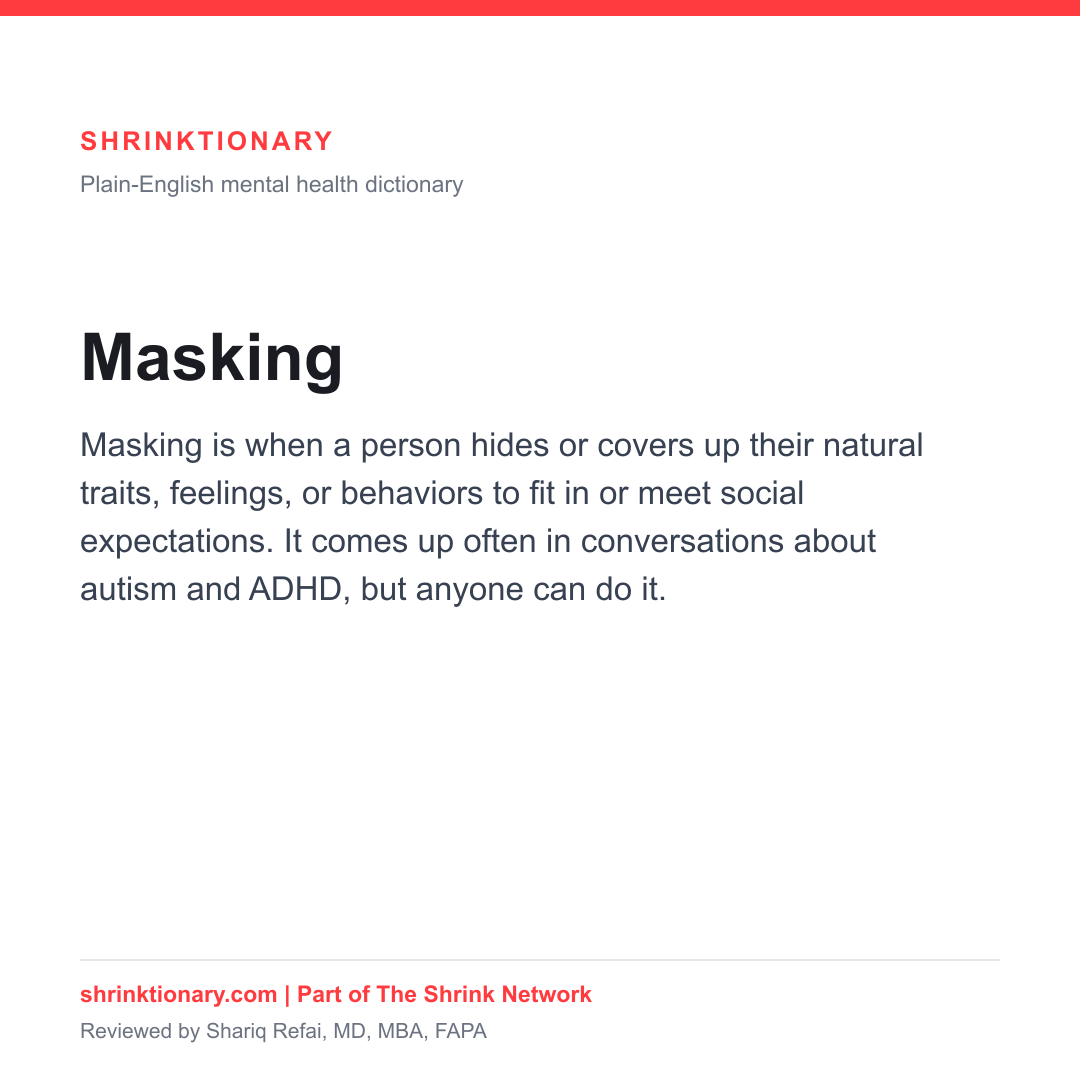
Masking is the act of hiding or covering up parts of yourself to blend in or seem like what a situation expects. That might mean holding back natural reactions, copying other people’s expressions and body language, forcing eye contact, or pushing down feelings so they don’t show. The goal is usually to avoid standing out, being judged, or facing trouble.
In everyday talk, the word shows up most in the context of autism and ADHD, where it often describes the effort of appearing “neurotypical” in social settings. But masking isn’t limited to any one group. Lots of people mask at work, at school, or around family, smoothing over how they really feel to keep things comfortable for others.
What people usually mean
When people say they were masking, they usually mean they were performing a more acceptable version of themselves while a different experience was going on inside. Someone might smile and chat at a party while feeling overwhelmed, or stay quiet about confusion to avoid looking out of step.
For autistic and ADHD individuals, masking can be more constant and more effortful. It might involve scripting conversations ahead of time, suppressing movements that help with focus or calm, or carefully mimicking social cues that don’t come automatically. People often describe this as exhausting because it takes ongoing mental energy to keep up. The phrase usually carries a sense of a gap between the outside performance and the inner reality.
What it isn’t
Masking isn’t the same as lying or being fake in a dishonest way. It’s usually a protective response, a way of staying safe or accepted, not an attempt to deceive people for gain.
It also isn’t always a conscious choice. Many people have learned to mask so early and so automatically that they barely notice they’re doing it. And masking isn’t harmless just because it looks fine from the outside. Long-term masking is linked to stress, exhaustion, and burnout, and it can make it harder for others to understand what a person actually needs.
Related terms you’ll see next
Why the distinction matters
Understanding masking helps explain why someone can seem fine on the surface while struggling underneath. It’s part of why difficulties in autism and ADHD are sometimes missed, especially in people who have gotten very good at hiding them. Recognizing masking can lead to more accurate understanding and support.
Naming it also gives people language for an experience that can feel isolating. Knowing that masking is common, effortful, and sometimes costly can make it easier to ask for accommodations, set boundaries, and find spaces where it feels safe to drop the mask.
When this word matters
Masking matters because someone can seem fine on the surface while struggling underneath, which is part of why autism and ADHD are sometimes missed in people who hide their difficulties well. Long-term masking is linked to stress, exhaustion, and burnout.
Commonly confused with
Frequently asked questions
What is masking?
Masking is the act of hiding or covering up parts of yourself to blend in or seem like what a situation expects, such as holding back natural reactions, copying others' body language, forcing eye contact, or pushing down feelings.
Is masking the same as lying or being fake?
No, masking isn't the same as lying or being dishonest. It's usually a protective response, a way of staying safe or accepted, and it's often not even a conscious choice.
Why can masking be harmful?
Masking isn't harmless just because it looks fine from the outside. Long-term masking is linked to stress, exhaustion, and burnout, and it can make it harder for others to understand what a person actually needs.
Related terms
Compare
Sources
- Autism spectrum disorder , National Institute of Mental Health (NIMH)
- Autism spectrum disorder , MedlinePlus
Use or cite this definition
Free to reuse with attribution. Paste the block into your own page, or grab a citation.
Embed on your site
<blockquote>
<p><strong>Masking:</strong> Masking is when a person hides or covers up their natural traits, feelings, or behaviors to fit in or meet social expectations. It comes up often in conversations about autism and ADHD, but anyone can do it.</p>
<p>— <a href="https://shrinktionary.com/terms/masking/">Shrinktionary</a>, a plain-English mental health dictionary, medically reviewed by a board certified psychiatrist.</p>
</blockquote>Cite (APA)
Refai, S. (2026). Masking. Shrinktionary. https://shrinktionary.com/terms/masking/
Cite (MLA)
"Masking." Shrinktionary, https://shrinktionary.com/terms/masking/. Accessed September 26, 2026.
Your next step in The Shrink Network
You are here: Shrinktionary, the language layer of The Shrink Network.
Each site in the network has one job. No matter where you enter, we help you find the next step that makes sense.
Want to understand more first?
See how this connects to everything else in the Term Web →
Take it with you
Free printable references you can save or share. For education, not medical advice.