What alogia actually is
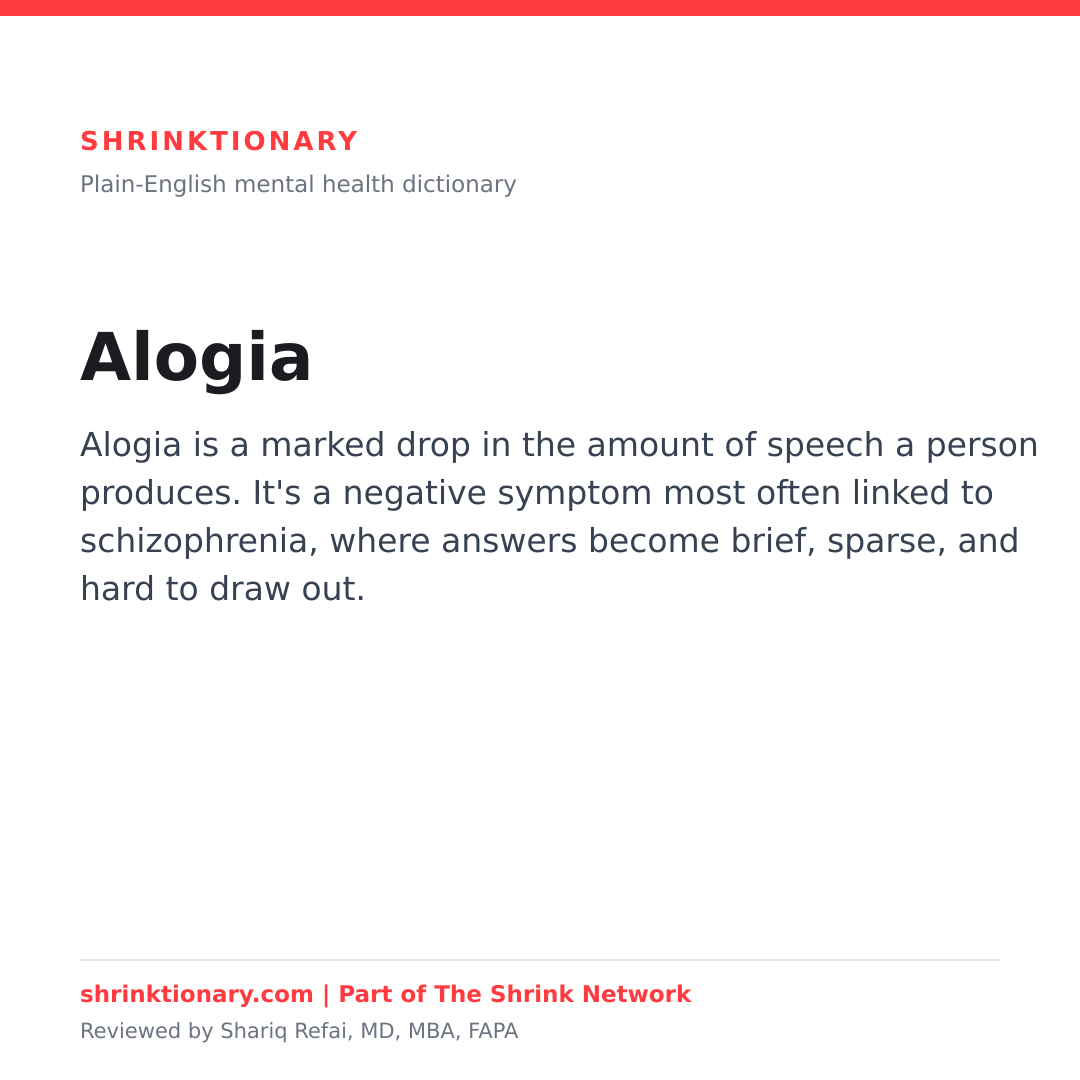
Alogia is a clear reduction in how much someone speaks. The word comes from roots meaning without speech, but in practice it rarely means total silence. It usually means the flow of words has thinned. Answers come back short. Spontaneous comments dry up. A conversation that should expand keeps contracting.
Clinicians group alogia with the negative symptoms of schizophrenia. Negative symptoms describe things that are taken away or turned down, rather than added on. Hallucinations and delusions are positive symptoms because they add experiences that aren’t there. Alogia, flat affect, and avolition sit on the other side, marking a loss of speech, expression, and drive.
Two patterns often get described. In poverty of speech, the total amount of language drops. In poverty of content, the words are there but they carry little information, circling without arriving anywhere. Both leave a listener with less to hold onto than the length of the exchange would suggest.
What alogia looks like
In conversation, alogia tends to feel like pulling on a thread that keeps coming up short. A question that invites a paragraph gets a single word. Follow-ups don’t open things up. There are long pauses before replies, and replies that close the topic instead of carrying it forward.
It’s not the same as being quiet by nature or thoughtful before speaking. The hallmark is a change from how the person used to communicate, paired with a sense that the words simply aren’t coming together. Family members sometimes notice it before the person does, describing someone who has gone from talkative to spare.
Alogia shows up most in schizophrenia and related conditions, but reduced speech can also appear in severe depression, in some forms of dementia, and after certain brain injuries. Because the causes differ, the surrounding picture matters as much as the symptom itself.
What alogia isn’t
Alogia isn’t shyness, and it isn’t a choice to hold back. The person isn’t refusing to engage or hiding something. The machinery that generates spontaneous speech is producing less of it. Treating that as rudeness or stubbornness misreads what’s happening.
It also isn’t the same as alexithymia, which is difficulty identifying and naming feelings, or mutism, where speech stops almost entirely. Alogia is specifically about reduced quantity and richness of speech, and it’s usually one piece of a larger clinical picture rather than a standalone problem.
Related terms you’ll see next
Flat affect often appears alongside alogia, since both involve a turning down of outward expression. Avolition describes a loss of drive and goal-directed activity, the third member of the negative-symptom cluster. Emotional blunting is a related thinning of emotional response that can overlap with these.
When to seek professional care
A lasting drop in someone’s speech, especially when it comes with reduced expression, low motivation, or social withdrawal, is worth a professional evaluation. These changes can be early signs of a serious condition, and they’re easier to address when they’re caught early. A clinician can sort out whether the cause is psychiatric, medical, or related to medication, and can build a plan from there.
When this word matters
It matters when a person's speech has clearly thinned out compared to how they used to communicate, especially alongside reduced expression, low motivation, or social withdrawal. As a negative symptom of schizophrenia, alogia can be an early clue that points toward a serious condition, and catching it early helps.
Commonly confused with
Frequently asked questions
What is alogia in simple terms?
Alogia is a clear drop in how much a person speaks. Answers become short and spontaneous comments dry up. It's a negative symptom most often linked to schizophrenia, sometimes called poverty of speech.
Is alogia the same as being shy or quiet?
No. Being quiet by nature isn't alogia. Alogia is a change from how the person used to communicate, where the words simply aren't coming together, and it's usually part of a larger clinical picture rather than a personality trait.
What conditions cause alogia?
Alogia is most associated with schizophrenia and related conditions as a negative symptom. Reduced speech can also appear in severe depression, in some forms of dementia, and after certain brain injuries, so the surrounding picture matters.
Related terms
Sources
- Schizophrenia , National Institute of Mental Health
- Schizophrenia , StatPearls (NCBI Bookshelf)
Use or cite this definition
Free to reuse with attribution. Paste the block into your own page, or grab a citation.
Embed on your site
<blockquote>
<p><strong>Alogia:</strong> Alogia is a marked drop in the amount of speech a person produces. It's a negative symptom most often linked to schizophrenia, where answers become brief, sparse, and hard to draw out.</p>
<p>— <a href="https://shrinktionary.com/terms/alogia/">Shrinktionary</a>, a plain-English mental health dictionary, medically reviewed by a board certified psychiatrist.</p>
</blockquote>Cite (APA)
Refai, S. (2026). Alogia. Shrinktionary. https://shrinktionary.com/terms/alogia/
Cite (MLA)
"Alogia." Shrinktionary, https://shrinktionary.com/terms/alogia/. Accessed September 26, 2026.
Your next step in The Shrink Network
You are here: Shrinktionary, the language layer of The Shrink Network.
Each site in the network has one job. No matter where you enter, we help you find the next step that makes sense.
Want to understand more first?
See how this connects to everything else in the Term Web →
Take it with you
Free printable references you can save or share. For education, not medical advice.