What catatonia actually is
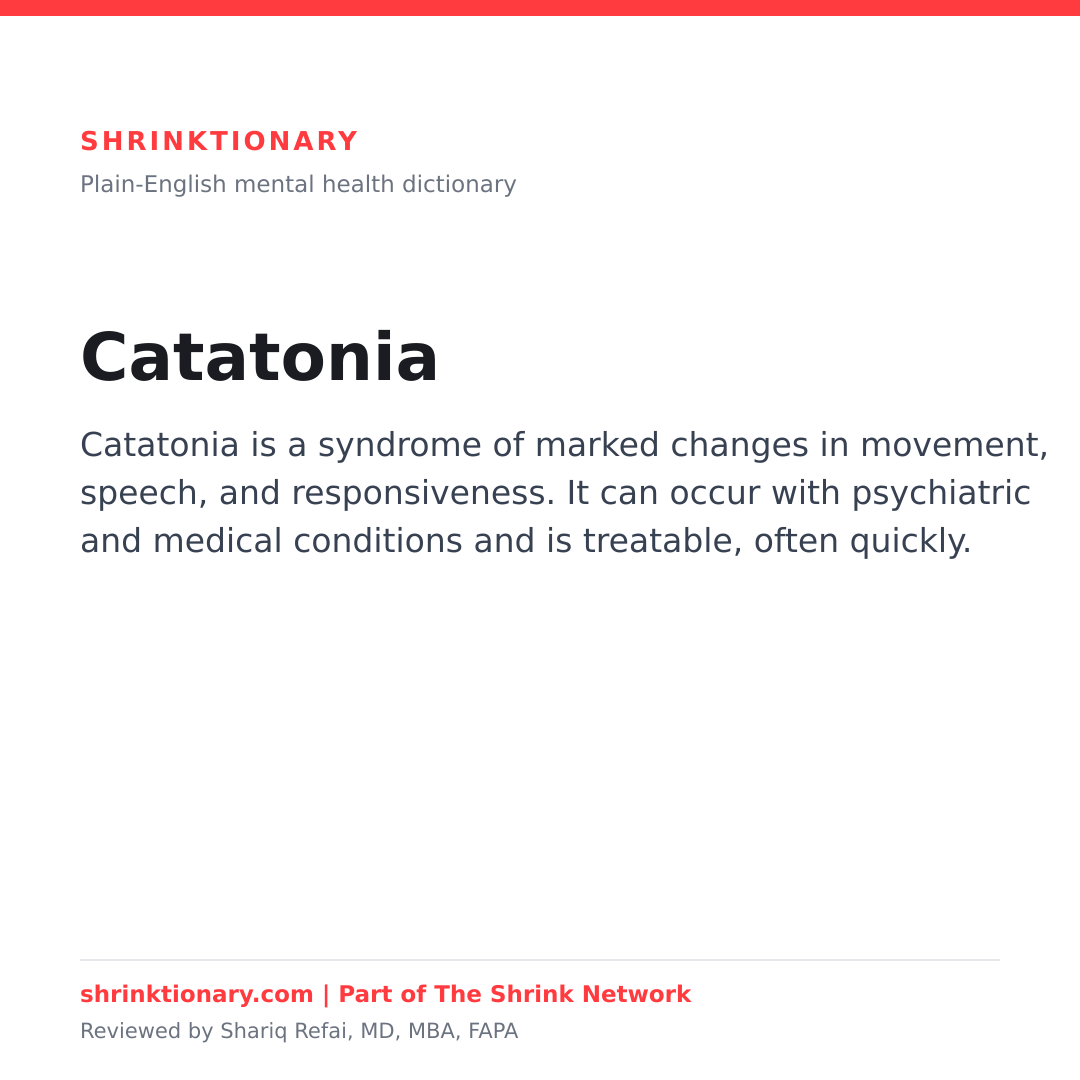
Catatonia is a syndrome marked by striking changes in movement, speech, and the way a person responds to the world around them. It isn’t a single symptom but a cluster, and it can range from a person becoming nearly motionless and unresponsive to a person showing excessive, agitated movement. The common thread is a serious disruption in how the body and behavior are organized.
In the DSM-5-TR, catatonia is recognized as a syndrome that can occur alongside several conditions rather than belonging to just one. It’s seen with mood disorders such as bipolar disorder and severe depression, with schizophrenia and related disorders, and with a range of medical and neurological conditions. Because it can also signal a serious underlying medical problem, catatonia is taken seriously and evaluated promptly. The encouraging part is that it’s often very treatable, and people can recover significantly once it’s recognized.
What catatonia can look like
Catatonia shows up in a number of recognizable features, and a person may have some but not others. In its withdrawn form, someone may stop moving, hold an unusual posture for a long time, fall silent, or stop responding to questions even while awake. They might resist being moved, or hold a position a person places them in. Some people show waxy flexibility, where their limbs can be slowly repositioned and then stay there.
In its more activated form, catatonia can involve excessive movement that seems purposeless, repeating the same motions, or echoing other people’s words or gestures. Eating, drinking, and self-care often suffer, which is part of why the condition needs prompt attention. To those around them, a person in a catatonic state may seem frozen, far away, or unreachable, even though they’re often aware of more than they can show.
What catatonia isn’t
It isn’t stubbornness, refusal, or a person choosing not to engage. The lack of movement or response comes from the syndrome, not from willful behavior. It also isn’t the same as being asleep, sedated, or simply withdrawn from low mood, though it can be mistaken for those.
Catatonia isn’t a rare curiosity tied only to schizophrenia, which is an outdated view. It occurs across many conditions, and it isn’t a hopeless state. With recognition and treatment, many people improve substantially.
Related terms you’ll see next
Psychomotor agitation describes the kind of excessive, driven movement that can appear in the more activated form of catatonia. Flat affect names the reduced outward expression that can accompany withdrawn states. Electroconvulsive therapy is one established treatment for catatonia that doesn’t respond to medication.
When to seek professional care
Catatonia is a medical situation that needs prompt professional evaluation. If a person becomes suddenly unresponsive, stops moving or speaking, holds unusual postures, or stops eating and drinking, that warrants urgent care, since catatonia can sometimes accompany a serious medical condition. The reassuring part is that catatonia often responds well to treatment, including certain medications and other established therapies. Quick recognition tends to lead to better outcomes, so it’s worth seeking help right away rather than waiting to see if it passes.
When this word matters
It matters because catatonia needs prompt professional evaluation and can sometimes accompany a serious medical condition. Sudden unresponsiveness, stopping movement or speech, holding unusual postures, or stopping eating and drinking all warrant urgent care, and quick recognition tends to lead to better outcomes.
Commonly confused with
Frequently asked questions
What is catatonia?
Catatonia is a syndrome marked by striking changes in movement, speech, and responsiveness. It can range from a person becoming nearly motionless and unresponsive to a person showing excessive, agitated movement. It occurs alongside several psychiatric and medical conditions.
Is catatonia only seen in schizophrenia?
No. That's an outdated view. The DSM-5-TR recognizes catatonia as a syndrome that can occur with mood disorders such as bipolar disorder and severe depression, with schizophrenia and related disorders, and with a range of medical and neurological conditions.
Is catatonia treatable?
Yes, and it's often very treatable. People can recover significantly once it's recognized, with treatments including certain medications and other established therapies. Because it can also signal a serious medical problem, prompt evaluation is important.
Related terms
In these language clusters
Sources
- Catatonia , StatPearls, NCBI Bookshelf
- Diagnostic and Statistical Manual of Mental Disorders, Fifth Edition, Text Revision (DSM-5-TR) , American Psychiatric Association
Use or cite this definition
Free to reuse with attribution. Paste the block into your own page, or grab a citation.
Embed on your site
<blockquote>
<p><strong>Catatonia:</strong> Catatonia is a syndrome of marked changes in movement, speech, and responsiveness. It can occur with psychiatric and medical conditions and is treatable, often quickly.</p>
<p>— <a href="https://shrinktionary.com/terms/catatonia/">Shrinktionary</a>, a plain-English mental health dictionary, medically reviewed by a board certified psychiatrist.</p>
</blockquote>Cite (APA)
Refai, S. (2026). Catatonia. Shrinktionary. https://shrinktionary.com/terms/catatonia/
Cite (MLA)
"Catatonia." Shrinktionary, https://shrinktionary.com/terms/catatonia/. Accessed September 26, 2026.
Your next step in The Shrink Network
You are here: Shrinktionary, the language layer of The Shrink Network.
Each site in the network has one job. No matter where you enter, we help you find the next step that makes sense.
Want to understand more first?
See how this connects to everything else in the Term Web →
Take it with you
Free printable references you can save or share. For education, not medical advice.