What delirium actually is
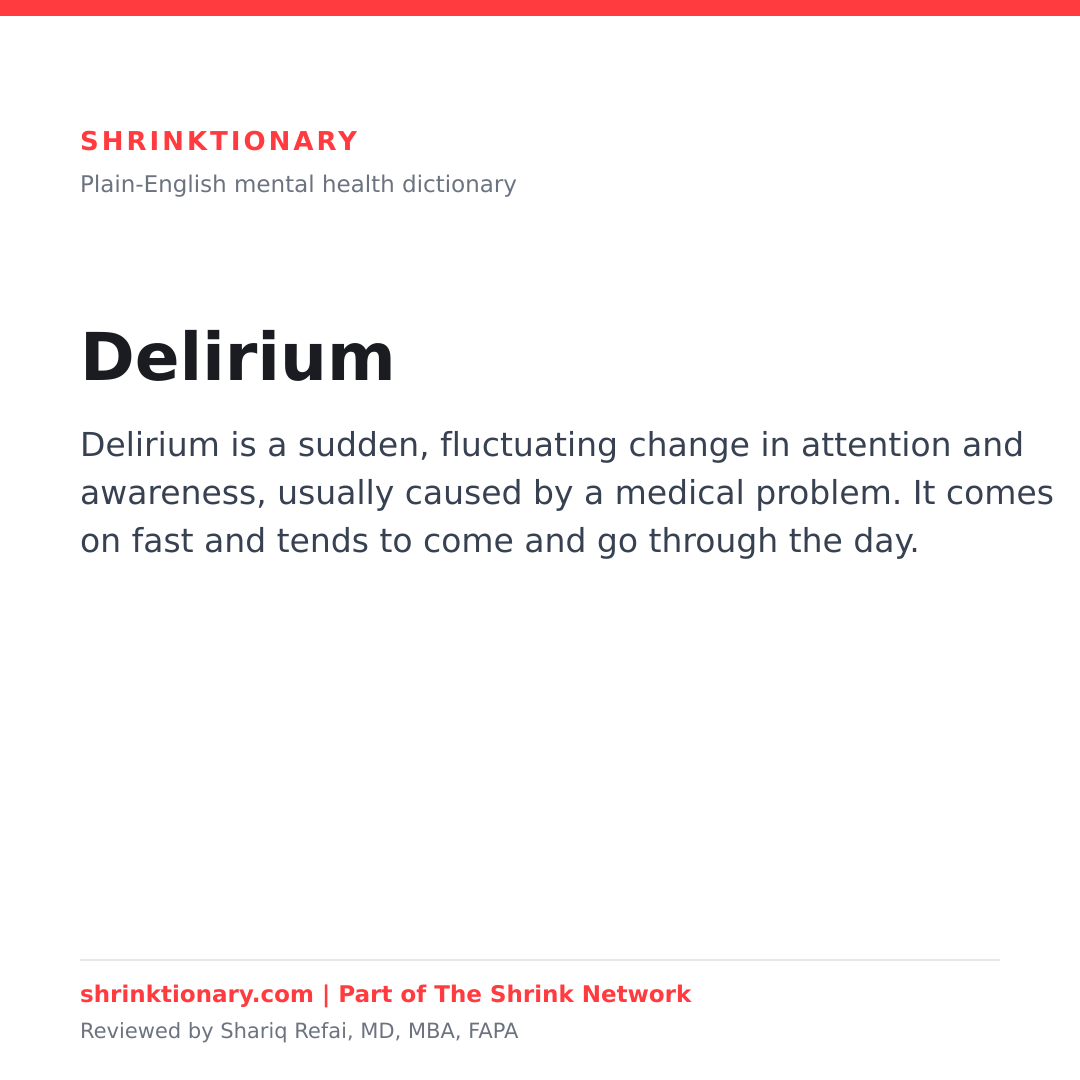
Delirium is a sudden disturbance in attention and awareness that develops over hours to a few days and tends to fluctuate, often getting worse in the evening. It’s described in the DSM-5-TR as an acute change from a person’s usual mental state, and it’s almost always a sign that something is wrong in the body. Infections, dehydration, medication effects, low oxygen, surgery, organ problems, and substance withdrawal are among the common triggers.
The core feature is a slipping of attention. A person in delirium has trouble focusing, holding, or shifting their attention, and their awareness of the surroundings is reduced. On top of that, thinking gets disorganized, memory and orientation can falter, and perception can distort into illusions or hallucinations. Because it points to an underlying medical cause, delirium is treated as a medical situation that needs prompt attention, not simply a psychiatric one.
What delirium can feel like
From the outside, delirium often looks like a person becoming confused, drowsy, or suddenly not themselves. Some people get restless, agitated, or fearful, a form called hyperactive delirium. Others go quiet, withdrawn, and sleepy, a form called hypoactive delirium that’s easy to miss. Many swing between the two.
For the person experiencing it, time and place can blur. They might not recognize where they are or why. Thoughts can feel scrambled, and the room may seem to shift or contain things that aren’t there. Episodes come and go, so someone can seem clear in the morning and badly confused by night. Afterward, people sometimes remember fragments of the experience as frightening or dreamlike.
What delirium isn’t
Delirium isn’t the same as dementia, even though both involve confusion. Dementia develops slowly over months to years and stays fairly steady, while delirium comes on quickly and fluctuates. The two can also occur together, and a person with dementia is at higher risk of becoming delirious.
It also isn’t a normal part of getting older, and it isn’t simply a bad mood, stubbornness, or willful confusion. It isn’t a primary psychiatric illness, though it can look like one. Because delirium signals an underlying medical problem, treating that cause is the heart of getting better.
Related terms you’ll see next
Agitation and hallucination are features that often appear during delirium. Brain fog is a much milder, everyday cloudiness that people sometimes confuse with this far more serious state.
When to seek professional care
Delirium is a medical emergency. If someone suddenly becomes confused, can’t focus, or has a rapid change in alertness or behavior, especially an older adult or someone who’s ill or recently had surgery, they need urgent medical evaluation. Finding and treating the underlying cause is what resolves delirium, so getting checked quickly matters.
When evaluation may help
Not everyone reading about delirium needs treatment. If it's getting in the way of your day, your sleep, your work, or your relationships, or if it isn't easing on its own, a professional evaluation is a reasonable next step. Most people start with their primary care doctor or a therapist. A psychiatrist is the right call when medication may be involved or the picture is complicated, though waits can be long.
We keep an honest, no-commission rundown of the options, from primary care to telepsychiatry to crisis lines, on one page.
If you're in crisis or thinking about suicide, call or text 988 in the US, or go to the nearest emergency room.
When this word matters
It matters immediately, because delirium is a medical emergency. A sudden change in attention, alertness, or behavior, especially in an older adult or someone who's ill or recently had surgery, signals that something is wrong in the body. The underlying cause needs urgent evaluation, since finding and treating it is what resolves delirium.
Commonly confused with
Frequently asked questions
What causes delirium?
Delirium is almost always a sign that something is wrong in the body. Common triggers include infections, dehydration, medication effects, low oxygen, surgery, organ problems, and substance withdrawal. Because of that, delirium is treated as a medical situation that needs prompt attention.
Is delirium the same as dementia?
No. Dementia develops slowly over months to years and stays fairly steady, while delirium comes on quickly over hours to days and fluctuates through the day. The two can occur together, and a person with dementia is at higher risk of becoming delirious.
Is delirium a medical emergency?
Yes. If someone suddenly becomes confused, can't focus, or has a rapid change in alertness or behavior, especially an older adult or someone who's ill or recently had surgery, they need urgent medical evaluation. Finding and treating the underlying cause is what resolves delirium.
Related terms
In these language clusters
Sources
- Delirium , MedlinePlus (U.S. National Library of Medicine)
- Delirium (StatPearls) , National Center for Biotechnology Information
Use or cite this definition
Free to reuse with attribution. Paste the block into your own page, or grab a citation.
Embed on your site
<blockquote>
<p><strong>Delirium:</strong> Delirium is a sudden, fluctuating change in attention and awareness, usually caused by a medical problem. It comes on fast and tends to come and go through the day.</p>
<p>— <a href="https://shrinktionary.com/terms/delirium/">Shrinktionary</a>, a plain-English mental health dictionary, medically reviewed by a board certified psychiatrist.</p>
</blockquote>Cite (APA)
Refai, S. (2026). Delirium. Shrinktionary. https://shrinktionary.com/terms/delirium/
Cite (MLA)
"Delirium." Shrinktionary, https://shrinktionary.com/terms/delirium/. Accessed September 26, 2026.
Your next step in The Shrink Network
You are here: Shrinktionary, the language layer of The Shrink Network.
Each site in the network has one job. No matter where you enter, we help you find the next step that makes sense.
Want to understand more first?
See how this connects to everything else in the Term Web →
Take it with you
Free printable references you can save or share. For education, not medical advice.