What cognitive flexibility actually is
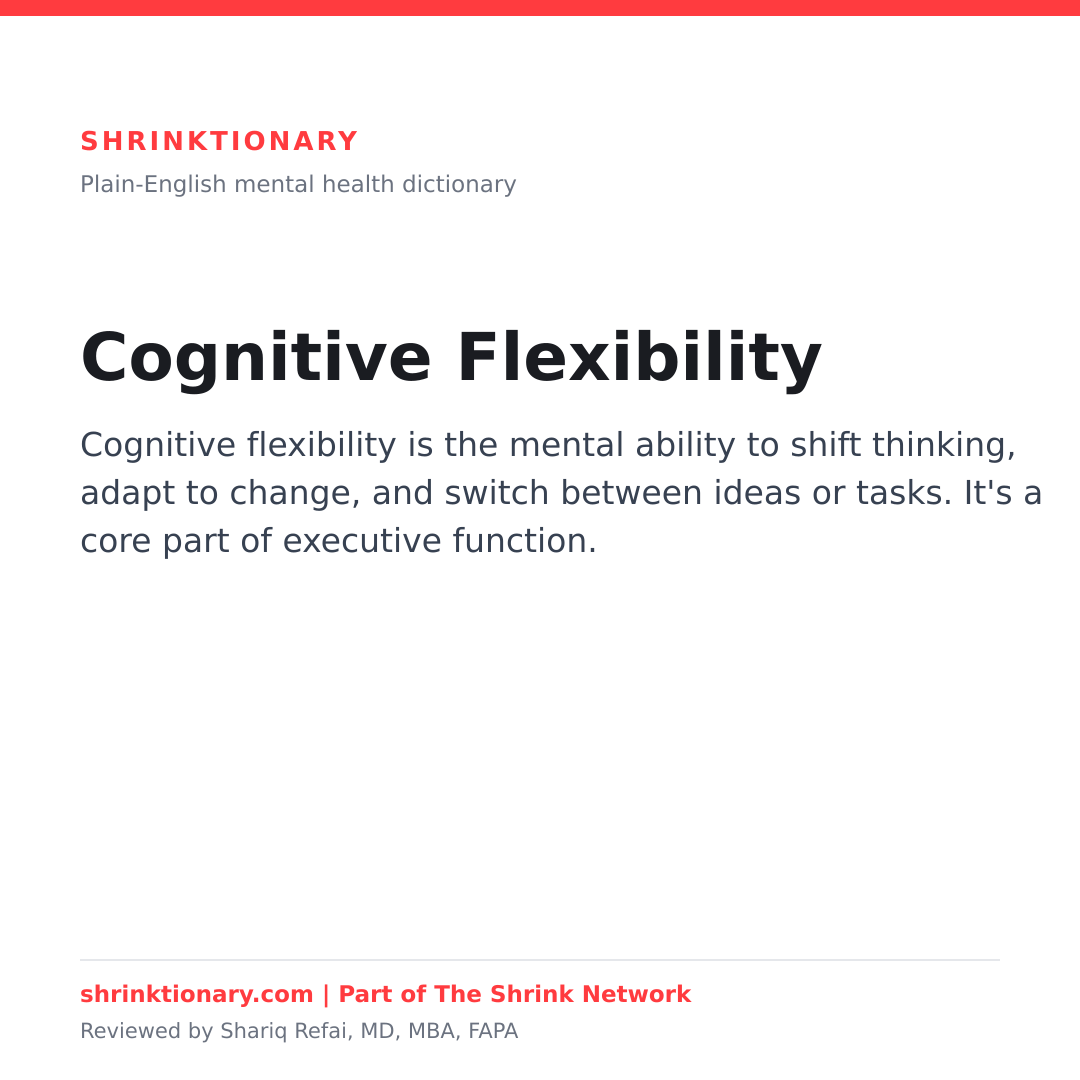
Cognitive flexibility is the brain’s ability to adjust. It’s what lets a person switch from one task to another, see a problem from a different angle, or change plans when the situation changes. When the usual approach stops working, cognitive flexibility is what helps someone try something new instead of getting stuck.
It’s one of the core skills psychologists group under executive function, alongside working memory and inhibition. Together these abilities, supported heavily by the prefrontal cortex, help people manage goals, control impulses, and respond to a world that keeps shifting.
How it works
Picture driving a familiar route and finding the road closed. Cognitive flexibility is what lets you let go of the original plan and find another way without falling apart. The same skill is at work when you take feedback and update your approach, or recognize that a strongly held opinion might need revising.
This ability develops through childhood and into early adulthood as the brain matures. It can be temporarily weakened by stress, exhaustion, or strong emotion, which is part of why people feel mentally rigid when they’re overwhelmed. The good news is that flexibility can be practiced and strengthened over time.
What it isn’t
Cognitive flexibility isn’t the same as being indecisive or having no firm beliefs. Being flexible means you can adapt when there’s a good reason to, not that you abandon your values at the first push.
It also isn’t a fixed trait you either have or don’t. Like other executive skills, it varies from person to person and from day to day, and it can be supported through practice, structure, and managing stress.
Related terms you’ll see next
Why it matters for mental health
Difficulty with cognitive flexibility shows up across many conditions. People with OCD may get stuck on the same thought, those with ADHD may struggle to switch tasks, and rigid thinking is common in anxiety and depression, where the same worries loop without resolution.
Building cognitive flexibility is a quiet goal of many therapies. Cognitive behavioral therapy, for instance, helps people loosen rigid thought patterns and consider other interpretations, which is flexibility in action.
When this word matters
It matters when someone struggles to shift gears, adapt to change, or switch between ideas and tasks, since it's a core part of executive function. Reduced flexibility shows up in conditions like ADHD, autism, OCD, and after brain injury.
Commonly confused with
Frequently asked questions
What does cognitive flexibility mean?
Cognitive flexibility is the brain's ability to adjust. It's what lets a person switch from one task to another, see a problem from a different angle, or change plans when the situation changes. It's one of the core skills psychologists group under executive function.
Can cognitive flexibility be improved?
Yes. It isn't a fixed trait you either have or don't. Like other executive skills it varies from person to person and day to day, and it can be supported through practice, structure, and managing stress.
Why does cognitive flexibility matter for mental health?
Difficulty with it shows up across many conditions, from getting stuck on the same thought in OCD to looping worries in anxiety and depression. Building cognitive flexibility is a quiet goal of many therapies, including cognitive behavioral therapy.
Related terms
Sources
- Attention-Deficit/Hyperactivity Disorder , National Institute of Mental Health
- Executive Function , MedlinePlus
Use or cite this definition
Free to reuse with attribution. Paste the block into your own page, or grab a citation.
Embed on your site
<blockquote>
<p><strong>Cognitive Flexibility:</strong> Cognitive flexibility is the mental ability to shift thinking, adapt to change, and switch between ideas or tasks. It's a core part of executive function.</p>
<p>— <a href="https://shrinktionary.com/terms/cognitive-flexibility/">Shrinktionary</a>, a plain-English mental health dictionary, medically reviewed by a board certified psychiatrist.</p>
</blockquote>Cite (APA)
Refai, S. (2026). Cognitive Flexibility. Shrinktionary. https://shrinktionary.com/terms/cognitive-flexibility/
Cite (MLA)
"Cognitive Flexibility." Shrinktionary, https://shrinktionary.com/terms/cognitive-flexibility/. Accessed September 26, 2026.
See also on ShrinkDaily
For a three-minute daily lesson on this idea, read the daily concept on cognitive flexibility.
Your next step in The Shrink Network
You are here: Shrinktionary, the language layer of The Shrink Network.
Each site in the network has one job. No matter where you enter, we help you find the next step that makes sense.
Want to understand more first?
See how this connects to everything else in the Term Web →
Take it with you
Free printable references you can save or share. For education, not medical advice.