What working memory actually is
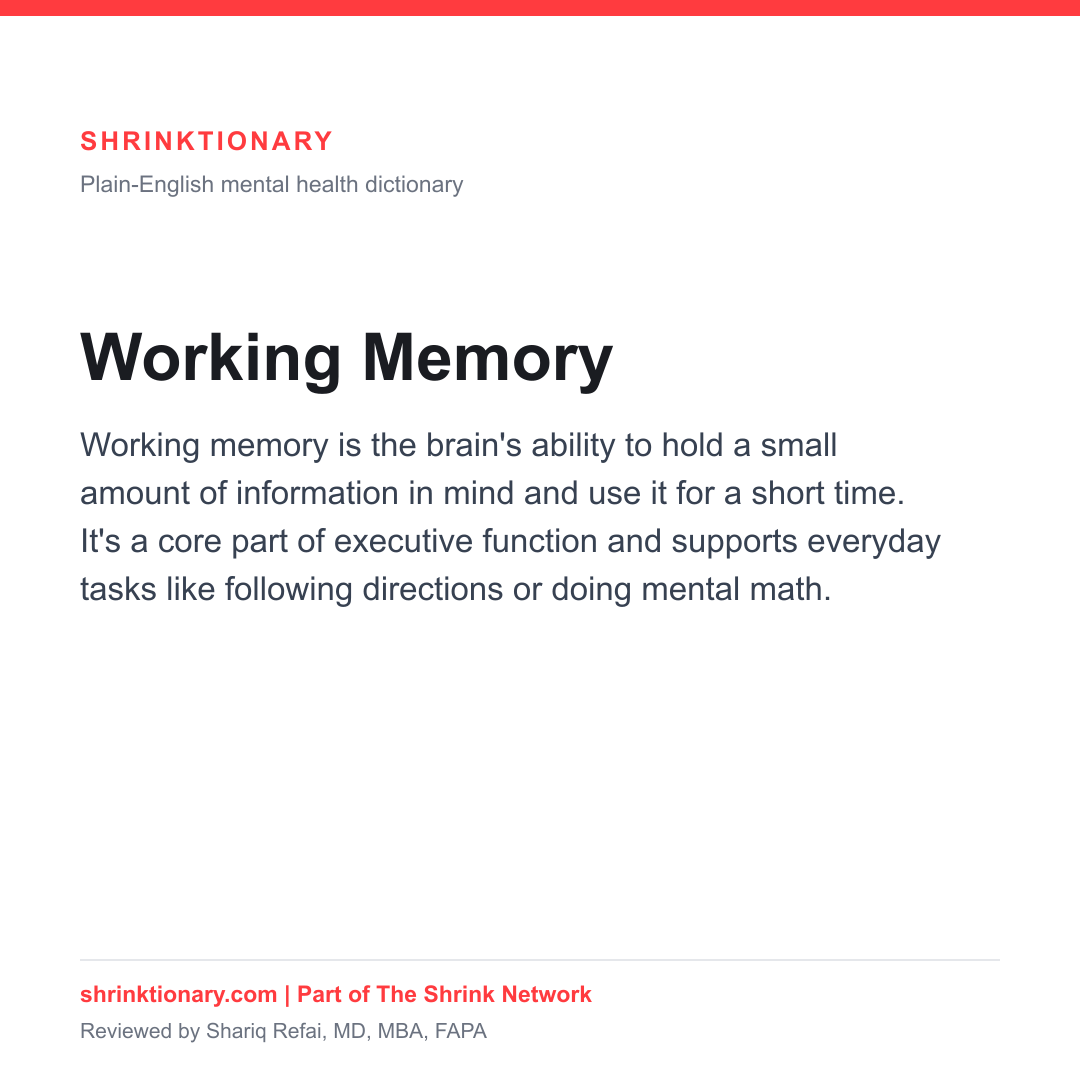
Working memory is the mental workspace where you hold information just long enough to use it. When you keep a phone number in mind while you dial, follow a set of spoken directions, or track the steps of a math problem in your head, you’re using working memory.
It’s closely tied to executive function, the set of mental skills that help you plan, focus, and manage tasks. Working memory has limited capacity. Most people can hold only a few items at once, and the information fades quickly unless they keep refreshing it or write it down.
What working memory can feel like in practice
Strong working memory feels like being able to keep your place in a task even when something interrupts you. You can hold a question in mind while listening to the answer, or remember the first half of an instruction while hearing the second half.
When working memory is strained, things slip. You walk into a room and forget why. You lose track mid-sentence. You reread the same paragraph because the earlier lines already faded. Conditions like ADHD, high stress, poor sleep, and aging can all reduce how well working memory holds up, which is why busy or tired people often feel scattered.
What working memory isn’t
Working memory isn’t the same as long-term memory. Long-term memory stores information for days, years, or a lifetime. Working memory holds information for seconds and then lets it go. The two systems work together but do different jobs.
It also isn’t a measure of intelligence or character. A person can be bright and capable and still have limited working memory, especially under stress. Forgetting a step in the moment is a feature of how this system works, not a sign of carelessness.
Related terms you’ll see next
Executive function is the larger set of skills that working memory belongs to. ADHD often involves working memory difficulties. Cognitive distortion describes a different kind of thinking pattern that therapy can target.
When to seek professional care
Occasional lapses in working memory are normal, especially when you’re tired or stressed. If memory and focus problems are persistent, getting worse, or interfering with work, school, or daily life, it’s worth talking with a clinician. They can look at what’s contributing, from sleep and mood to attention conditions, and suggest practical steps or further evaluation.
When this word matters
Working memory is the mental workspace for holding information just long enough to use it, and trouble with it becomes worth attention when it gets in the way of work, school, or following directions. Weak working memory shows up in ADHD, depression, anxiety, and brain fog, and it's a core part of executive function.
Commonly confused with
Frequently asked questions
What is the difference between working memory and long-term memory?
Long-term memory stores information for days, years, or a lifetime, while working memory holds information for only seconds and then lets it go. The two systems work together but do different jobs.
What weakens working memory?
Conditions like ADHD, high stress, poor sleep, and aging can all reduce how well working memory holds up, which is why busy or tired people often feel scattered.
Does poor working memory mean low intelligence?
No. Working memory isn't a measure of intelligence or character. A person can be bright and capable and still have limited working memory, especially under stress, and forgetting a step in the moment is a feature of how the system works.
Related terms
Compare
Sources
- Executive Function & Self-Regulation , Harvard Center on the Developing Child
- Memory , MedlinePlus (U.S. National Library of Medicine)
Use or cite this definition
Free to reuse with attribution. Paste the block into your own page, or grab a citation.
Embed on your site
<blockquote>
<p><strong>Working Memory:</strong> Working memory is the brain's ability to hold a small amount of information in mind and use it for a short time. It's a core part of executive function and supports everyday tasks like following directions or doing mental math.</p>
<p>— <a href="https://shrinktionary.com/terms/working-memory/">Shrinktionary</a>, a plain-English mental health dictionary, medically reviewed by a board certified psychiatrist.</p>
</blockquote>Cite (APA)
Refai, S. (2026). Working Memory. Shrinktionary. https://shrinktionary.com/terms/working-memory/
Cite (MLA)
"Working Memory." Shrinktionary, https://shrinktionary.com/terms/working-memory/. Accessed September 26, 2026.
Your next step in The Shrink Network
You are here: Shrinktionary, the language layer of The Shrink Network.
Each site in the network has one job. No matter where you enter, we help you find the next step that makes sense.
Want to understand more first?
See how this connects to everything else in the Term Web →
Take it with you
Free printable references you can save or share. For education, not medical advice.