What a Hallucination actually is
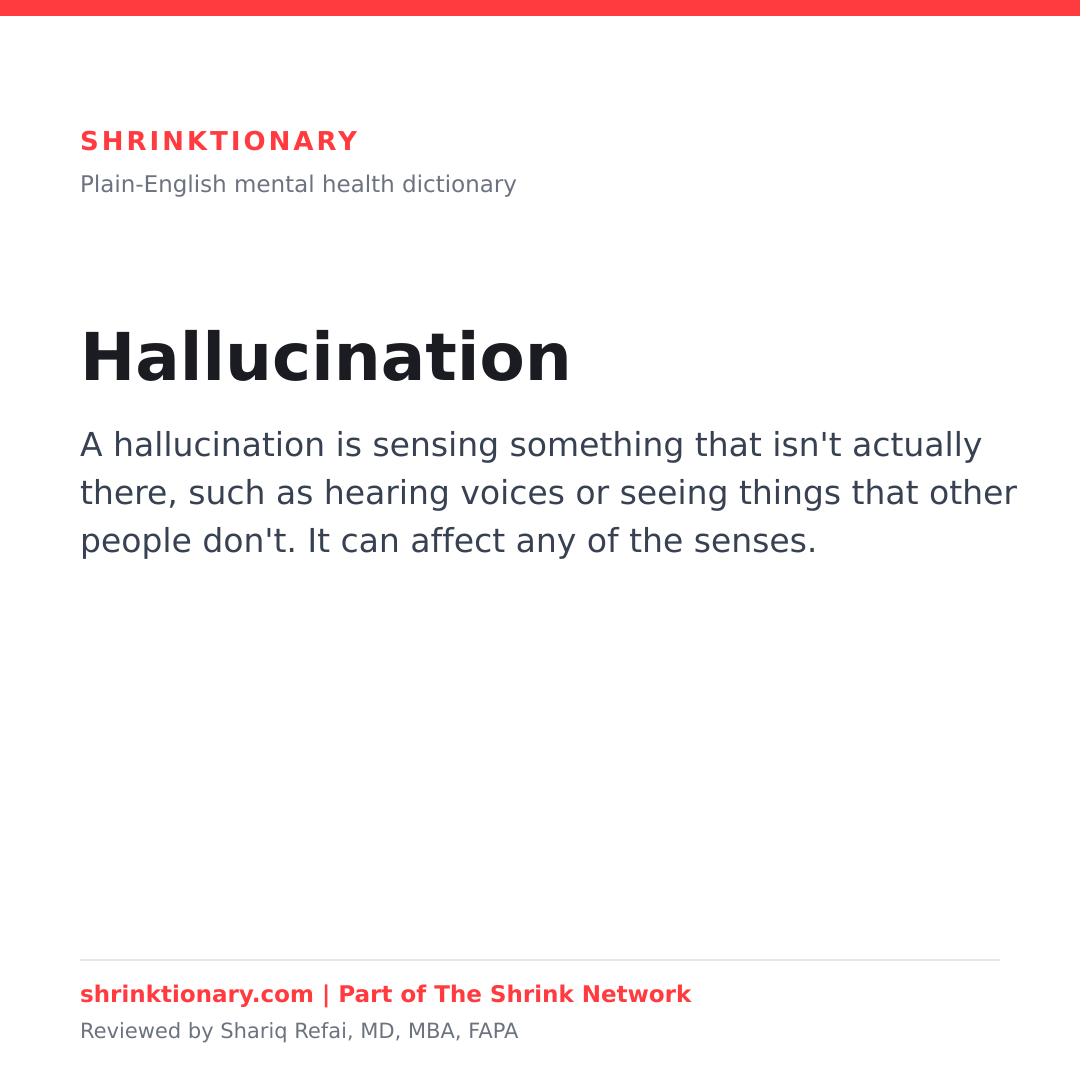
A hallucination is a sensory experience that feels real but isn’t actually happening in the outside world. The brain produces a sight, sound, smell, taste, or physical sensation without any matching source. Hearing voices when no one is speaking is the most common type.
Hallucinations can affect any of the senses. A person might hear sounds, see shapes or people, smell odors, taste things, or feel sensations on the skin that others don’t share. They can be a symptom of conditions like schizophrenia or bipolar disorder, but they can also come from sleep deprivation, high fever, certain medications, substance use, or some medical conditions.
What a Hallucination can feel like
To the person having it, a hallucination usually feels completely real. A voice can sound as clear as someone talking in the room. This is part of what makes the experience so distressing, because there’s no obvious way to tell from the inside that it isn’t real.
Hallucinations can range from neutral to frightening. Some voices comment or repeat phrases. Others may be critical or commanding. The experience can be confusing and exhausting, and people often feel alone with it, unsure whether to tell anyone what’s happening.
What a Hallucination isn’t
It isn’t the same as imagination, a daydream, or a vivid memory, all of which a person knows are happening only in their mind. A hallucination is experienced as coming from the outside world.
It also isn’t the same as a delusion. A hallucination is a false perception, something a person senses. A delusion is a false belief, something a person thinks is true. The two can occur together, but they’re different symptoms.
Related terms you’ll see next
When to seek professional care
Hallucinations are a reason to seek a professional evaluation, especially if they’re new, ongoing, or distressing. A doctor or mental health professional can help find the cause, which is important because the right treatment depends on what’s behind them.
If a hallucination involves commands to harm yourself or others, or if there’s any immediate danger, call 911 or go to the nearest emergency room. In the US, you can also call or text 988 any time to reach the Suicide and Crisis Lifeline. Help is available, and many causes of hallucinations respond well to treatment.
When this word matters
A hallucination becomes clinically meaningful when it's new, persistent, or distressing, since it can signal conditions like schizophrenia or bipolar disorder, or causes like sleep deprivation, fever, or substance use. Any voices commanding harm are an emergency.
Commonly confused with
Frequently asked questions
What is a hallucination?
A hallucination is a sensory experience that feels real but isn't actually happening in the outside world. The brain produces a sight, sound, smell, taste, or physical sensation without any matching source, and hearing voices when no one is speaking is the most common type.
What can cause hallucinations?
They can be a symptom of conditions like schizophrenia or bipolar disorder, but they can also come from sleep deprivation, high fever, certain medications, substance use, or some medical conditions. Because there are many possible causes, a professional evaluation matters, since the right treatment depends on what's behind them.
What's the difference between a hallucination and a delusion?
A hallucination is a false perception, something a person senses, while a delusion is a false belief, something a person thinks is true. The two can occur together, but they're different symptoms.
Related terms
In these language clusters
Compare
Sources
- Schizophrenia , National Institute of Mental Health
- Hallucinations , MedlinePlus
Use or cite this definition
Free to reuse with attribution. Paste the block into your own page, or grab a citation.
Embed on your site
<blockquote>
<p><strong>Hallucination:</strong> A hallucination is sensing something that isn't actually there, such as hearing voices or seeing things that other people don't. It can affect any of the senses.</p>
<p>— <a href="https://shrinktionary.com/terms/hallucination/">Shrinktionary</a>, a plain-English mental health dictionary, medically reviewed by a board certified psychiatrist.</p>
</blockquote>Cite (APA)
Refai, S. (2026). Hallucination. Shrinktionary. https://shrinktionary.com/terms/hallucination/
Cite (MLA)
"Hallucination." Shrinktionary, https://shrinktionary.com/terms/hallucination/. Accessed September 26, 2026.
Your next step in The Shrink Network
You are here: Shrinktionary, the language layer of The Shrink Network.
Each site in the network has one job. No matter where you enter, we help you find the next step that makes sense.
Want to understand more first?
See how this connects to everything else in the Term Web →
Take it with you
Free printable references you can save or share. For education, not medical advice.