What an intrusive thought actually is
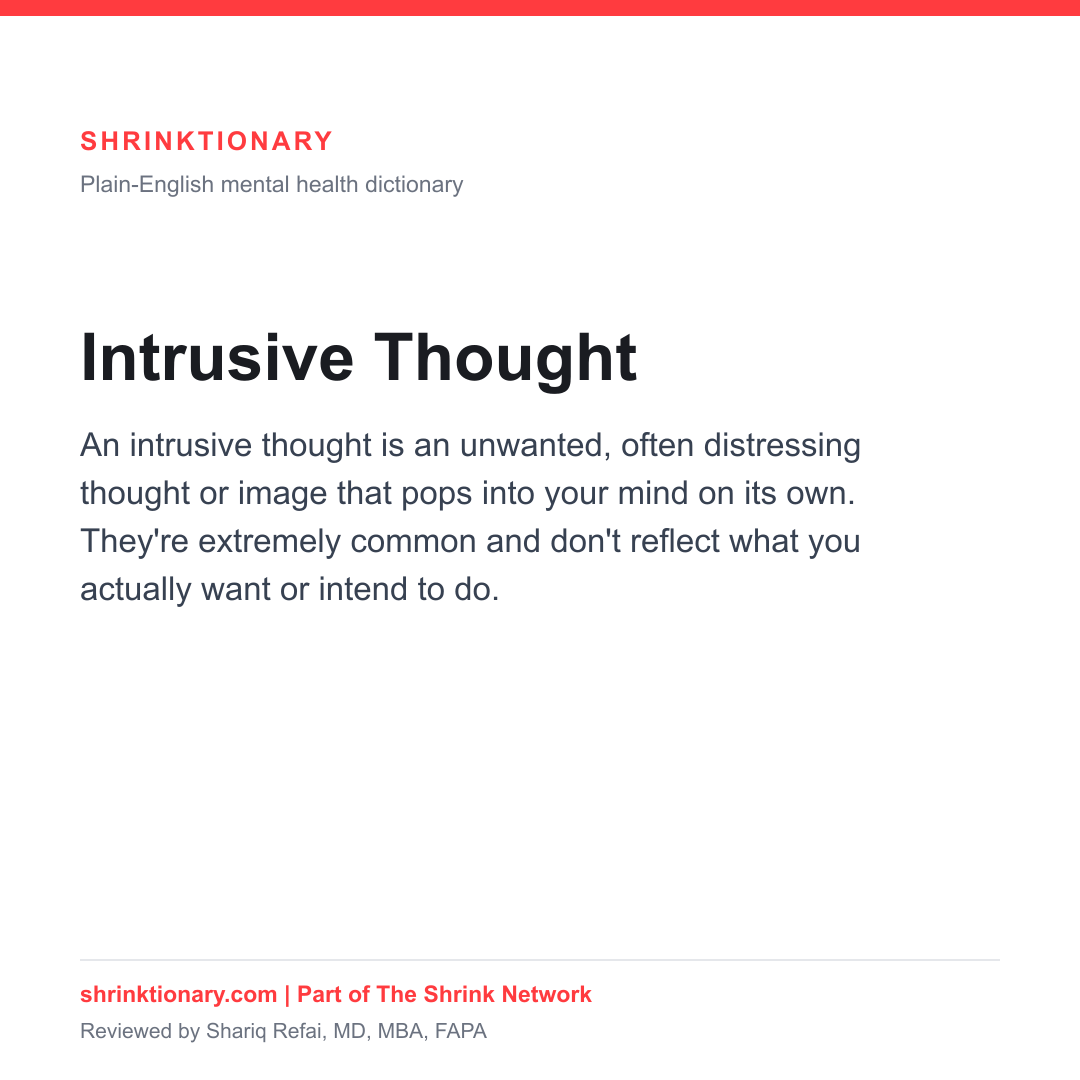
An intrusive thought is a thought or mental image that shows up uninvited, usually feels distressing or disturbing, and runs against what the person actually values. It might be a sudden violent picture, a taboo idea, a fear of having done something wrong, or a worry that feels both alarming and out of character.
Here’s the part that surprises most people: intrusive thoughts are extremely common. Surveys find that the large majority of people have them. The brain throws up all kinds of content, and a passing strange thought is just mental noise, not a message about who you are.
What turns a normal blip into a problem is how much weight a person gives it. When someone treats the thought as meaningful and tries hard to suppress or neutralize it, the thought tends to stick around and grow louder.
What an intrusive thought can feel like
Intrusive thoughts often feel jarring precisely because they clash with a person’s character. A gentle person might get a flash of harming someone. A devoted parent might picture something terrible happening to their child. The distress is a sign the thought matters to them in the wrong direction, not the right one.
People often describe a spike of fear, followed by a frantic urge to make the thought go away or to prove to themselves it isn’t true. That urge to check, reassure, or push the thought down is the engine that keeps the cycle running.
What an intrusive thought isn’t
An intrusive thought isn’t a hidden wish or a sign of intent. Having a thought is not the same as wanting it, agreeing with it, or being likely to act on it. The repulsion most people feel toward these thoughts is exactly the opposite of desire.
It also isn’t a sign that something is deeply wrong with you. Intrusive thoughts are a normal feature of the human mind. They become a clinical concern, often connected to OCD or anxiety, when they’re frequent, intense, and drive compulsions or avoidance that eat up time and distress.
Related terms you’ll see next
When to seek professional care
A stray unwanted thought now and then doesn’t need treatment. It’s worth professional attention when intrusive thoughts become frequent and intense, when they trigger rituals or avoidance, or when they take up significant time and cause real distress. These are common features of OCD and anxiety disorders, both of which respond well to therapy.
Approaches like cognitive behavioral therapy and exposure-based therapy can help people relate to these thoughts differently, so they lose their grip. If intrusive thoughts ever include urges to harm yourself, reach out for help right away. If you’re in crisis, call or text 988 in the United States.
When this word matters
A stray intrusive thought is normal and extremely common, but it becomes a clinical concern when thoughts are frequent and intense and drive compulsions or avoidance that eat up time and distress. That pattern is often connected to OCD or anxiety.
Commonly confused with
Frequently asked questions
Are intrusive thoughts normal?
Yes. Intrusive thoughts are extremely common, and surveys find the large majority of people have them. A passing strange thought is just mental noise, not a message about who you are.
Do intrusive thoughts mean I secretly want to act on them?
No. An intrusive thought isn't a hidden wish or a sign of intent. Having a thought is not the same as wanting it, and the repulsion most people feel toward these thoughts is the opposite of desire.
When do intrusive thoughts become a problem?
They become a clinical concern, often connected to OCD or anxiety, when they're frequent and intense, trigger rituals or avoidance, and take up significant time and cause real distress. Both conditions respond well to therapy.
Related terms
In these language clusters
Compare
Sources
- Obsessive-Compulsive Disorder (OCD) , National Institute of Mental Health
- Anxiety Disorders , American Psychiatric Association
Use or cite this definition
Free to reuse with attribution. Paste the block into your own page, or grab a citation.
Embed on your site
<blockquote>
<p><strong>Intrusive Thought:</strong> An intrusive thought is an unwanted, often distressing thought or image that pops into your mind on its own. They're extremely common and don't reflect what you actually want or intend to do.</p>
<p>— <a href="https://shrinktionary.com/terms/intrusive-thought/">Shrinktionary</a>, a plain-English mental health dictionary, medically reviewed by a board certified psychiatrist.</p>
</blockquote>Cite (APA)
Refai, S. (2026). Intrusive Thought. Shrinktionary. https://shrinktionary.com/terms/intrusive-thought/
Cite (MLA)
"Intrusive Thought." Shrinktionary, https://shrinktionary.com/terms/intrusive-thought/. Accessed September 26, 2026.
Your next step in The Shrink Network
You are here: Shrinktionary, the language layer of The Shrink Network.
Each site in the network has one job. No matter where you enter, we help you find the next step that makes sense.
Want to understand more first?
See how this connects to everything else in the Term Web →
Take it with you
Free printable references you can save or share. For education, not medical advice.