What worry actually is
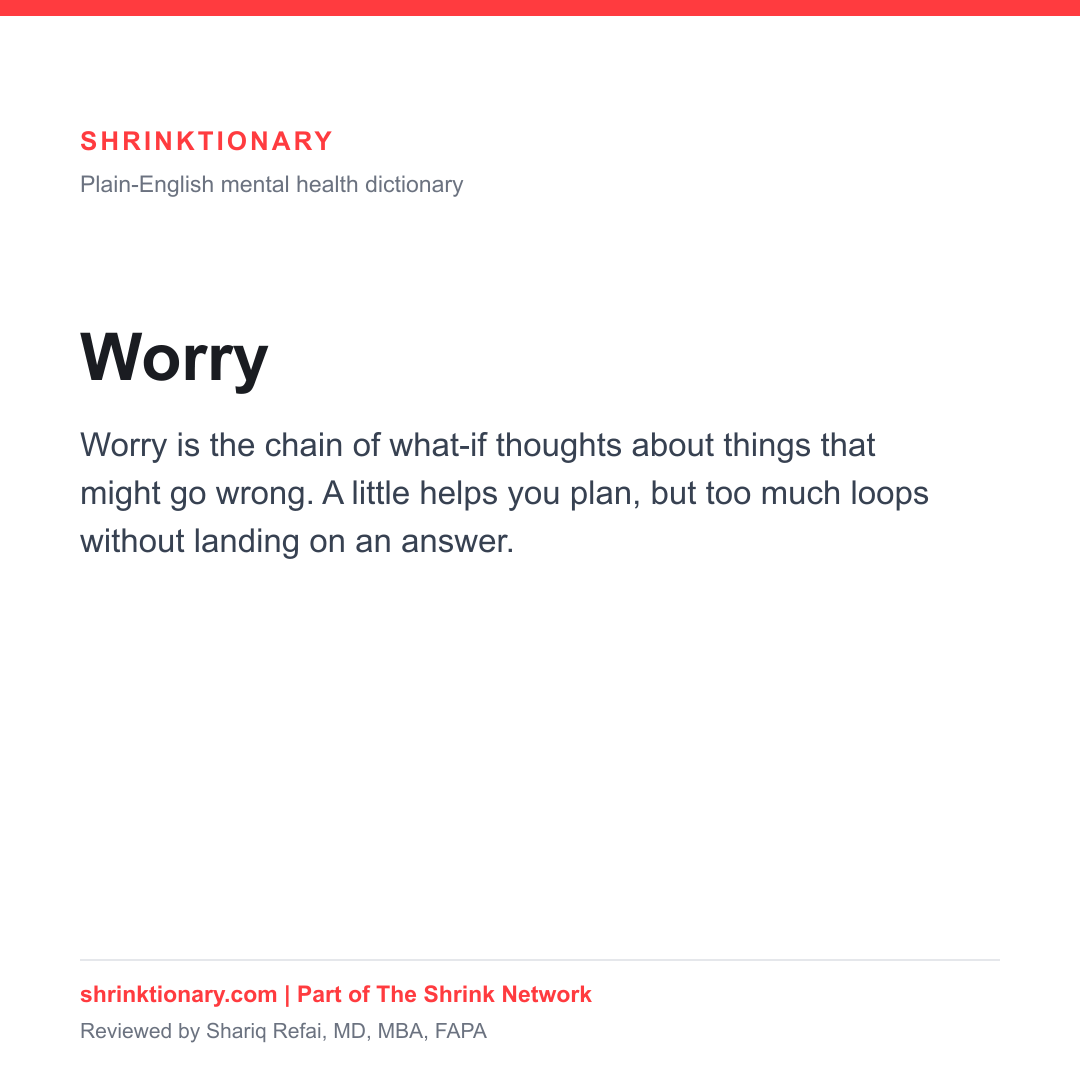
Worry is the mind’s way of turning toward something that might go wrong. It’s the run of “what if” thoughts about the future, played out in words you can almost hear in your head. A certain amount is useful, and it’s how you plan, prepare, and catch problems before they arrive. Worry is a normal part of being human, not a disorder on its own.
The trouble starts when worry stops doing its job. Useful worry lands on a plan and lets go. Unhelpful worry loops, jumps from one topic to the next, and keeps running long after the thinking has stopped paying off.
What worry can feel like
From the inside, worry feels like a mind that won’t sit still. One concern hands off to the next, and each answer just raises another question. It often shows up worst at night, when there’s nothing left to do about the thing you’re turning over. Many people describe a background hum of “I’m forgetting something” or “something bad is coming,” even when the day is going fine.
Worry usually travels with body signals too, like a tight chest, a clenched jaw, or a stomach that won’t settle. That’s the overlap with anxiety, where the thinking and the body’s alarm feed each other.
What worry isn’t
Worry isn’t the same as anxiety, even though people use the words interchangeably. Anxiety is the body’s alarm response, and worry is the thinking that can set it off or keep it going. Worry also isn’t rumination, which faces backward and replays what already happened. Worry faces forward, bracing for what might.
And worry isn’t a character flaw or a failure of willpower. Telling a worrier to “just stop” rarely works, because the loop isn’t really a choice. It’s a habit the brain has learned, and it responds far better to skills than to scolding.
Related terms you’ll see next
Worry sits close to overthinking, catastrophizing, which is jumping straight to the worst case, and rumination. When it runs most days and won’t switch off, it can point toward generalized anxiety disorder. It’s worth seeing how it lines up against its neighbors in worry vs rumination and stress vs anxiety vs worry.
When to seek professional care
Worry crosses into something worth treating when it’s excessive, hard to control, and running most days for six months or more, and when it starts costing you sleep, focus, or peace of mind. That pattern is the core of generalized anxiety disorder, which responds well to therapy and, for some people, medication. If your worry is steering your days rather than helping you plan them, a clinician can help you find the right place to start.
If you’d like somewhere to begin on your own, try the Anxiety Reset, a psychiatrist-designed guide to calming chronic worry on shrinkMD. shrinkMD is part of The Shrink Network, founded by Shariq Refai, MD.
When this word matters
Worry matters when it's excessive, hard to control, and running most days for six months or more, costing you sleep, focus, or calm. That persistent, hard-to-switch-off pattern is the core of generalized anxiety disorder.
Commonly confused with
Frequently asked questions
Is worrying a mental illness?
No. Worry is a normal, universal part of being human, and in small amounts it helps you plan and prepare. It only starts to look like a disorder, usually generalized anxiety disorder, when it's excessive, hard to control, and running most days for six months or more while getting in the way of daily life.
What's the difference between worry and anxiety?
Worry is the thinking, the chain of what-if thoughts in your head. Anxiety is the body's alarm response, like a racing heart and tight chest. They feed each other, but they start in different places, which is why the fixes are different.
How do I stop worrying so much?
You usually can't force worry to switch off, and trying tends to make it louder. What helps is changing what you do with the thinking, like setting aside a short worry time, testing whether the thought is realistic, or grounding yourself in the moment. If worry is running your days, a therapist can teach these skills directly, and approaches like CBT are well studied for it.
Related terms
In these language clusters
Compare
Sources
- Anxiety Disorders , National Institute of Mental Health
- Anxiety , MedlinePlus, U.S. National Library of Medicine
- What's the difference between stress and anxiety? , American Psychological Association
Use or cite this definition
Free to reuse with attribution. Paste the block into your own page, or grab a citation.
Embed on your site
<blockquote>
<p><strong>Worry:</strong> Worry is the chain of what-if thoughts about things that might go wrong. A little helps you plan, but too much loops without landing on an answer.</p>
<p>— <a href="https://shrinktionary.com/terms/worry/">Shrinktionary</a>, a plain-English mental health dictionary, medically reviewed by a board certified psychiatrist.</p>
</blockquote>Cite (APA)
Refai, S. (2026). Worry. Shrinktionary. https://shrinktionary.com/terms/worry/
Cite (MLA)
"Worry." Shrinktionary, https://shrinktionary.com/terms/worry/. Accessed September 29, 2026.
Your next step in The Shrink Network
You are here: Shrinktionary, the language layer of The Shrink Network.
Each site in the network has one job. No matter where you enter, we help you find the next step that makes sense.
Want to understand more first?
See how this connects to everything else in the Term Web →
Take it with you
Free printable references you can save or share. For education, not medical advice.