What psychomotor agitation actually is
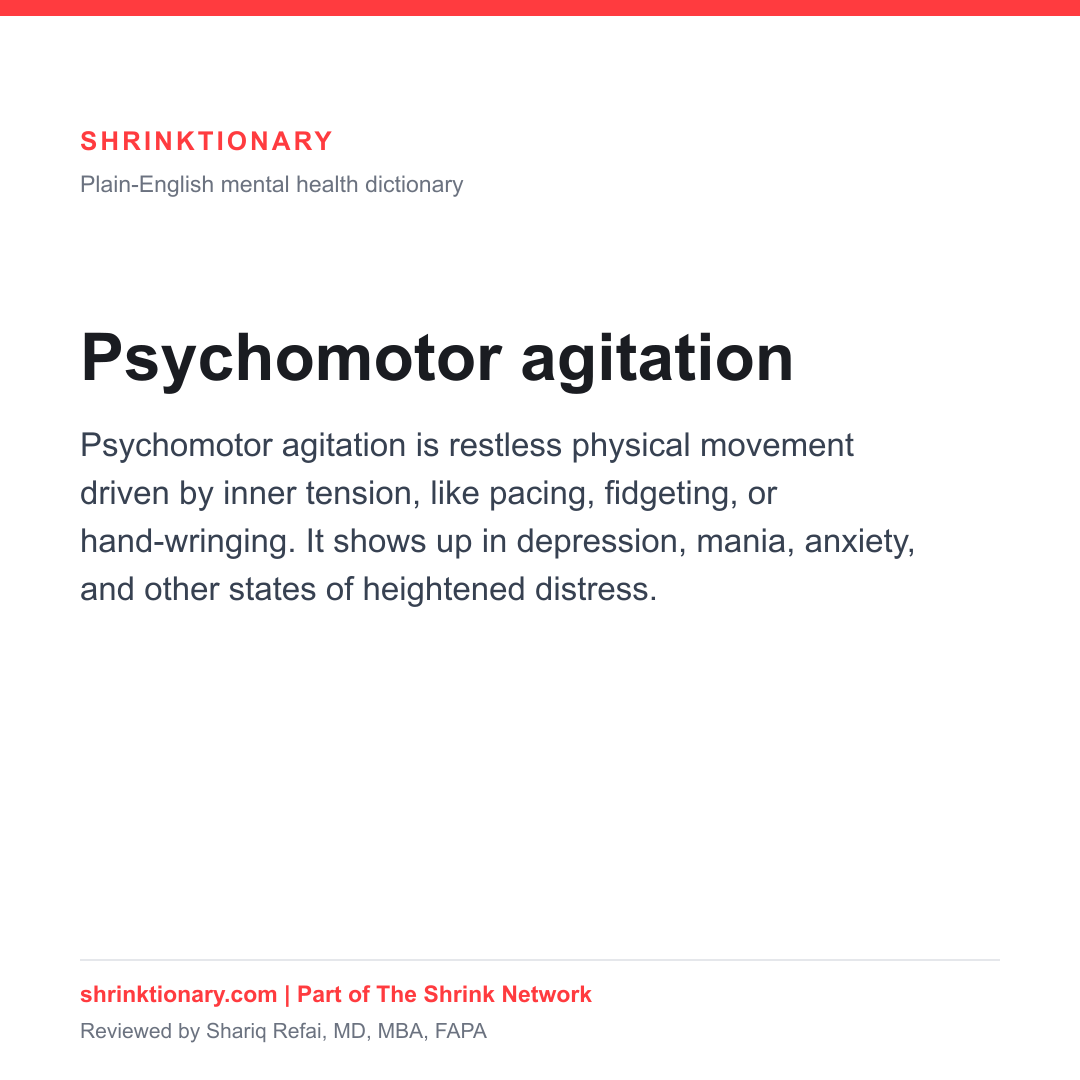
Psychomotor agitation is excess physical movement that springs from inner tension rather than from any useful purpose. The term joins two ideas. Psycho points to the mind, and motor points to movement. Put together, it names the way internal distress spills out into the body as restless, repetitive activity.
The movements are typically purposeless or only loosely tied to a goal. Pacing back and forth, wringing the hands, fidgeting, tapping, shifting position, picking at clothing or skin, and being unable to sit still are common forms. The person isn’t moving to get something done. The body is discharging unease.
Clinicians treat psychomotor agitation as a symptom rather than a diagnosis. It can appear in a depressive episode, in mania, in anxiety, in psychosis, during withdrawal from certain substances, and in medical conditions such as delirium. Its opposite, psychomotor retardation, is a slowing of movement and thought that can also appear in depression.
What psychomotor agitation can feel like
From the inside, people often describe a buzzing or churning sensation, a sense that they have to move even when there’s nowhere to go and nothing to do. Sitting still feels intolerable. The restlessness can be accompanied by racing thoughts, irritability, and a feeling of being wound too tight.
From the outside, others may notice the constant motion before anything else. The pacing that doesn’t stop. The leg that won’t hold still. The hands that keep moving. In more intense states, the agitation can build toward distress that’s visible and hard for the person to contain.
Because the same outward picture can come from very different causes, context matters. Agitation in a depressive episode points one direction. Agitation with elevated mood and little need for sleep points toward mania. Agitation that comes on suddenly with confusion can signal a medical emergency such as delirium.
What psychomotor agitation isn’t
Psychomotor agitation isn’t ordinary fidgeting or having a lot of energy. The defining feature is that the movement is driven by inner distress and tends to come with other signs of a heightened or disturbed state. A restless habit on its own isn’t the same thing.
It also isn’t akathisia, though the two can look alike. Akathisia is a specific kind of inner restlessness and urge to move that’s usually caused by certain medications, especially antipsychotics. Sorting the two apart matters, because the treatment is different.
Related terms you’ll see next
Agitation is the broader state of inner tension and restlessness that psychomotor agitation expresses physically. Psychomotor retardation is its slowed-down counterpart. Akathisia is a medication-related form of restlessness that can be mistaken for it.
When to seek professional care
New or worsening psychomotor agitation deserves attention, especially when it comes with changes in mood, sleep, or thinking. If it appears suddenly along with confusion, fever, or disorientation, that can signal a medical emergency and warrants urgent care. When agitation is part of depression, mania, or anxiety, a clinician can identify the cause and target treatment accordingly. If agitation comes with thoughts of harming yourself or others, seek help right away.
When this word matters
It matters when restless, purposeless movement is new or worsening and comes with changes in mood, sleep, or thinking. If it appears suddenly along with confusion, fever, or disorientation, that can signal a medical emergency such as delirium and warrants urgent care.
Commonly confused with
Frequently asked questions
What is psychomotor agitation?
Psychomotor agitation is excess physical movement driven by inner tension rather than purpose. Pacing, hand-wringing, fidgeting, and being unable to sit still are common forms. It's a symptom that can appear in depression, mania, anxiety, and other states.
What's the difference between psychomotor agitation and akathisia?
They can look alike, but akathisia is a specific inner restlessness and urge to move usually caused by certain medications, especially antipsychotics. Sorting the two apart matters because the treatment is different.
Is psychomotor agitation a medical emergency?
Not always, but it can be. If agitation comes on suddenly with confusion, fever, or disorientation, that can signal a medical emergency such as delirium and warrants urgent care. Agitation with thoughts of harm also needs help right away.
Related terms
In these language clusters
Sources
- Depression , National Institute of Mental Health
- Psychomotor Agitation , StatPearls (NCBI Bookshelf)
Use or cite this definition
Free to reuse with attribution. Paste the block into your own page, or grab a citation.
Embed on your site
<blockquote>
<p><strong>Psychomotor agitation:</strong> Psychomotor agitation is restless physical movement driven by inner tension, like pacing, fidgeting, or hand-wringing. It shows up in depression, mania, anxiety, and other states of heightened distress.</p>
<p>— <a href="https://shrinktionary.com/terms/psychomotor-agitation/">Shrinktionary</a>, a plain-English mental health dictionary, medically reviewed by a board certified psychiatrist.</p>
</blockquote>Cite (APA)
Refai, S. (2026). Psychomotor agitation. Shrinktionary. https://shrinktionary.com/terms/psychomotor-agitation/
Cite (MLA)
"Psychomotor agitation." Shrinktionary, https://shrinktionary.com/terms/psychomotor-agitation/. Accessed September 26, 2026.
Your next step in The Shrink Network
You are here: Shrinktionary, the language layer of The Shrink Network.
Each site in the network has one job. No matter where you enter, we help you find the next step that makes sense.
Want to understand more first?
See how this connects to everything else in the Term Web →
Take it with you
Free printable references you can save or share. For education, not medical advice.