What a Delusion actually is
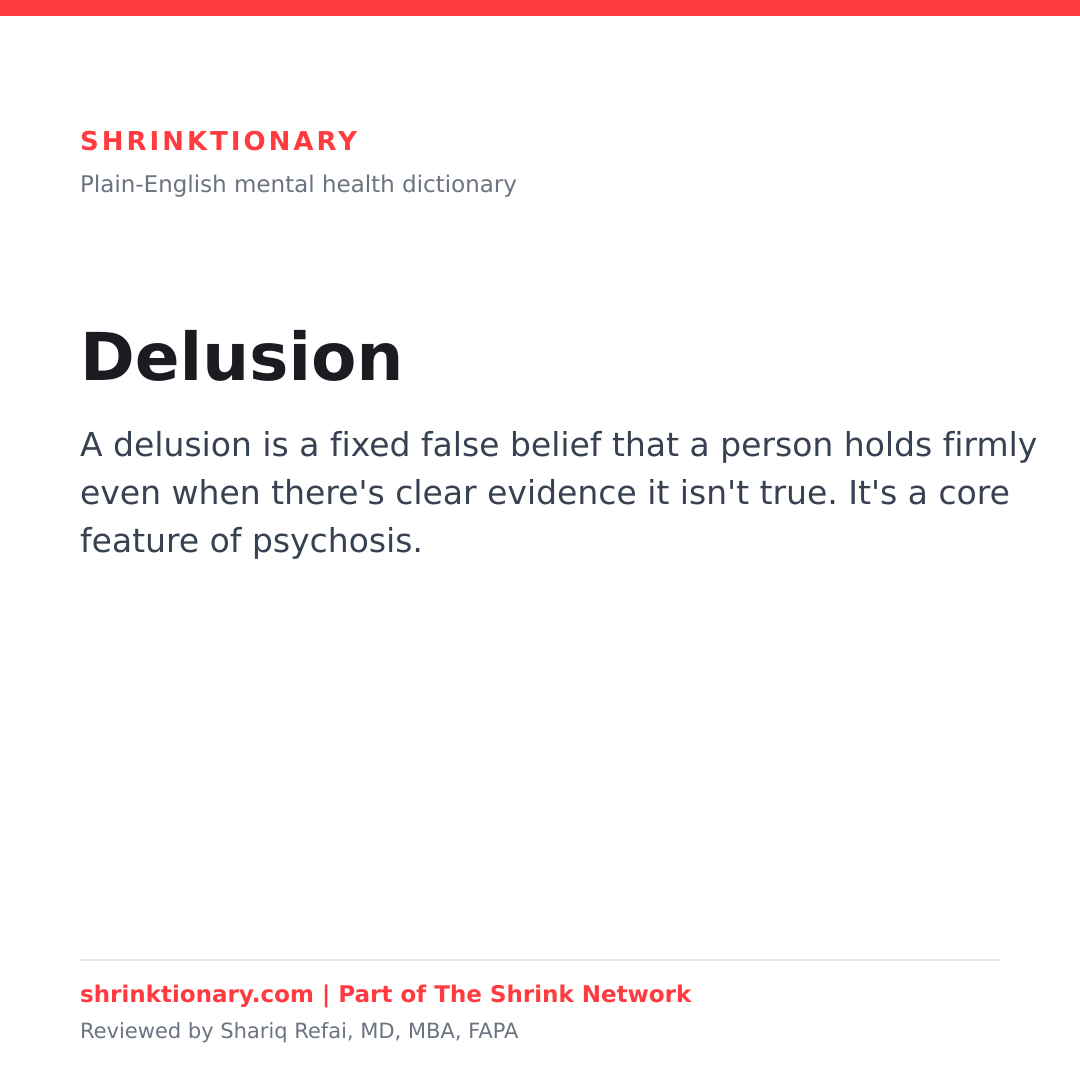
A delusion is a belief that a person holds onto firmly, even though it’s clearly not true and there’s strong evidence against it. The belief doesn’t budge with logic, facts, or the views of others. It’s one of the central features of psychosis.
Delusions come in different forms. Some are paranoid, like believing others are plotting harm. Some are grandiose, like believing one has special powers or importance. Others involve beliefs about the body, about being controlled, or about hidden meanings in everyday events. Delusions can appear in schizophrenia, bipolar disorder, severe depression, and some medical or substance-related conditions.
What a Delusion can feel like
From the inside, a delusion doesn’t feel like a false belief at all. It feels like an obvious truth. That’s what sets it apart and what makes it so hard to talk a person out of it. To them, the belief explains things that feel real and pressing.
For the person and those around them, delusions can be distressing and isolating. The gap between what the person believes and what others see can strain trust and relationships. The person may feel misunderstood or convinced that others just don’t see what’s really going on.
What a Delusion isn’t
It isn’t simply being wrong about something or holding an unusual opinion. People change ordinary beliefs when given good evidence. A delusion stays fixed even when the facts clearly contradict it.
It also isn’t the same as a hallucination. A delusion is a false belief, a matter of thinking. A hallucination is a false perception, a matter of sensing. A strongly held cultural or religious belief shared by a person’s community is not a delusion either.
Related terms you’ll see next
When to seek professional care
Fixed false beliefs that don’t respond to evidence are a reason to seek a professional evaluation, especially when they cause distress or affect safety and daily life. A mental health professional can help identify the cause and discuss treatment.
If a delusion leads to thoughts of harming yourself or others, or if there’s any immediate danger, call 911 or go to the nearest emergency room. In the US, you can also call or text 988 any time to reach the Suicide and Crisis Lifeline. Delusions often improve with treatment, so reaching out matters.
When this word matters
It becomes clinically meaningful when a fixed false belief is held firmly despite clear evidence against it, which is a core feature of psychosis seen in schizophrenia and sometimes in severe mania or depression. It's distinct from a hallucination, which is a false perception rather than a belief.
Commonly confused with
Frequently asked questions
What is a delusion?
A delusion is a belief a person holds onto firmly even though it's clearly not true and there's strong evidence against it. The belief doesn't budge with logic, facts, or the views of others, and it's one of the central features of psychosis.
What's the difference between a delusion and a hallucination?
A delusion is a false belief, a matter of thinking, while a hallucination is a false perception, a matter of sensing. The two can occur together, but they're different symptoms.
What can cause delusions?
Delusions can appear in schizophrenia, bipolar disorder, severe depression, and some medical or substance-related conditions. Because there are many possible causes, fixed false beliefs that don't respond to evidence deserve a professional evaluation, especially when they cause distress or affect safety, and many causes improve with treatment.
Related terms
In these language clusters
Compare
Sources
- Schizophrenia , National Institute of Mental Health
- Schizophrenia , MedlinePlus
Use or cite this definition
Free to reuse with attribution. Paste the block into your own page, or grab a citation.
Embed on your site
<blockquote>
<p><strong>Delusion:</strong> A delusion is a fixed false belief that a person holds firmly even when there's clear evidence it isn't true. It's a core feature of psychosis.</p>
<p>— <a href="https://shrinktionary.com/terms/delusion/">Shrinktionary</a>, a plain-English mental health dictionary, medically reviewed by a board certified psychiatrist.</p>
</blockquote>Cite (APA)
Refai, S. (2026). Delusion. Shrinktionary. https://shrinktionary.com/terms/delusion/
Cite (MLA)
"Delusion." Shrinktionary, https://shrinktionary.com/terms/delusion/. Accessed September 26, 2026.
Your next step in The Shrink Network
You are here: Shrinktionary, the language layer of The Shrink Network.
Each site in the network has one job. No matter where you enter, we help you find the next step that makes sense.
Want to understand more first?
See how this connects to everything else in the Term Web →
Take it with you
Free printable references you can save or share. For education, not medical advice.