What hyperarousal actually is
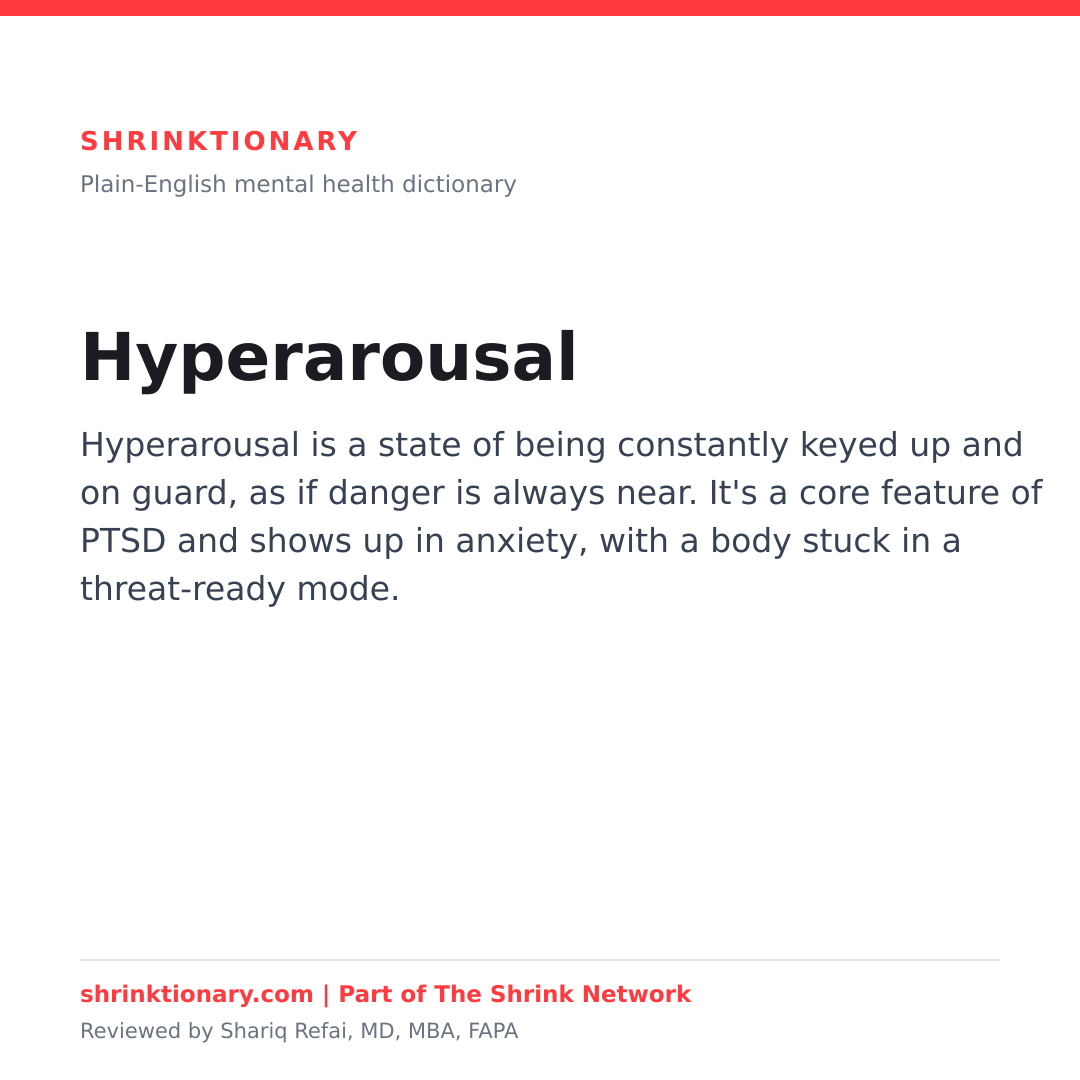
Hyperarousal is a sustained state of heightened alertness in which the body and mind stay primed for threat. The nervous system, which is built to ramp up in a moment of danger and then settle back down, gets stuck in the ramped-up position. The result is a person who is keyed up much of the time, even when nothing dangerous is happening.
It’s one of the core symptom clusters of post-traumatic stress disorder. After trauma, the brain’s alarm system can recalibrate so that it treats more situations as dangerous and stays switched on long after the threat has passed. Hyperarousal is the everyday cost of that recalibration, a body that won’t stand down.
The state is driven largely by the sympathetic nervous system, the same fight-or-flight machinery that floods the body with stress hormones in an emergency. In hyperarousal, that response fires too easily and too often, so a person carries a baseline of physical readiness that’s exhausting to maintain.
What hyperarousal can feel like
People describe being constantly on edge, unable to relax even in safe settings. They startle easily, jumping at sudden sounds or movements. Sleep is often disrupted, since it’s hard to let the guard down enough to rest. Concentration suffers because attention keeps scanning for threats. Irritability is common, with a short fuse and outbursts that feel out of proportion.
Physically, hyperarousal can show up as a racing heart, muscle tension, sweating, and a sense of being wired. The body behaves as if an emergency is underway, which over time wears a person down. Many people with hyperarousal also have hypervigilance, an intense watchfulness that keeps scanning the environment for danger.
Although hyperarousal is central to PTSD, it also appears in anxiety disorders, in acute stress, and in some other conditions that crank up the stress response. The trigger and the surrounding pattern help point to the cause.
What hyperarousal isn’t
Hyperarousal isn’t ordinary nervousness before a stressful event, and it isn’t just being a high-energy or alert person. It’s a persistent state of threat readiness that doesn’t match the actual level of safety, and it usually takes a toll on sleep, concentration, mood, and the body.
It also isn’t overreacting on purpose or a failure of willpower. The startle responses, the irritability, the inability to relax, these come from a nervous system that has shifted its settings, often after trauma or prolonged stress. Telling someone to simply calm down misunderstands what’s happening inside them.
Related terms you’ll see next
Hypervigilance is the watchful scanning that usually travels with hyperarousal. Fight or flight is the underlying stress response that hyperarousal keeps switched on. PTSD is the condition where hyperarousal is a defining feature.
When to seek professional care
If you feel constantly on guard, startle easily, struggle to sleep, or stay wired in situations that are actually safe, and this has lasted beyond the aftermath of a stressful event, a professional evaluation is appropriate. Hyperarousal is treatable. Trauma-focused therapies and other approaches can help the nervous system learn to stand down. If it follows a traumatic event and is disrupting daily life, earlier care tends to help.
When this word matters
It matters when a person stays keyed up and on guard in situations that are actually safe, with the state lasting beyond the aftermath of a stressful event. As a core PTSD symptom, persistent hyperarousal that disrupts sleep, concentration, or mood is a sign that a professional evaluation is appropriate.
Commonly confused with
Frequently asked questions
What is hyperarousal?
Hyperarousal is a sustained state of being keyed up and on guard, as if danger is always near. The nervous system, built to ramp up in an emergency and then settle, gets stuck in the ramped-up position. It's a core feature of PTSD.
What are the signs of hyperarousal?
Common signs include feeling constantly on edge, startling easily, trouble sleeping, difficulty concentrating, and irritability. Physically it can show up as a racing heart, muscle tension, and a wired feeling, as if an emergency is underway.
Can hyperarousal be treated?
Yes. Hyperarousal is treatable. Trauma-focused therapies and other approaches can help the nervous system learn to stand down. If it follows a traumatic event and is disrupting daily life, earlier care tends to help.
Related terms
In these language clusters
Sources
- Post-Traumatic Stress Disorder , National Institute of Mental Health
- Post-Traumatic Stress Disorder , StatPearls (NCBI Bookshelf)
Use or cite this definition
Free to reuse with attribution. Paste the block into your own page, or grab a citation.
Embed on your site
<blockquote>
<p><strong>Hyperarousal:</strong> Hyperarousal is a state of being constantly keyed up and on guard, as if danger is always near. It's a core feature of PTSD and shows up in anxiety, with a body stuck in a threat-ready mode.</p>
<p>— <a href="https://shrinktionary.com/terms/hyperarousal/">Shrinktionary</a>, a plain-English mental health dictionary, medically reviewed by a board certified psychiatrist.</p>
</blockquote>Cite (APA)
Refai, S. (2026). Hyperarousal. Shrinktionary. https://shrinktionary.com/terms/hyperarousal/
Cite (MLA)
"Hyperarousal." Shrinktionary, https://shrinktionary.com/terms/hyperarousal/. Accessed September 26, 2026.
Your next step in The Shrink Network
You are here: Shrinktionary, the language layer of The Shrink Network.
Each site in the network has one job. No matter where you enter, we help you find the next step that makes sense.
Want to understand more first?
See how this connects to everything else in the Term Web →
Take it with you
Free printable references you can save or share. For education, not medical advice.