What avoidant personality disorder actually is
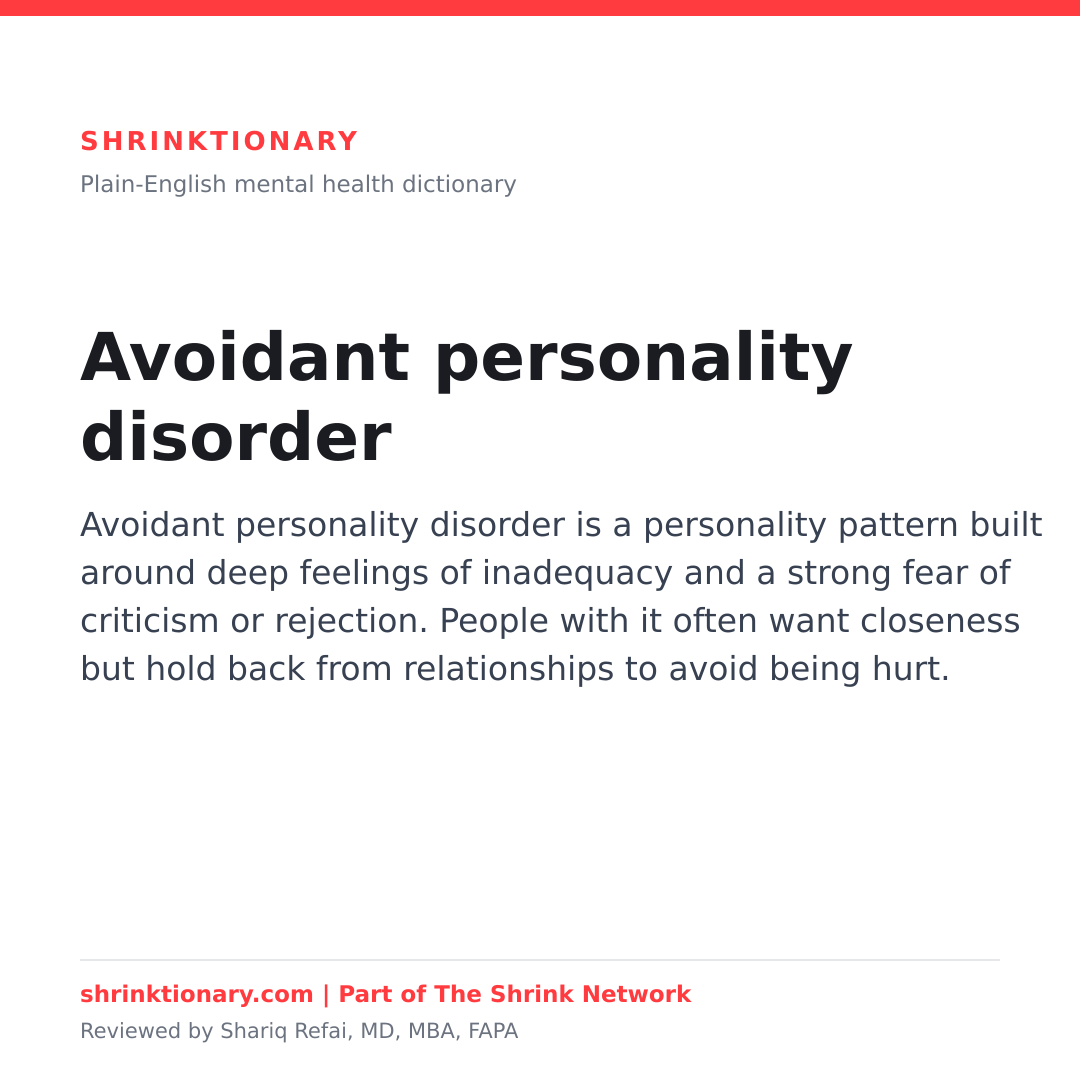
Avoidant personality disorder is a long-standing personality pattern shaped by a deep sense of not being good enough and a strong fear of being judged, criticized, or rejected. The pattern usually appears by early adulthood and stays consistent across different settings. It often leads people to steer clear of situations where they might be evaluated, including work activities and close relationships.
What sets it apart is that the avoidance comes from painful self-doubt rather than a lack of interest in others. Many people with this pattern very much want connection, but the fear of rejection feels too big to risk. It’s considered a disorder when this fear is pervasive and significantly limits a person’s life.
How avoidant personality disorder shows up
Day to day, it can look like turning down invitations, avoiding new responsibilities, or staying quiet in groups for fear of saying the wrong thing. A person might assume others see them as inferior and read neutral reactions as disapproval. Even when a relationship is going well, they may hold back from getting closer in case they get hurt.
Inside, there’s often a great deal of loneliness and longing. The person may replay social moments, worry about embarrassment, and feel stuck between wanting closeness and fearing it. That tension can feel exhausting.
What avoidant personality disorder isn’t
It isn’t the same as being introverted or simply enjoying time alone. Many introverts feel content in their own company. With this pattern, the withdrawal is driven by fear and inadequacy, not preference, and it tends to cause real distress.
It also overlaps a lot with social anxiety disorder, and the two can occur together, but a personality disorder describes a broader and more enduring pattern. And it isn’t a sign of weakness or a lack of trying. The fear is genuine, and it responds to support.
Related terms you’ll see next
When to seek professional care
It’s worth reaching out when fear of judgment keeps someone from work, friendships, or the kind of life they want. Therapy can gently help build confidence and reduce avoidance, often starting with small, manageable steps. If low mood or hopelessness comes along with the avoidance, that’s another good reason to talk with a professional, and help is available.
When evaluation may help
Not everyone reading about avoidant personality disorder needs treatment. If it's getting in the way of your day, your sleep, your work, or your relationships, or if it isn't easing on its own, a professional evaluation is a reasonable next step. Most people start with their primary care doctor or a therapist. A psychiatrist is the right call when medication may be involved or the picture is complicated, though waits can be long.
We keep an honest, no-commission rundown of the options, from primary care to telepsychiatry to crisis lines, on one page.
If you're in crisis or thinking about suicide, call or text 988 in the US, or go to the nearest emergency room.
When this word matters
It matters when deep feelings of inadequacy and a strong fear of criticism lead someone to hold back from relationships they actually want, in a lasting pattern rather than situational shyness. The longing for closeness alongside the avoidance is what helps separate it from simply being a loner.
Commonly confused with
Frequently asked questions
What is avoidant personality disorder?
It's a long-standing personality pattern shaped by a deep sense of not being good enough and a strong fear of being judged, criticized, or rejected. It often leads people to avoid situations where they might be evaluated.
Is avoidant personality disorder the same as being introverted?
No. Many introverts feel content in their own company, but with this pattern the withdrawal is driven by fear and inadequacy rather than preference, and it tends to cause real distress.
How is avoidant personality disorder different from social anxiety?
The two overlap a lot and can occur together, but a personality disorder describes a broader and more enduring pattern. The avoidance comes from painful self-doubt rather than a lack of interest in others.
Related terms
Sources
- Personality Disorders , MedlinePlus
- What Are Personality Disorders? , American Psychiatric Association
Use or cite this definition
Free to reuse with attribution. Paste the block into your own page, or grab a citation.
Embed on your site
<blockquote>
<p><strong>Avoidant personality disorder:</strong> Avoidant personality disorder is a personality pattern built around deep feelings of inadequacy and a strong fear of criticism or rejection. People with it often want closeness but hold back from relationships to avoid being hurt.</p>
<p>— <a href="https://shrinktionary.com/terms/avoidant-personality-disorder/">Shrinktionary</a>, a plain-English mental health dictionary, medically reviewed by a board certified psychiatrist.</p>
</blockquote>Cite (APA)
Refai, S. (2026). Avoidant personality disorder. Shrinktionary. https://shrinktionary.com/terms/avoidant-personality-disorder/
Cite (MLA)
"Avoidant personality disorder." Shrinktionary, https://shrinktionary.com/terms/avoidant-personality-disorder/. Accessed September 26, 2026.
Your next step in The Shrink Network
You are here: Shrinktionary, the language layer of The Shrink Network.
Each site in the network has one job. No matter where you enter, we help you find the next step that makes sense.
Want to understand more first?
See how this connects to everything else in the Term Web →
Take it with you
Free printable references you can save or share. For education, not medical advice.