What self-efficacy actually is
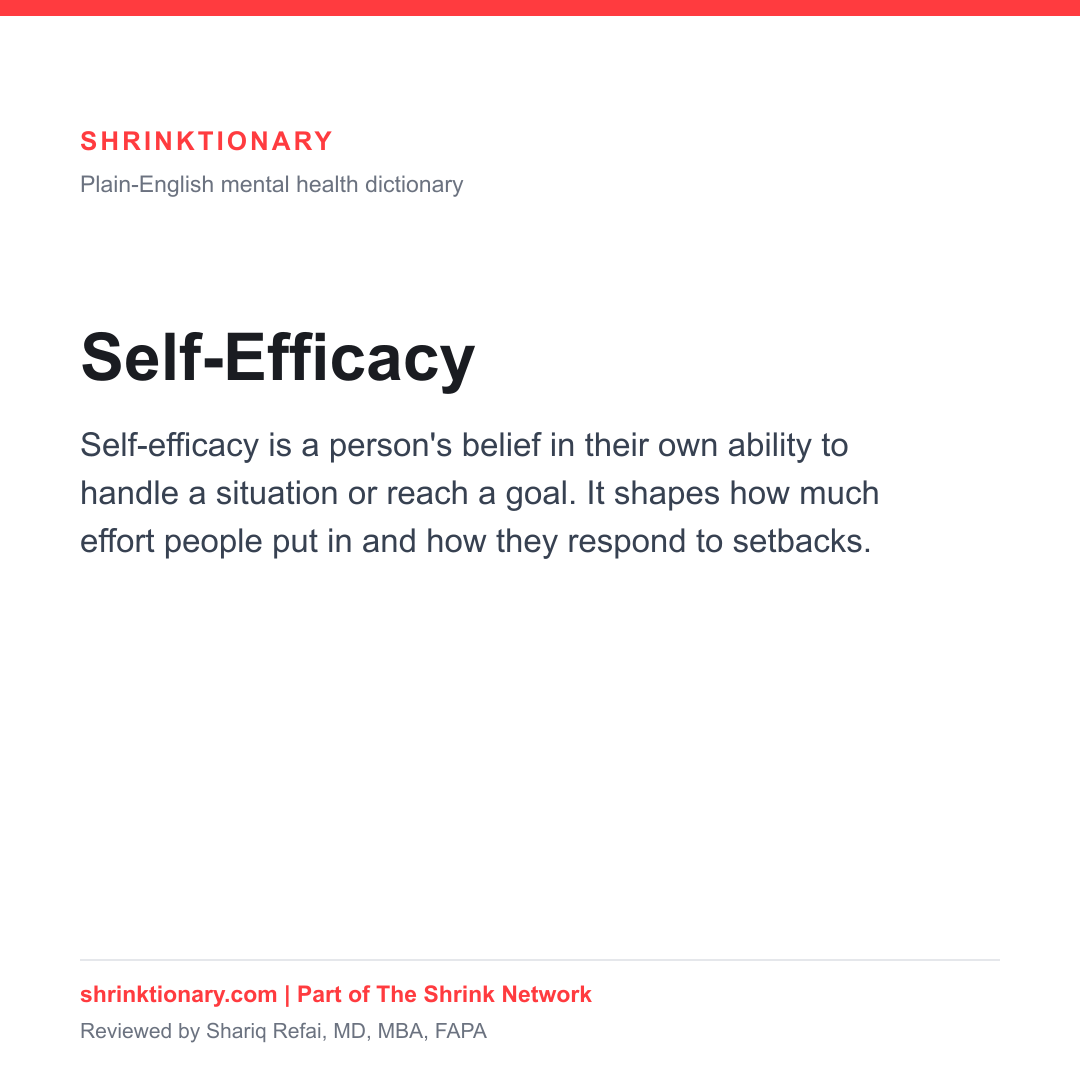
Self-efficacy is the belief that you can do what a situation calls for. It’s the confidence that you can study for the exam, have the hard conversation, or stick with a new routine. The term comes from psychologist Albert Bandura, who described it as a person’s judgment of their own capability to carry out a specific task.
It’s worth noting that self-efficacy is usually task specific. Someone can feel highly capable at work and far less sure of themselves in social settings. So it’s less a single overall trait and more a collection of beliefs that shift depending on the situation.
How it works
Self-efficacy grows mostly through experience. Succeeding at something, especially after effort, is the strongest way to build it. Watching people similar to you succeed, getting genuine encouragement, and learning to read your own nervousness as normal rather than as proof of failure all play a part too.
Belief in your ability changes behavior in practical ways. People with stronger self-efficacy tend to set higher goals, keep going when things get hard, and bounce back from setbacks instead of giving up. People with low self-efficacy may avoid challenges entirely because they expect to fail before they even start.
What it isn’t
Self-efficacy isn’t the same as self-esteem. Self-esteem is how much you value yourself overall, while self-efficacy is about whether you believe you can do a particular thing. A person can have solid self-esteem and still doubt their ability at a specific task.
It also isn’t blind optimism or arrogance. Healthy self-efficacy is grounded in real skill and experience, not in ignoring difficulty. And it doesn’t guarantee success. It simply makes effort and persistence more likely.
Related terms you’ll see next
Why it matters for mental health
Self-efficacy shows up throughout mental health care. Many therapies, including cognitive behavioral therapy, work partly by helping people rack up small successes that rebuild the belief that they can manage their lives.
Low self-efficacy is common in depression and anxiety, where people often feel that effort is pointless or that they’ll fail no matter what. Strengthening that belief, one realistic step at a time, can be a meaningful part of recovery.
When this word matters
The distinction matters because self-efficacy is belief in your ability to handle a specific task, which shapes effort and persistence, and it's usually task-specific rather than a single overall trait. It's easy to confuse with self-esteem, which is about overall worth, and with confidence in general.
Commonly confused with
Frequently asked questions
What is self-efficacy?
Self-efficacy is your belief that you can do what a situation calls for, like studying for an exam or sticking with a new routine. The term comes from psychologist Albert Bandura, who described it as a person's judgment of their own capability to carry out a specific task.
What is the difference between self-efficacy and self-esteem?
Self-esteem is how much you value yourself overall, while self-efficacy is about whether you believe you can do a particular thing. A person can have solid self-esteem and still doubt their ability at a specific task.
How does self-efficacy grow?
It grows mostly through experience, especially succeeding at something after effort. Watching people similar to you succeed, getting genuine encouragement, and learning to read your own nervousness as normal all help too.
Related terms
Sources
- Building Your Resilience , American Psychological Association
- Caring for Your Mental Health , National Institute of Mental Health
Use or cite this definition
Free to reuse with attribution. Paste the block into your own page, or grab a citation.
Embed on your site
<blockquote>
<p><strong>Self-Efficacy:</strong> Self-efficacy is a person's belief in their own ability to handle a situation or reach a goal. It shapes how much effort people put in and how they respond to setbacks.</p>
<p>— <a href="https://shrinktionary.com/terms/self-efficacy/">Shrinktionary</a>, a plain-English mental health dictionary, medically reviewed by a board certified psychiatrist.</p>
</blockquote>Cite (APA)
Refai, S. (2026). Self-Efficacy. Shrinktionary. https://shrinktionary.com/terms/self-efficacy/
Cite (MLA)
"Self-Efficacy." Shrinktionary, https://shrinktionary.com/terms/self-efficacy/. Accessed September 26, 2026.
Your next step in The Shrink Network
You are here: Shrinktionary, the language layer of The Shrink Network.
Each site in the network has one job. No matter where you enter, we help you find the next step that makes sense.
Want to understand more first?
See how this connects to everything else in the Term Web →
Take it with you
Free printable references you can save or share. For education, not medical advice.