What learned helplessness actually is
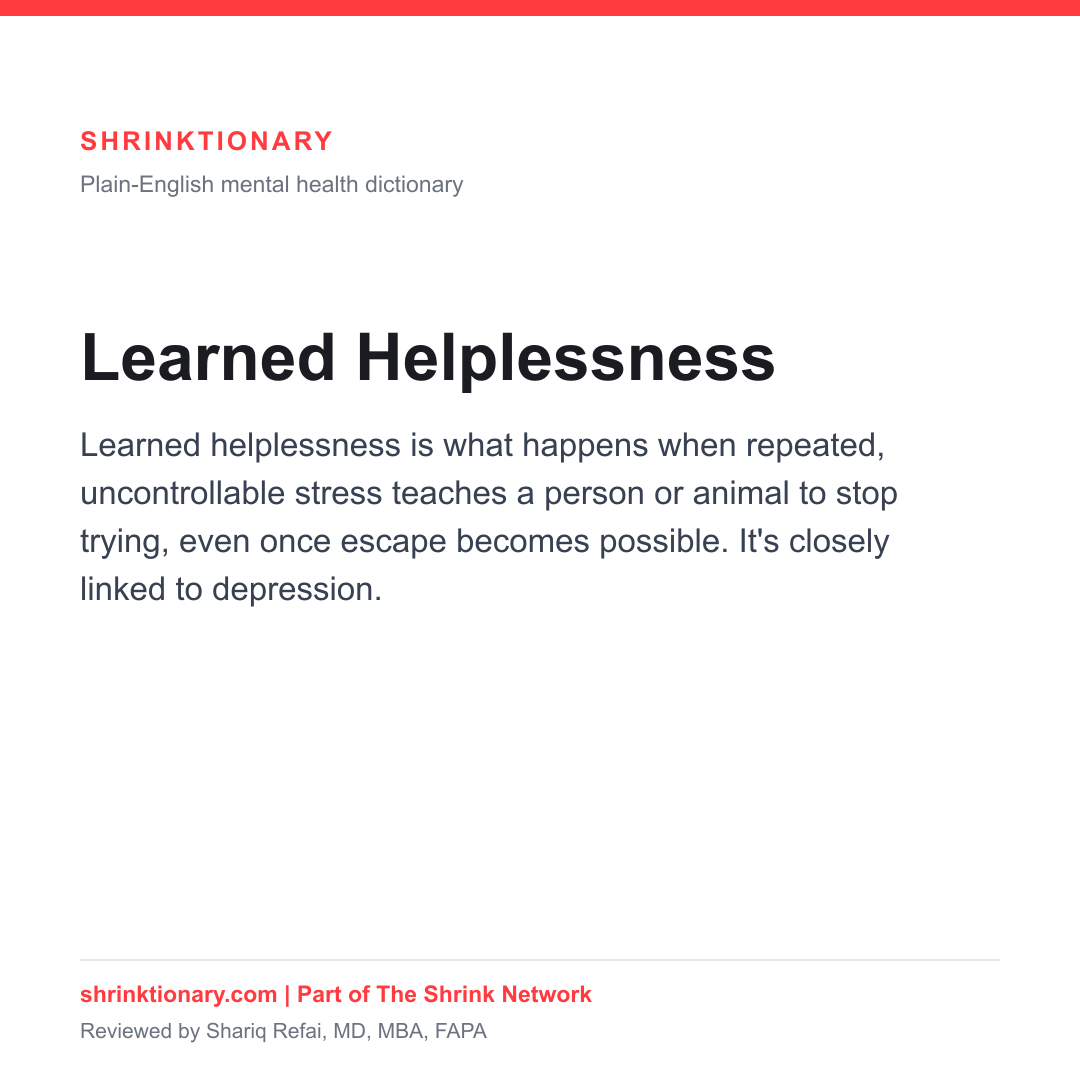
Learned helplessness is the giving-up response that sets in after someone faces stress they can’t control, over and over, until they come to believe that nothing they do will make a difference. The striking part is that the belief sticks even after circumstances change and action would actually help. The person stops trying anyway.
The concept came out of experiments by psychologists Martin Seligman and Steven Maier in the 1960s. They noticed that animals exposed to stress they couldn’t escape later failed to escape even when escape became easy. They had learned that their actions didn’t matter, and they carried that lesson into situations where it no longer applied.
How learned helplessness works
The core ingredient is a lack of control. When effort repeatedly fails to change an outcome, the mind draws a conclusion. My actions don’t matter here. That conclusion can then generalize, spreading to new situations where the person could succeed but doesn’t try. In people, this often shows up alongside a particular thinking style, where setbacks get explained as permanent, widespread, and the person’s own fault.
This pattern has been an influential model for understanding depression. The passivity, low motivation, and hopelessness seen in depression can look a lot like learned helplessness, and the connection helped shape modern thinking about how depression develops. Later research refined the original idea, suggesting that giving up is closer to the default response to prolonged stress, and that learning control is what actually counters it. That refinement points straight at treatment. Therapies that help people regain a sense of agency, by taking small effective actions, work directly against the helplessness pattern.
What learned helplessness isn’t
Learned helplessness isn’t laziness or a lack of willpower. It’s a learned expectation built by real experiences of powerlessness, not a character flaw. It also isn’t permanent. Because it’s learned, it can be unlearned, especially when a person starts having experiences where their actions clearly do produce results.
It isn’t a formal diagnosis either. It’s a psychological concept that helps explain features of depression and the effects of chronic stress, not a condition listed in the diagnostic manuals.
Related terms you’ll see next
People reading about learned helplessness often move to depression, the condition it helps explain, then to operant conditioning and self-efficacy, which deal with control and consequences, and to cognitive distortion, the thinking patterns that feed it.
Why it matters
Learned helplessness explains why people sometimes stop trying even when help is available, and understanding it reframes that giving-up as something learned rather than a personal failing. Because the pattern can be reversed, regaining small experiences of control, often with a therapist’s help, is a meaningful path out of it.
When this word matters
Learned helplessness matters when explaining why people stop trying even when help is available, after repeated stress they couldn't control. It's an influential model for understanding depression, not a formal diagnosis, and it can be unlearned.
Commonly confused with
Frequently asked questions
What is learned helplessness?
It's the giving-up response that sets in after someone faces stress they can't control over and over, until they come to believe nothing they do will make a difference. The belief can stick even after circumstances change and action would actually help.
Is learned helplessness the same as laziness?
No. It's a learned expectation built by real experiences of powerlessness, not a character flaw or a lack of willpower. Because it's learned, it can also be unlearned.
How is learned helplessness related to depression?
It has been an influential model for understanding depression, since the passivity, low motivation, and hopelessness seen in depression can look a lot like learned helplessness. It isn't itself a formal diagnosis.
Related terms
Sources
- Depression , National Institute of Mental Health
- Depression , MedlinePlus
Use or cite this definition
Free to reuse with attribution. Paste the block into your own page, or grab a citation.
Embed on your site
<blockquote>
<p><strong>Learned Helplessness:</strong> Learned helplessness is what happens when repeated, uncontrollable stress teaches a person or animal to stop trying, even once escape becomes possible. It's closely linked to depression.</p>
<p>— <a href="https://shrinktionary.com/terms/learned-helplessness/">Shrinktionary</a>, a plain-English mental health dictionary, medically reviewed by a board certified psychiatrist.</p>
</blockquote>Cite (APA)
Refai, S. (2026). Learned Helplessness. Shrinktionary. https://shrinktionary.com/terms/learned-helplessness/
Cite (MLA)
"Learned Helplessness." Shrinktionary, https://shrinktionary.com/terms/learned-helplessness/. Accessed September 26, 2026.
Your next step in The Shrink Network
You are here: Shrinktionary, the language layer of The Shrink Network.
Each site in the network has one job. No matter where you enter, we help you find the next step that makes sense.
Want to understand more first?
See how this connects to everything else in the Term Web →
Take it with you
Free printable references you can save or share. For education, not medical advice.