What motivation actually is
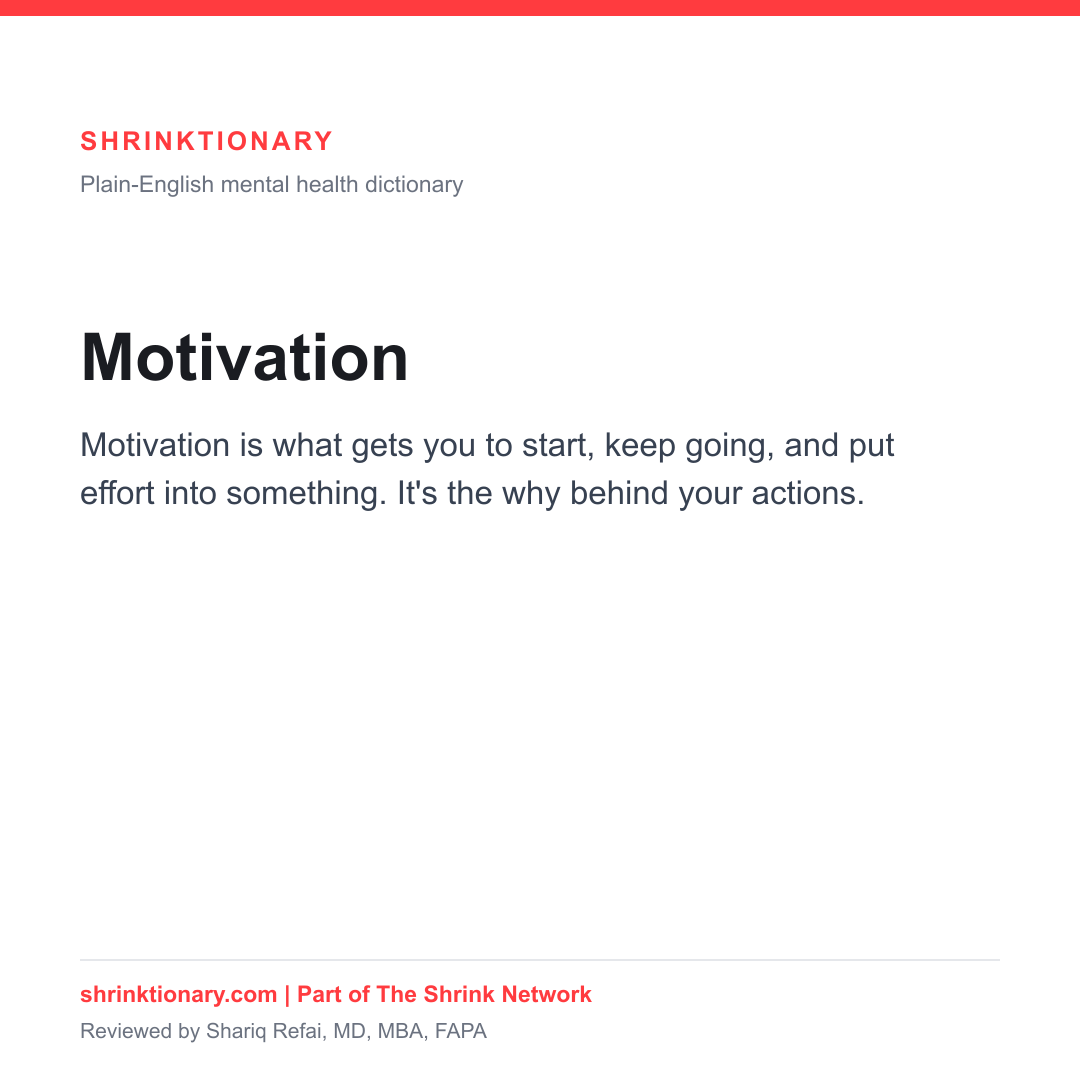
Motivation is the force that moves you to act. It’s why you get out of bed for a job you care about, why you push through the last mile of a run, or why you can’t quite make yourself start a task you dread. It covers both the spark that gets you going and the staying power that keeps you at it.
Psychologists often split it into two flavors. Intrinsic motivation comes from inside, like doing something because it’s interesting or satisfying. Extrinsic motivation comes from outside, like working for a paycheck, a grade, or praise.
How it works
Motivation isn’t a single switch. It rises and falls based on your goals, your mood, your energy, and whether your effort seems likely to pay off. When a goal feels meaningful and reachable, motivation tends to climb. When it feels pointless or impossible, motivation drains away.
The brain’s reward system plays a big role here. Chemicals like dopamine are tied to wanting and pursuing things, not just enjoying them. That’s part of why anticipation can feel so driving and why a loss of interest can feel so flat.
What it isn’t
Motivation isn’t the same as discipline or willpower, though people often blur them. You can act with very little motivation by relying on habit and structure, and plenty of motivated people still struggle to follow through. Waiting to “feel motivated” before acting is a common trap.
It also isn’t a character flaw to lack it. A sudden drop in motivation can be a symptom of depression or burnout rather than laziness.
Related terms you’ll see next
Why it matters
Changes in motivation are some of the clearest signals in mental health. A steep, lasting loss of drive can point to depression, while burnout often shows up as running on empty. Treatments like behavioral activation work partly by getting people moving first, since action can rebuild motivation rather than the other way around.
When this word matters
Low motivation matters clinically when it's persistent and paired with other changes like loss of pleasure or low energy, since that pattern can point to depression rather than ordinary lack of drive.
Commonly confused with
Frequently asked questions
What is the difference between intrinsic and extrinsic motivation?
Intrinsic motivation comes from inside, like doing something because it's interesting or satisfying. Extrinsic motivation comes from outside, like working for a paycheck, a grade, or praise.
Is motivation the same as willpower or discipline?
No, though people often blur them. You can act with very little motivation by relying on habit and structure, and waiting to feel motivated before acting is a common trap.
Can a lack of motivation be a sign of something more?
Yes, a sudden drop in motivation can be a symptom of depression or burnout rather than laziness. A steep, lasting loss of drive is one of the clearer signals in mental health.
Related terms
Sources
- Motivation , American Psychological Association
- Depression , National Institute of Mental Health
Use or cite this definition
Free to reuse with attribution. Paste the block into your own page, or grab a citation.
Embed on your site
<blockquote>
<p><strong>Motivation:</strong> Motivation is what gets you to start, keep going, and put effort into something. It's the why behind your actions.</p>
<p>— <a href="https://shrinktionary.com/terms/motivation/">Shrinktionary</a>, a plain-English mental health dictionary, medically reviewed by a board certified psychiatrist.</p>
</blockquote>Cite (APA)
Refai, S. (2026). Motivation. Shrinktionary. https://shrinktionary.com/terms/motivation/
Cite (MLA)
"Motivation." Shrinktionary, https://shrinktionary.com/terms/motivation/. Accessed September 26, 2026.
Your next step in The Shrink Network
You are here: Shrinktionary, the language layer of The Shrink Network.
Each site in the network has one job. No matter where you enter, we help you find the next step that makes sense.
Want to understand more first?
See how this connects to everything else in the Term Web →
Take it with you
Free printable references you can save or share. For education, not medical advice.