What reinforcement actually is
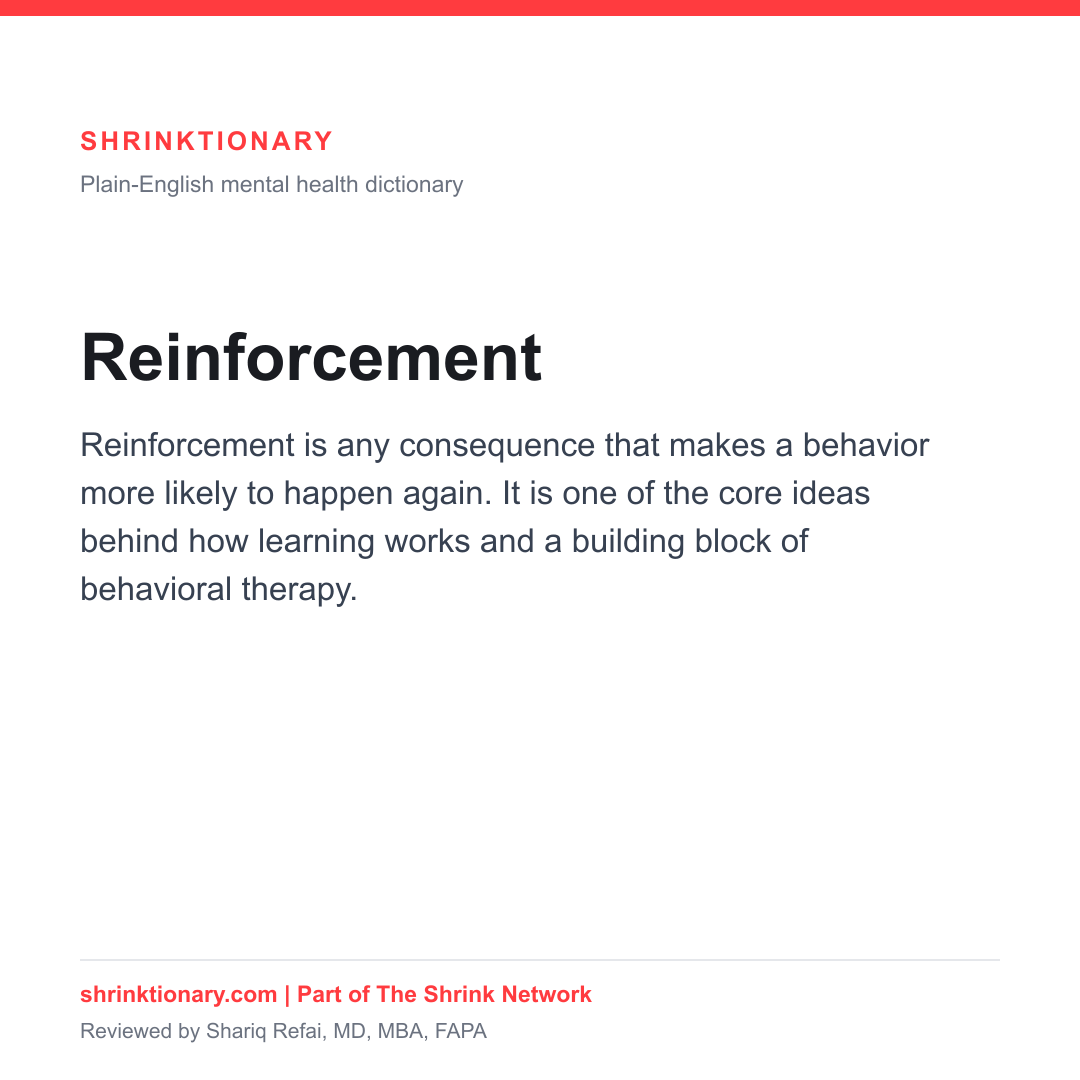
Reinforcement is a learning process. When a behavior is followed by a consequence that feels good or removes something unpleasant, that behavior tends to happen more often in the future. The behavior gets stronger. That is the whole idea in plain terms.
Psychologists usually split it into two types. Positive reinforcement adds something the person wants after the behavior, like praise, money, or a sense of relief. Negative reinforcement takes away something unpleasant after the behavior, like stopping a loud alarm or escaping an uncomfortable situation. Both make the behavior more likely. The word “negative” here means something is subtracted, not that it is bad.
How reinforcement works
The brain pays attention to what happens right after we act. If an action leads to a reward, we are nudged to repeat it. Brain systems that involve the chemical messenger dopamine help signal that something was worth doing, though learning is far more complex than any single chemical.
Timing and consistency matter. A consequence that comes right after the behavior teaches faster than one that comes much later. This is why habits form so easily around things that pay off quickly. It also explains why some unhelpful patterns stick around. Avoiding a feared situation brings instant relief, and that relief reinforces the avoidance, even though the fear never gets a chance to fade.
What reinforcement isn’t
Reinforcement is not the same as punishment. Punishment is meant to make a behavior less likely, while reinforcement makes it more likely. People often confuse negative reinforcement with punishment, but they work in opposite directions.
It is also not just bribery or simple reward charts. Reinforcement is happening all the time, often without anyone planning it. And it is not a way to control people against their will. It describes a natural pattern in how living things learn from results.
Related terms you’ll see next
Why it matters for mental health
A lot of therapy works by changing what gets reinforced. Behavioral activation helps people with depression do small rewarding activities so that action starts to feel worthwhile again. Exposure work helps break the cycle where avoidance gets reinforced by short-term relief. Understanding reinforcement gives you a practical lens for your own habits. If a behavior keeps showing up, it is worth asking what payoff is quietly keeping it going.
When this word matters
The distinction matters because reinforcement always makes a behavior more likely, whether it adds something wanted (positive) or removes something unpleasant (negative), and negative here means subtracted, not bad. People most often mix it up with punishment, which is meant to reduce a behavior.
Commonly confused with
Frequently asked questions
What is the difference between positive and negative reinforcement?
Positive reinforcement adds something a person wants after a behavior, like praise or relief, while negative reinforcement takes away something unpleasant, like turning off a loud alarm. Both make the behavior more likely, and the word negative just means something is subtracted, not that it's bad.
Is reinforcement the same as punishment?
No. Reinforcement makes a behavior more likely to happen again, while punishment is meant to make a behavior less likely. People often mix up negative reinforcement with punishment, but they work in opposite directions.
How is reinforcement used in therapy?
A lot of therapy works by changing what gets reinforced. Behavioral activation helps people do small rewarding activities so action feels worthwhile again, and exposure work helps break cycles where avoidance gets reinforced by short-term relief.
Related terms
Sources
- Psychotherapies , National Institute of Mental Health
- Psychotherapy , American Psychological Association
Use or cite this definition
Free to reuse with attribution. Paste the block into your own page, or grab a citation.
Embed on your site
<blockquote>
<p><strong>Reinforcement:</strong> Reinforcement is any consequence that makes a behavior more likely to happen again. It is one of the core ideas behind how learning works and a building block of behavioral therapy.</p>
<p>— <a href="https://shrinktionary.com/terms/reinforcement/">Shrinktionary</a>, a plain-English mental health dictionary, medically reviewed by a board certified psychiatrist.</p>
</blockquote>Cite (APA)
Refai, S. (2026). Reinforcement. Shrinktionary. https://shrinktionary.com/terms/reinforcement/
Cite (MLA)
"Reinforcement." Shrinktionary, https://shrinktionary.com/terms/reinforcement/. Accessed September 26, 2026.
Your next step in The Shrink Network
You are here: Shrinktionary, the language layer of The Shrink Network.
Each site in the network has one job. No matter where you enter, we help you find the next step that makes sense.
Want to understand more first?
See how this connects to everything else in the Term Web →
Take it with you
Free printable references you can save or share. For education, not medical advice.