What antisocial personality disorder actually is
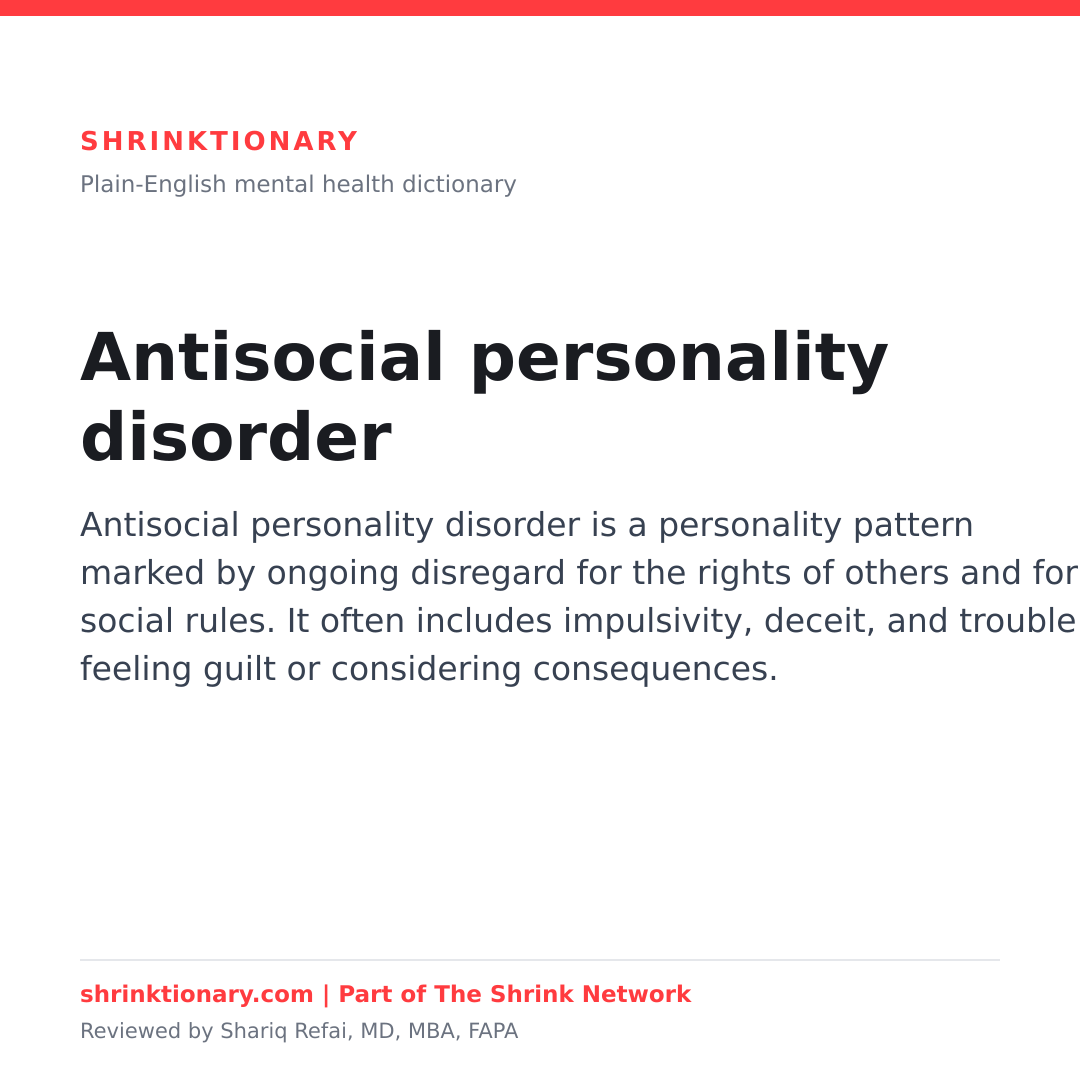
Antisocial personality disorder is a long-standing personality pattern that involves a persistent disregard for other people’s rights and for the rules most people live by. It usually includes impulsivity, a tendency toward deceit, and difficulty feeling guilt or anticipating consequences. The diagnosis is made in adults, and the pattern typically has roots that show up in childhood or the teen years.
It’s considered a disorder when these traits are stable over time and cause clear harm, whether through broken relationships, legal trouble, or repeated risk to the person and to others. Researchers think it grows out of a mix of genetics, temperament, and early environment, including exposure to harsh or unstable conditions.
How antisocial personality disorder shows up
The pattern can look like repeatedly breaking rules or laws, lying or manipulating to get what one wants, acting on impulse without weighing the fallout, and showing little remorse afterward. Some people seem charming on the surface, which can make the pattern harder to spot at first.
There can also be irritability, aggression, and a hard time holding down steady work or keeping commitments. Relationships often suffer because trust and accountability are difficult. People with this pattern may not feel that anything is wrong, which is one reason it’s challenging to treat.
What antisocial personality disorder isn’t
It isn’t the same as occasionally bending the rules or being a rebellious teenager. The pattern has to be persistent and wide-ranging, and the diagnosis isn’t applied to children. It also isn’t identical to the popular images of a “psychopath” from movies, which exaggerate and dramatize the picture.
Having this diagnosis doesn’t mean a person is beyond help or inevitably dangerous. It describes a behavior pattern, not a person’s whole worth, and understanding it is more useful than condemning it.
Related terms you’ll see next
When to seek professional care
Because people with this pattern often don’t seek help on their own, family members or partners are frequently the ones who reach out, sometimes for their own support and safety. Professional care can address related issues like substance use, impulsivity, and anger, and a clinician can help sort out the diagnosis. If anyone’s safety is at risk, contacting emergency services or a crisis line is the right step.
When evaluation may help
Not everyone reading about antisocial personality disorder needs treatment. If it's getting in the way of your day, your sleep, your work, or your relationships, or if it isn't easing on its own, a professional evaluation is a reasonable next step. Most people start with their primary care doctor or a therapist. A psychiatrist is the right call when medication may be involved or the picture is complicated, though waits can be long.
We keep an honest, no-commission rundown of the options, from primary care to telepsychiatry to crisis lines, on one page.
If you're in crisis or thinking about suicide, call or text 988 in the US, or go to the nearest emergency room.
When this word matters
It matters when there's an ongoing pattern of disregard for others' rights, often with impulsivity, deceit, and little guilt, present since at least the mid-teens rather than a one-off act. The term is clinical and is not the same as the everyday words sociopath or psychopath.
Commonly confused with
Frequently asked questions
What is antisocial personality disorder?
It's a long-standing personality pattern involving persistent disregard for other people's rights and for social rules, often with impulsivity, deceit, and difficulty feeling guilt. The diagnosis is made in adults.
Is antisocial personality disorder the same as being a psychopath?
It isn't identical to the popular movie images of a psychopath, which exaggerate and dramatize the picture. The diagnosis describes a behavior pattern, not a person's whole worth.
Can antisocial personality disorder be treated?
Having the diagnosis doesn't mean someone is beyond help. Professional care can address related issues like substance use, impulsivity, and anger, though people with this pattern often don't seek help on their own.
Related terms
Sources
- Personality Disorders , MedlinePlus
- What Are Personality Disorders? , American Psychiatric Association
Use or cite this definition
Free to reuse with attribution. Paste the block into your own page, or grab a citation.
Embed on your site
<blockquote>
<p><strong>Antisocial personality disorder:</strong> Antisocial personality disorder is a personality pattern marked by ongoing disregard for the rights of others and for social rules. It often includes impulsivity, deceit, and trouble feeling guilt or considering consequences.</p>
<p>— <a href="https://shrinktionary.com/terms/antisocial-personality-disorder/">Shrinktionary</a>, a plain-English mental health dictionary, medically reviewed by a board certified psychiatrist.</p>
</blockquote>Cite (APA)
Refai, S. (2026). Antisocial personality disorder. Shrinktionary. https://shrinktionary.com/terms/antisocial-personality-disorder/
Cite (MLA)
"Antisocial personality disorder." Shrinktionary, https://shrinktionary.com/terms/antisocial-personality-disorder/. Accessed September 26, 2026.
Your next step in The Shrink Network
You are here: Shrinktionary, the language layer of The Shrink Network.
Each site in the network has one job. No matter where you enter, we help you find the next step that makes sense.
Want to understand more first?
See how this connects to everything else in the Term Web →
Take it with you
Free printable references you can save or share. For education, not medical advice.