What substance use disorder actually is
Substance use disorder is a medical condition in which a person continues using a substance, such as alcohol, opioids, stimulants, or cannabis, even though it’s causing problems in their health, relationships, work, or daily life. Clinicians look at a set of features to make the diagnosis, including using more than intended, struggling to cut down, strong cravings, spending a lot of time getting or recovering from the substance, and giving up activities that once mattered.
The condition exists on a spectrum. Based on how many features are present, it can be classified as mild, moderate, or severe. Two related processes often show up. Tolerance means needing more of the substance to get the same effect, and withdrawal means uncomfortable symptoms when use stops or slows down.
Over time, repeated use can change brain circuits involved in reward, motivation, and self-control. That’s part of why stopping is so hard and why the condition is understood as a health issue rather than simply a matter of willpower.
What substance use disorder can feel like
Many people describe a tug-of-war between wanting to stop and feeling pulled to use anyway. Cravings can be powerful, and the substance may come to feel like the main way to cope with stress, pain, or difficult emotions, even as it makes life harder.
There’s often a cycle of resolving to quit, slipping, and feeling shame or defeat, which can feed more use. People may notice their world narrowing around getting and using the substance, while important parts of life slip away. These patterns are common features of the condition, not signs of a moral failing.
What substance use disorder isn’t
Substance use disorder isn’t a lack of willpower or a character defect. The brain changes that come with heavy, repeated use make stopping genuinely difficult, which is why support and treatment matter so much.
It also isn’t hopeless. Recovery is common, and effective treatments exist, including counseling, behavioral therapies, medications for certain substances, and peer support. A return to use after a period of stopping is best understood as part of a chronic condition that can be managed, not as proof that change is impossible.
Related terms you’ll see next
Dopamine is a brain chemical involved in the reward changes seen in addiction. Reinforcement helps explain how substance use patterns get strengthened. Coping describes the strategies people use, healthy and unhealthy, to manage distress. Comorbidity is common, since substance use disorders often occur with other mental health conditions.
When to seek professional care
If substance use is causing harm or feels hard to control, an evaluation can help, no matter where you fall on the spectrum. A clinician can sort out the severity and discuss treatments, which may include counseling, medication, and support programs. Reaching out is a sign of strength, and effective help is available. If you’re having thoughts of suicide or self-harm, seek help right away. If you’re in crisis, call or text 988 in the United States.
When evaluation may help
Not everyone reading about substance use disorder needs treatment. If it's getting in the way of your day, your sleep, your work, or your relationships, or if it isn't easing on its own, a professional evaluation is a reasonable next step. Most people start with their primary care doctor or a therapist. A psychiatrist is the right call when medication may be involved or the picture is complicated, though waits can be long.
We keep an honest, no-commission rundown of the options, from primary care to telepsychiatry to crisis lines, on one page.
If you're in crisis or thinking about suicide, call or text 988 in the US, or go to the nearest emergency room.
When this word matters
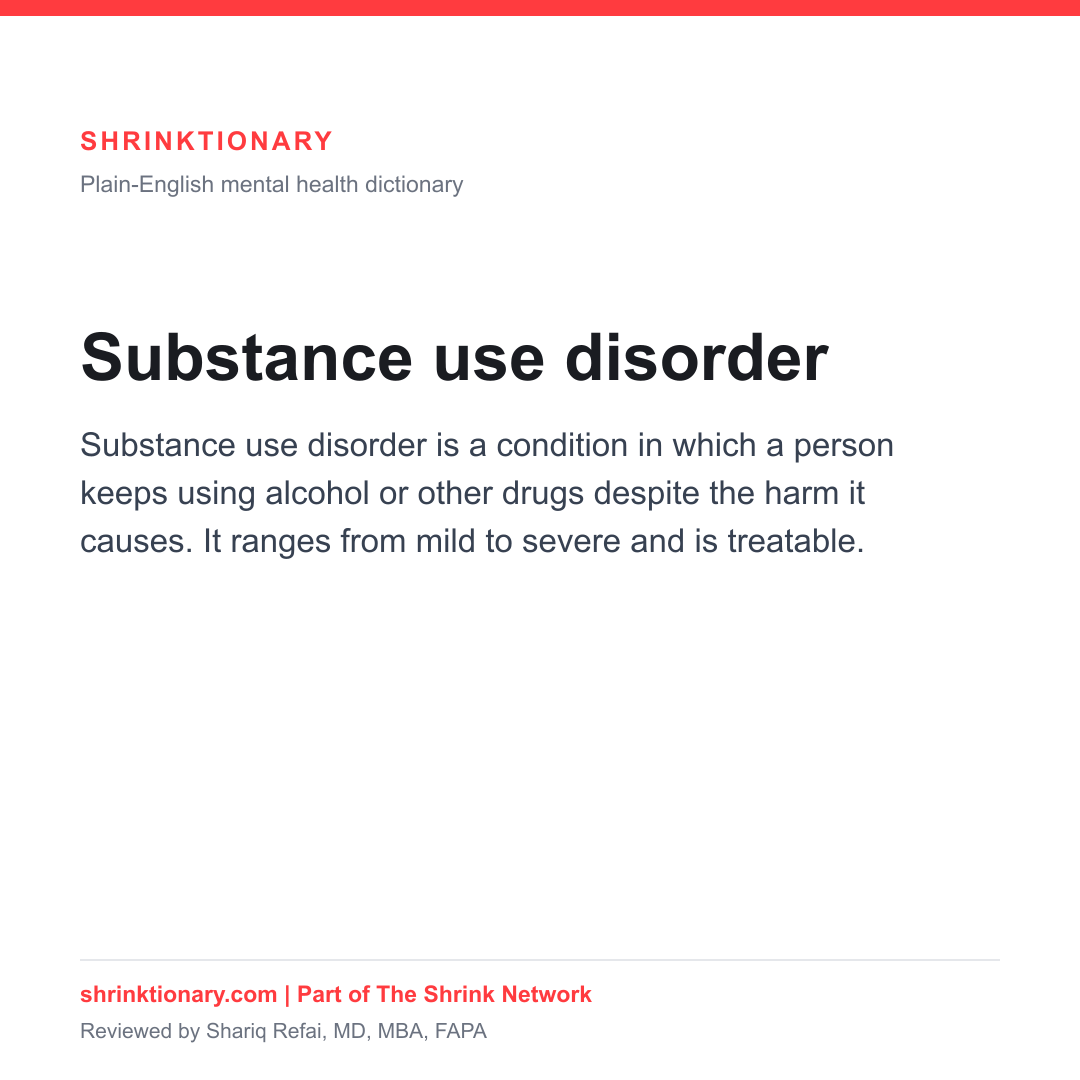
Use crosses into a disorder when someone keeps using alcohol or other drugs despite real harm to health, relationships, or work, struggles to cut down, and feels strong cravings. It ranges from mild to severe, often occurs alongside depression or anxiety, and is treatable.
Commonly confused with
Frequently asked questions
Is substance use disorder a lack of willpower?
No. It isn't a character defect or a moral failing. Repeated use can change brain circuits involved in reward, motivation, and self-control, which is why stopping is genuinely difficult and why it's understood as a health issue.
What is the difference between tolerance and withdrawal?
Tolerance means needing more of the substance to get the same effect, while withdrawal means uncomfortable symptoms when use stops or slows down. Both often show up as part of the condition.
Can substance use disorder be treated?
Yes, recovery is common and effective treatments exist, including counseling, behavioral therapies, medications for certain substances, and peer support. A return to use after stopping is best understood as part of a chronic condition that can be managed, not proof that change is impossible.
Related terms
Sources
- Substance Use and Mental Health , National Institute of Mental Health
- Substance use disorder , MedlinePlus Medical Encyclopedia
- Diagnostic and Statistical Manual of Mental Disorders, Fifth Edition, Text Revision (DSM-5-TR) , American Psychiatric Association
Use or cite this definition
Free to reuse with attribution. Paste the block into your own page, or grab a citation.
Embed on your site
<blockquote>
<p><strong>Substance use disorder:</strong> Substance use disorder is a condition in which a person keeps using alcohol or other drugs despite the harm it causes. It ranges from mild to severe and is treatable.</p>
<p>— <a href="https://shrinktionary.com/terms/substance-use-disorder/">Shrinktionary</a>, a plain-English mental health dictionary, medically reviewed by a board certified psychiatrist.</p>
</blockquote>Cite (APA)
Refai, S. (2026). Substance use disorder. Shrinktionary. https://shrinktionary.com/terms/substance-use-disorder/
Cite (MLA)
"Substance use disorder." Shrinktionary, https://shrinktionary.com/terms/substance-use-disorder/. Accessed September 26, 2026.
Your next step in The Shrink Network
You are here: Shrinktionary, the language layer of The Shrink Network.
Each site in the network has one job. No matter where you enter, we help you find the next step that makes sense.
Want to understand more first?
See how this connects to everything else in the Term Web →
Take it with you
Free printable references you can save or share. For education, not medical advice.