What avoidant/restrictive food intake disorder actually is
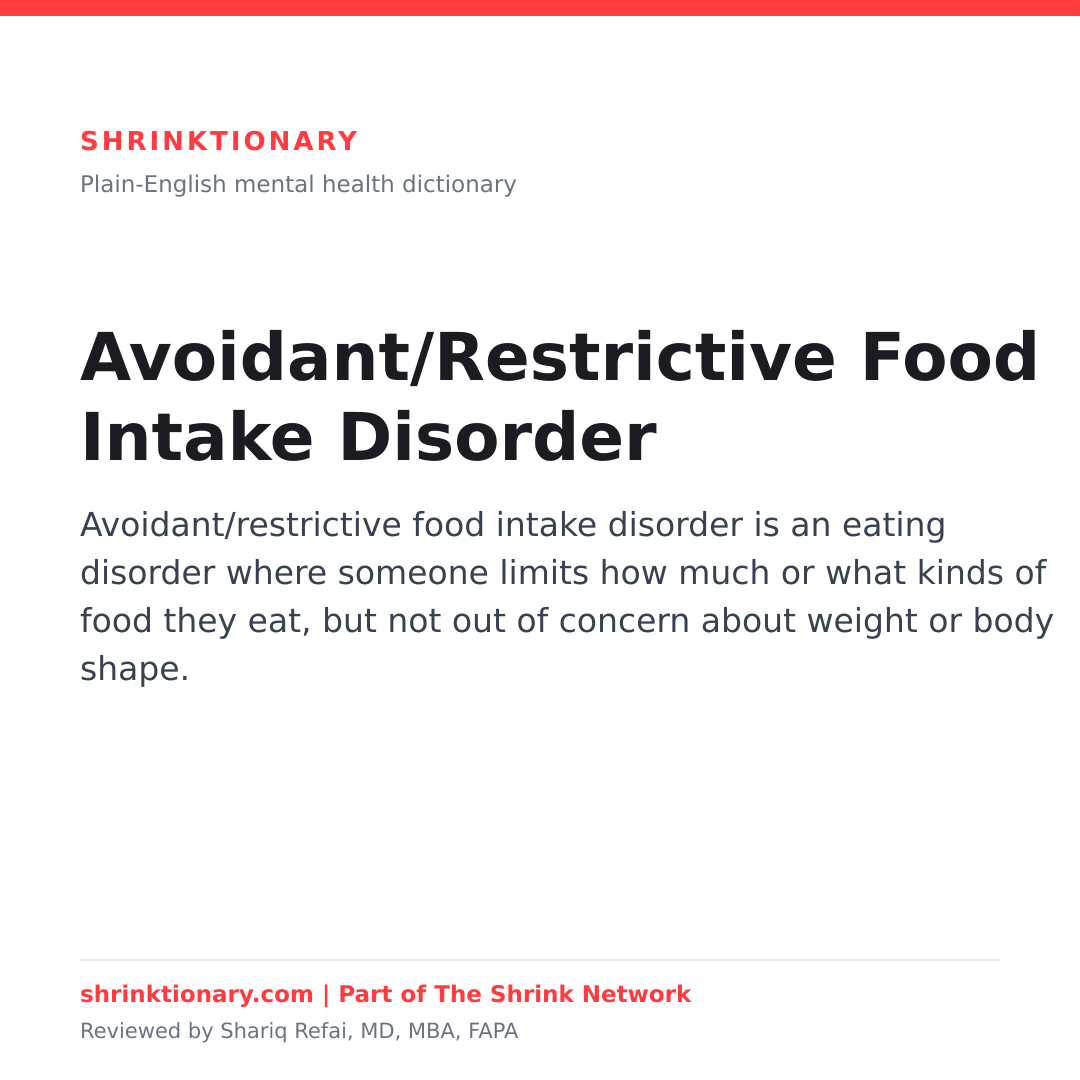
Avoidant/restrictive food intake disorder, almost always shortened to ARFID, is an eating and feeding disorder in the DSM-5-TR. The defining feature is that a person eats too little, or too narrow a range of food, to meet their nutritional or energy needs. What sets it apart from other eating disorders is the reason. The restriction isn’t driven by worry about weight, shape, or body image.
The reasons usually fall into a few overlapping patterns. Some people avoid food because of its sensory qualities, the texture, smell, color, or taste. Some eat little because they have low interest in food and rarely feel hungry. Others restrict after a frightening experience like choking or vomiting, and fear it happening again. To meet the diagnosis, the limited eating leads to real consequences, such as significant weight loss or failure to grow as expected, nutritional deficiency, dependence on supplements or tube feeding, or clear interference with daily life and relationships.
What avoidant/restrictive food intake disorder can feel like
For many people it feels less like a choice and more like a wall. A food that others find ordinary can seem genuinely unsafe or revolting. Mealtimes with new or mixed foods can bring real dread. Parents often describe years of so-called picky eating that never faded and started shrinking the menu instead of expanding it.
People with ARFID may eat the same small set of foods for comfort and predictability, and feel anxious when those options aren’t available. Eating out, travel, and social meals can become stressful. Underneath, there’s often frustration, because the person may genuinely want to eat more variety and find that their body or anxiety won’t cooperate.
What avoidant/restrictive food intake disorder isn’t
It isn’t ordinary picky eating that a child grows out of. Lots of kids go through fussy phases without ever developing a disorder. ARFID is diagnosed only when restricted eating causes meaningful harm to health, growth, or daily functioning.
It also isn’t anorexia nervosa. Both involve eating too little, but anorexia centers on fear of weight gain and distress about body shape, while ARFID doesn’t. ARFID can affect children, teens, and adults, and it’s more common in people who are autistic or have anxiety, though it occurs across all kinds of people.
Related terms you’ll see next
Anorexia nervosa is the eating disorder most often confused with ARFID. Sensory overload and autism spectrum disorder come up often, because sensory sensitivity is a common driver of food avoidance.
When to seek professional care
If limited eating is leading to weight loss, poor growth in a child, nutritional problems, reliance on supplements, or real strain at meals and in daily life, an evaluation is worth seeking. ARFID is diagnosed by a qualified clinician and often treated by a team that can include a therapist, a dietitian, and a medical provider. Early support tends to make change easier.
When evaluation may help
Not everyone reading about avoidant/restrictive food intake disorder needs treatment. If it's getting in the way of your day, your sleep, your work, or your relationships, or if it isn't easing on its own, a professional evaluation is a reasonable next step. Most people start with their primary care doctor or a therapist. A psychiatrist is the right call when medication may be involved or the picture is complicated, though waits can be long.
We keep an honest, no-commission rundown of the options, from primary care to telepsychiatry to crisis lines, on one page.
If you're in crisis or thinking about suicide, call or text 988 in the US, or go to the nearest emergency room.
When this word matters
It matters when limited eating is no longer a passing phase and starts causing weight loss, poor growth in a child, nutritional problems, reliance on supplements, or real strain at meals and in daily life. Because the restriction isn't about body image, ARFID is easy to overlook, and an evaluation by a qualified clinician is the right step when eating gets this narrow.
Commonly confused with
Frequently asked questions
What is ARFID?
ARFID stands for avoidant/restrictive food intake disorder. It's an eating disorder where a person eats too little or too narrow a range of food to meet their nutritional needs. What sets it apart is that the restriction isn't driven by worry about weight or body shape.
How is ARFID different from anorexia?
Both involve eating too little, but the reason differs. Anorexia nervosa centers on fear of weight gain and distress about body shape, while ARFID is driven by things like sensory sensitivity, low interest in food, or fear of choking or vomiting, not body image.
Is ARFID just picky eating?
No. Many children go through fussy phases without ever developing a disorder. ARFID is diagnosed only when restricted eating causes real harm, such as significant weight loss, poor growth, nutritional deficiency, or clear interference with daily life.
Related terms
Sources
- Eating Disorders , National Institute of Mental Health
- Avoidant Restrictive Food Intake Disorder (StatPearls) , National Center for Biotechnology Information
Use or cite this definition
Free to reuse with attribution. Paste the block into your own page, or grab a citation.
Embed on your site
<blockquote>
<p><strong>Avoidant/Restrictive Food Intake Disorder:</strong> Avoidant/restrictive food intake disorder is an eating disorder where someone limits how much or what kinds of food they eat, but not out of concern about weight or body shape.</p>
<p>— <a href="https://shrinktionary.com/terms/avoidant-restrictive-food-intake-disorder/">Shrinktionary</a>, a plain-English mental health dictionary, medically reviewed by a board certified psychiatrist.</p>
</blockquote>Cite (APA)
Refai, S. (2026). Avoidant/Restrictive Food Intake Disorder. Shrinktionary. https://shrinktionary.com/terms/avoidant-restrictive-food-intake-disorder/
Cite (MLA)
"Avoidant/Restrictive Food Intake Disorder." Shrinktionary, https://shrinktionary.com/terms/avoidant-restrictive-food-intake-disorder/. Accessed September 29, 2026.
Your next step in The Shrink Network
You are here: Shrinktionary, the language layer of The Shrink Network.
Each site in the network has one job. No matter where you enter, we help you find the next step that makes sense.
Want to understand more first?
See how this connects to everything else in the Term Web →
Take it with you
Free printable references you can save or share. For education, not medical advice.