What radical acceptance actually is
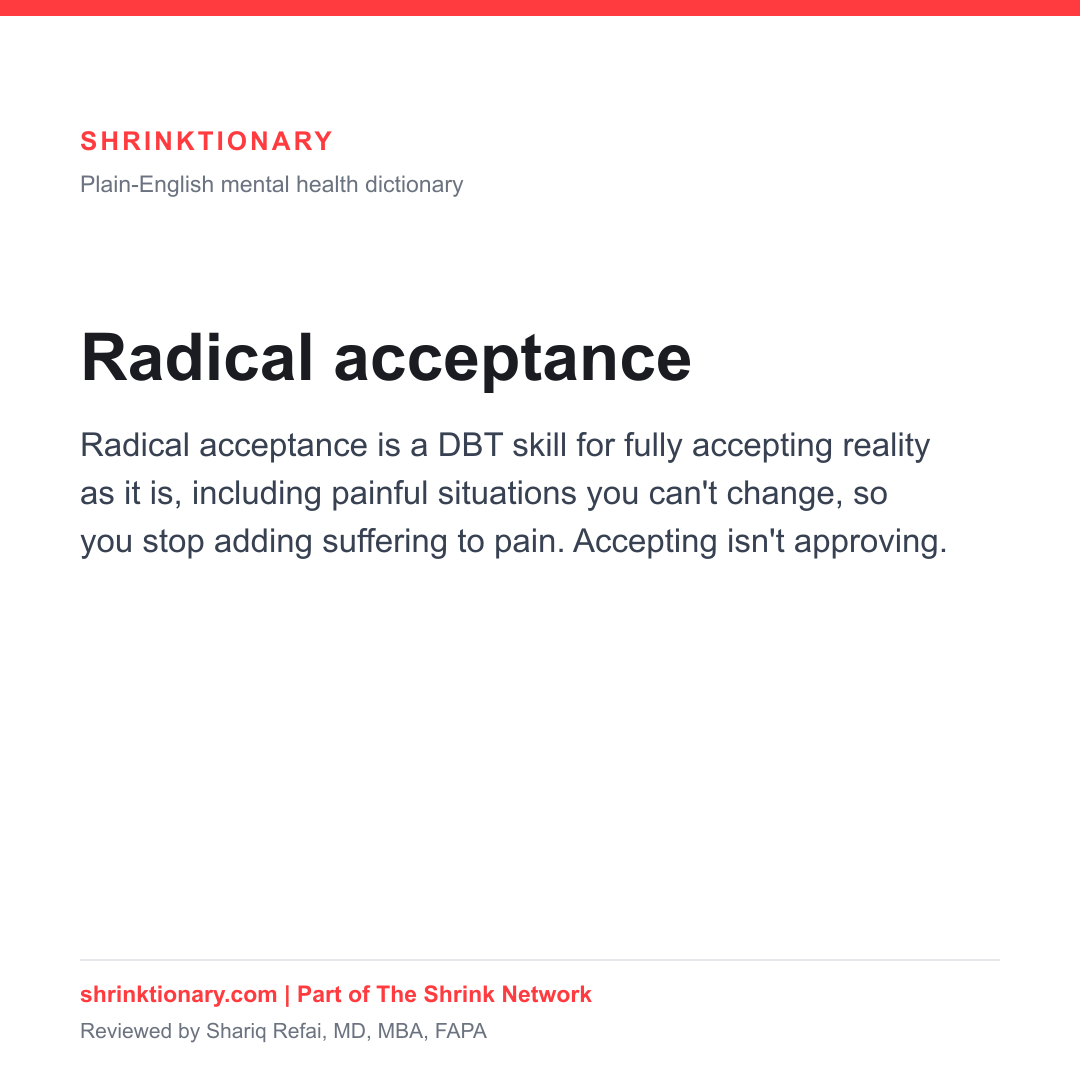
Radical acceptance is a skill from dialectical behavior therapy for accepting reality fully, exactly as it is, especially the parts you can’t change. The word radical means complete and total, all the way down. It’s the practice of stopping the fight against a fact that’s already true and choosing instead to acknowledge it without judgment.
The idea rests on a distinction that DBT makes central. Pain is part of life and often unavoidable. Suffering, in this framework, is what gets added when a person refuses to accept the pain, when they replay it, protest it, or insist that it shouldn’t be happening. Radical acceptance targets that added layer. It doesn’t remove the pain, but it can lower the suffering stacked on top of it.
Crucially, acceptance here isn’t agreement, approval, or giving up. A person can radically accept that something painful or unjust has happened while still wishing it were different and still working to change what can be changed. Acceptance is about seeing clearly what’s real right now, which is the only ground from which change can actually start.
How it’s used
In DBT, radical acceptance sits within the distress tolerance skills, the set of tools for getting through crises without making them worse. A therapist might introduce it when a client is stuck fighting a reality they can’t alter, such as a loss, a diagnosis, or a situation that’s already unfolded.
In practice, it often starts with noticing the fight. People catch themselves in thoughts like this shouldn’t be happening or it isn’t fair. The skill is then to turn the mind, gently and repeatedly, toward accepting what is. This usually isn’t a one-time decision. It’s a practice that has to be renewed, sometimes many times, because the mind keeps drifting back to protest.
Practitioners often pair radical acceptance with the body. Relaxing tense muscles, slowing the breath, and using accepting self-talk can help the acceptance settle past the level of words. Over time, the aim is to free up the energy that was going into resisting reality so it can go toward responding to it.
What radical acceptance isn’t
Radical acceptance isn’t approval. Accepting that something happened doesn’t mean it was okay, fair, or deserved. It also isn’t passivity or giving up. People often accept a reality precisely so they can act on it more effectively, rather than staying stuck in protest.
It isn’t pretending to feel fine, and it isn’t forced positivity. Radical acceptance makes room for the full weight of a painful truth rather than papering over it. And it isn’t a single heroic act. It’s an ongoing practice that has to be returned to, which is part of why it’s a skill rather than a switch.
Related terms you’ll see next
DBT is the therapy that radical acceptance comes from. Distress tolerance is the broader skill set it belongs to, aimed at surviving crises without making them worse. Mindfulness-based cognitive therapy underpins it, since accepting reality starts with seeing it clearly and without judgment.
Why it matters
Radical acceptance matters because fighting an unchangeable reality tends to keep people stuck and adds suffering to pain that’s already there. By accepting what’s real, people often find they can stop spending energy on the fight and start putting it toward the parts of their lives they can influence. It’s especially useful in the face of loss, chronic illness, or situations that can’t be undone, where the only thing left to change is the relationship to the fact itself. As a learned skill, it tends to get easier with practice.
When this word matters
It matters most in the face of loss, chronic illness, or situations that can't be undone, where fighting an unchangeable reality keeps a person stuck and adds suffering to pain. Accepting what's real frees up energy to put toward the parts of life that can still be influenced.
Commonly confused with
Frequently asked questions
What is radical acceptance?
Radical acceptance is a DBT skill for accepting reality fully, exactly as it is, especially the parts you can't change. The idea is that fighting an unchangeable fact adds suffering on top of pain, and accepting what's real lowers that added layer.
Does radical acceptance mean approving of what happened?
No. Acceptance isn't agreement, approval, or giving up. You can radically accept that something painful or unjust happened while still wishing it were different and still working to change what can be changed.
When is radical acceptance useful?
It's especially useful with loss, chronic illness, or situations that can't be undone, where the only thing left to change is your relationship to the fact itself. It's a practice that usually has to be renewed, and it tends to get easier with time.
Related terms
In these language clusters
Sources
- Psychotherapies , National Institute of Mental Health
- Dialectical Behavior Therapy , StatPearls (NCBI Bookshelf)
Use or cite this definition
Free to reuse with attribution. Paste the block into your own page, or grab a citation.
Embed on your site
<blockquote>
<p><strong>Radical acceptance:</strong> Radical acceptance is a DBT skill for fully accepting reality as it is, including painful situations you can't change, so you stop adding suffering to pain. Accepting isn't approving.</p>
<p>— <a href="https://shrinktionary.com/terms/radical-acceptance/">Shrinktionary</a>, a plain-English mental health dictionary, medically reviewed by a board certified psychiatrist.</p>
</blockquote>Cite (APA)
Refai, S. (2026). Radical acceptance. Shrinktionary. https://shrinktionary.com/terms/radical-acceptance/
Cite (MLA)
"Radical acceptance." Shrinktionary, https://shrinktionary.com/terms/radical-acceptance/. Accessed September 26, 2026.
Your next step in The Shrink Network
You are here: Shrinktionary, the language layer of The Shrink Network.
Each site in the network has one job. No matter where you enter, we help you find the next step that makes sense.
Want to understand more first?
See how this connects to everything else in the Term Web →
Take it with you
Free printable references you can save or share. For education, not medical advice.