What treatment-resistant depression actually is
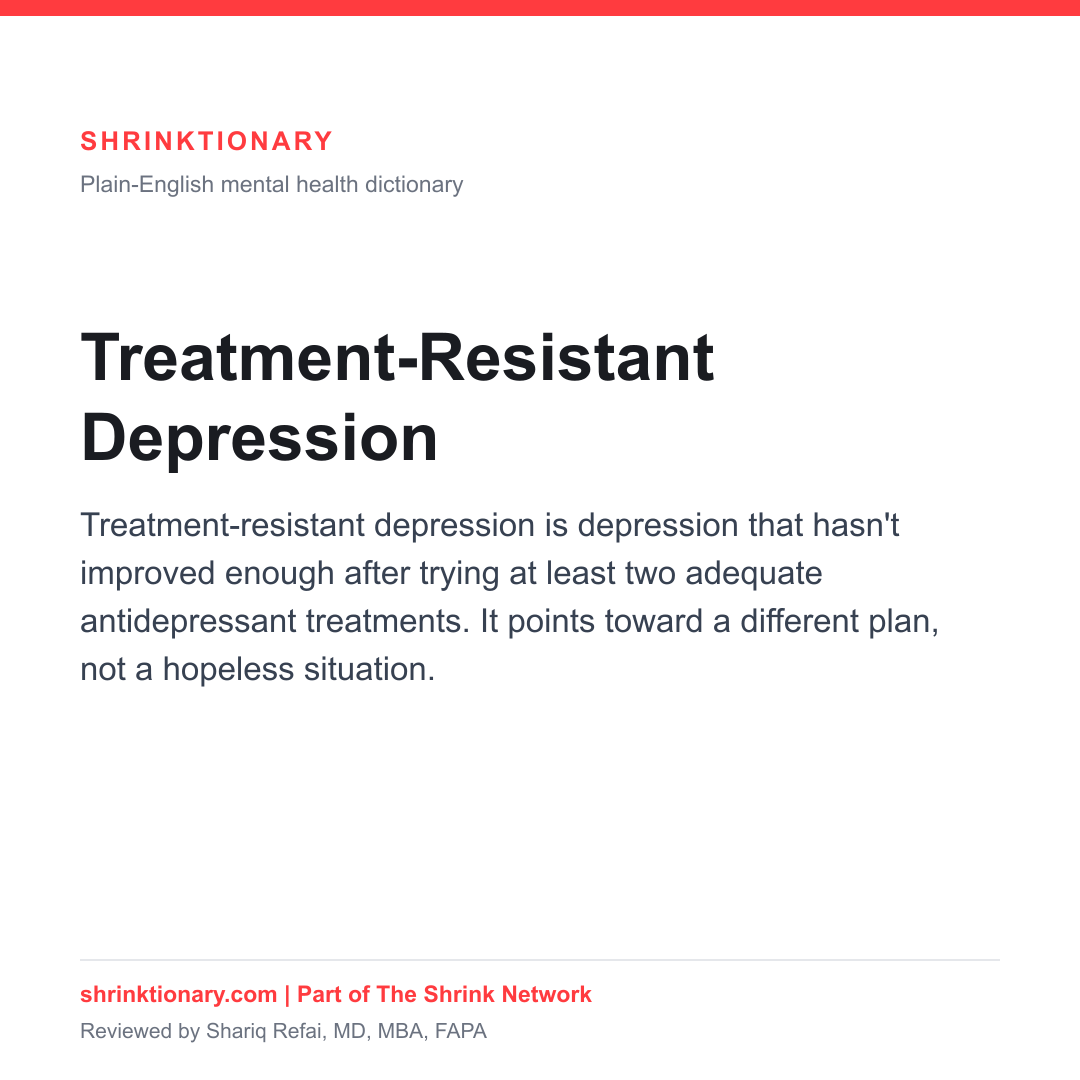
Treatment-resistant depression is the term for depression that hasn’t responded well enough after a fair trial of treatment, usually defined as at least two different antidepressants taken at an adequate dose for an adequate length of time. The label signals that the usual first steps haven’t done the job. “Adequate” is doing a lot of work in that sentence, since a trial that’s too short or too low a dose doesn’t really count. Most guidelines expect a medication to have several weeks at a full dose before it can be called a fair trial.
It’s a common and recognized situation, affecting a meaningful share of people treated for major depressive disorder. Putting a name to it isn’t a verdict. It’s a cue to step back and rethink the approach.
How it works in practice
When depression isn’t responding, a clinician first checks the basics. Was the dose high enough? Was it taken long enough? Were doses missed? Is something else going on, like an undiagnosed condition, a thyroid problem, sleep apnea, or another illness adding to the picture? Sometimes what looks like resistance is really an incomplete trial or a diagnosis that needs revisiting, such as an unrecognized bipolar pattern.
Once those are sorted out, the plan shifts. Options can include switching medications, augmentation by adding a second agent, combining an antidepressant with therapy, or considering treatments like electroconvulsive therapy or transcranial magnetic stimulation. The point of the label is to trigger this fresh look rather than repeating the same thing and hoping for a different result. Measurement, such as tracking symptoms with a brief questionnaire over time, helps make the next choice on evidence rather than impression.
What it isn’t
It isn’t a sign that someone is broken or beyond help. Many people with treatment-resistant depression improve once the plan changes, and reaching remission after several tries is a realistic goal. Resistance describes the treatment history so far, not a fixed trait of the person.
It also isn’t a diagnosis you give yourself after one medication didn’t work. The term has a specific meaning tied to adequate trials, and sorting that out is a clinician’s job. It’s also not the same as depression that never got real treatment in the first place, or depression made worse by factors like ongoing substance use that need their own attention.
Related terms you’ll see next
Why it matters
The label matters because it changes the next step. Naming depression as treatment-resistant pushes a clinician to look harder at what’s been tried, rule out hidden factors, and move toward a different strategy. It reframes a frustrating stretch as a turning point rather than a dead end, and it opens the door to options that go beyond the first round of treatment. For the person living it, that reframe can matter as much as the plan itself, since it replaces “nothing works” with “we haven’t found the right combination yet.” That shift often makes it easier to stay engaged with care long enough to find what helps.
When this word matters
The label applies when depression hasn't improved enough after at least two adequate antidepressant trials, and it matters because it points toward a different plan, such as augmentation, a switch, or other treatments, rather than a hopeless situation. Worth checking first is whether earlier trials were at a full dose for a long enough time.
Commonly confused with
Frequently asked questions
What counts as treatment-resistant depression?
It's usually defined as depression that hasn't responded well enough after a fair trial of at least two different antidepressants taken at an adequate dose for an adequate length of time. The label signals the usual first steps haven't done the job.
Does the label mean someone is beyond help?
No. It isn't a sign that someone is broken, and many people with treatment-resistant depression improve once the plan changes. The label is a cue to step back and rethink the approach.
What happens after depression is labeled treatment-resistant?
A clinician first checks the basics, such as whether the dose was high enough and taken long enough, then may switch medications, combine approaches, add therapy, or consider other treatments.
Related terms
Sources
- Depression , National Institute of Mental Health
- Depression , MedlinePlus
Use or cite this definition
Free to reuse with attribution. Paste the block into your own page, or grab a citation.
Embed on your site
<blockquote>
<p><strong>Treatment-Resistant Depression:</strong> Treatment-resistant depression is depression that hasn't improved enough after trying at least two adequate antidepressant treatments. It points toward a different plan, not a hopeless situation.</p>
<p>— <a href="https://shrinktionary.com/terms/treatment-resistant-depression/">Shrinktionary</a>, a plain-English mental health dictionary, medically reviewed by a board certified psychiatrist.</p>
</blockquote>Cite (APA)
Refai, S. (2026). Treatment-Resistant Depression. Shrinktionary. https://shrinktionary.com/terms/treatment-resistant-depression/
Cite (MLA)
"Treatment-Resistant Depression." Shrinktionary, https://shrinktionary.com/terms/treatment-resistant-depression/. Accessed September 26, 2026.
Your next step in The Shrink Network
You are here: Shrinktionary, the language layer of The Shrink Network.
Each site in the network has one job. No matter where you enter, we help you find the next step that makes sense.
Want to understand more first?
See how this connects to everything else in the Term Web →
Take it with you
Free printable references you can save or share. For education, not medical advice.