What a contraindication actually is
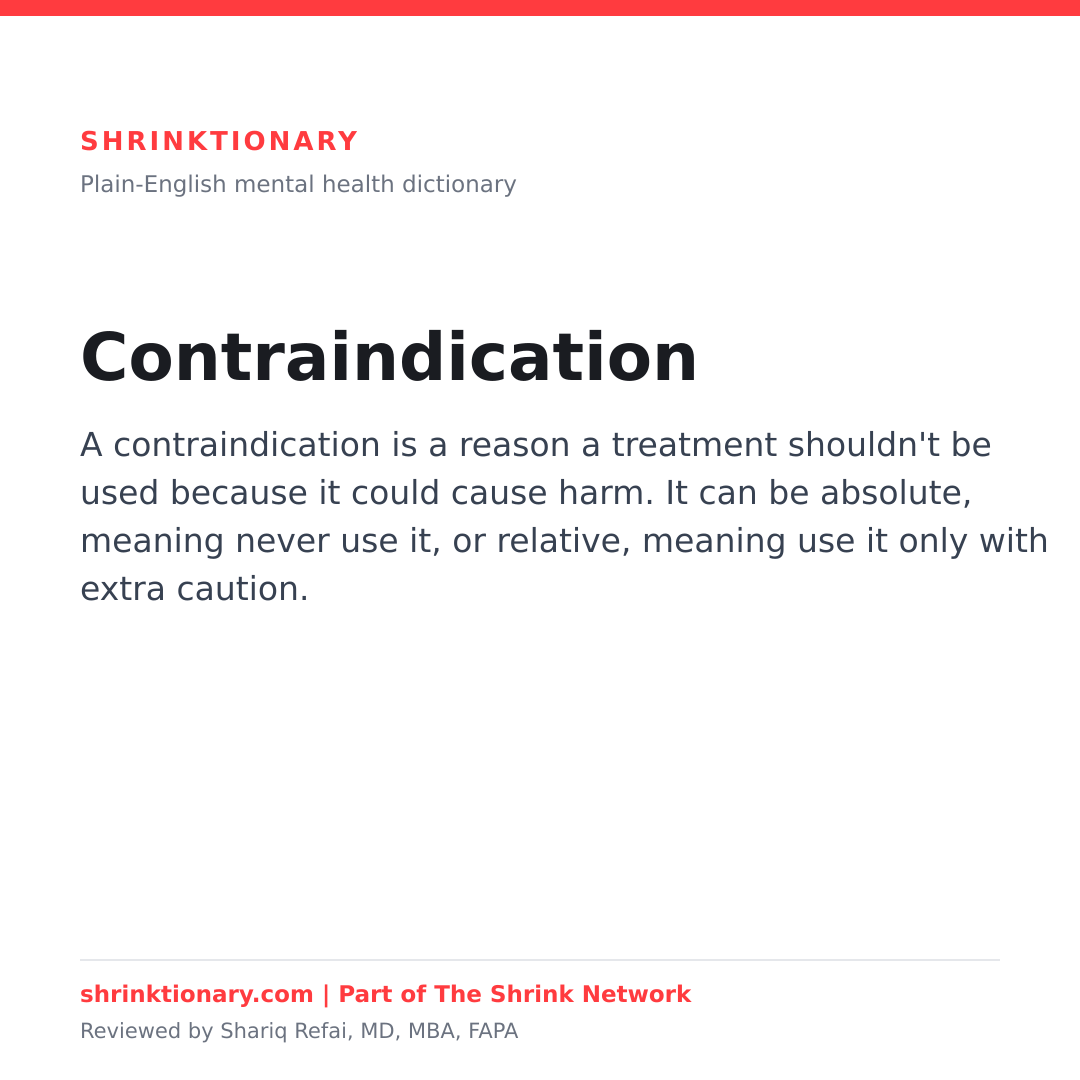
A contraindication is a specific situation in which a medication, procedure, or treatment shouldn’t be used because the risk of harm is too high. It’s the medical version of a warning label that says this isn’t safe for you, and it’s based on a person’s health conditions, other medications, age, pregnancy status, or allergies.
Contraindications come in two strengths. An absolute contraindication means the treatment should never be used in that situation, full stop. A relative contraindication means the treatment can be used, but only with extra caution, closer monitoring, or a clear reason that the benefit outweighs the risk.
How contraindications work
Before prescribing, a clinician checks a person’s full picture against the known contraindications for a medication. Take a class of older antidepressants called MAOIs. They have an absolute contraindication against being combined with certain other antidepressants, because the mix can cause a dangerous spike in a brain chemical called serotonin. A clinician seeing that combination on the chart won’t write the prescription.
Relative contraindications are more of a judgment call. A medication that’s hard on the liver might be a relative contraindication for someone with mild liver problems. The clinician weighs how much the person needs the medication against the added risk, and may proceed with extra blood tests and monitoring. This is why being honest about your full medication list, health history, and pregnancy status matters so much. Those details are exactly what contraindication checks rely on.
What a contraindication isn’t
A contraindication isn’t the same as a side effect. A side effect is an unwanted result that can happen during normal use, while a contraindication is a reason not to start the treatment at all. It also isn’t the same as a black box warning, which flags serious risks but doesn’t necessarily forbid use.
A contraindication isn’t a permanent judgment about a person either. Many are tied to a temporary state, like pregnancy or a current medication, and lift once that situation changes.
Related terms you’ll see next
Readers often move from contraindication to MAOI, a drug class with strict contraindications, to black box warning, to off-label prescribing, and to antidepressant more broadly.
Why it matters
Contraindications are how clinicians keep treatment from doing more harm than good. Sharing a complete and accurate health history is the single best way to make sure those safety checks work, since a missed detail is exactly what a contraindication check is designed to catch. Anyone unsure whether a treatment is safe given their other conditions should ask their prescriber directly.
When this word matters
It matters when a treatment shouldn't be used because it could cause harm, which can be absolute, meaning never use it, or relative, meaning use it only with extra caution. It often comes up around drug interactions, like the foods and medicines to avoid with an MAOI.
Commonly confused with
Frequently asked questions
What does contraindication mean in medicine?
A contraindication is a specific situation in which a medication, procedure, or treatment shouldn't be used because the risk of harm is too high. It's based on things like a person's health conditions, other medications, age, pregnancy status, or allergies.
What's the difference between an absolute and a relative contraindication?
An absolute contraindication means the treatment should never be used in that situation. A relative contraindication means it can be used, but only with extra caution, closer monitoring, or a clear reason that the benefit outweighs the risk.
Is a contraindication the same as a side effect?
No. A side effect is an unwanted result that can happen during normal use, while a contraindication is a reason not to start the treatment at all. They're also different from a black box warning, which flags serious risks but doesn't necessarily forbid use.
Related terms
In these language clusters
Sources
- Mental Health Medications , National Institute of Mental Health
Use or cite this definition
Free to reuse with attribution. Paste the block into your own page, or grab a citation.
Embed on your site
<blockquote>
<p><strong>Contraindication:</strong> A contraindication is a reason a treatment shouldn't be used because it could cause harm. It can be absolute, meaning never use it, or relative, meaning use it only with extra caution.</p>
<p>— <a href="https://shrinktionary.com/terms/contraindication/">Shrinktionary</a>, a plain-English mental health dictionary, medically reviewed by a board certified psychiatrist.</p>
</blockquote>Cite (APA)
Refai, S. (2026). Contraindication. Shrinktionary. https://shrinktionary.com/terms/contraindication/
Cite (MLA)
"Contraindication." Shrinktionary, https://shrinktionary.com/terms/contraindication/. Accessed September 26, 2026.
Your next step in The Shrink Network
You are here: Shrinktionary, the language layer of The Shrink Network.
Each site in the network has one job. No matter where you enter, we help you find the next step that makes sense.
Want to understand more first?
See how this connects to everything else in the Term Web →
Take it with you
Free printable references you can save or share. For education, not medical advice.