What off-label actually is
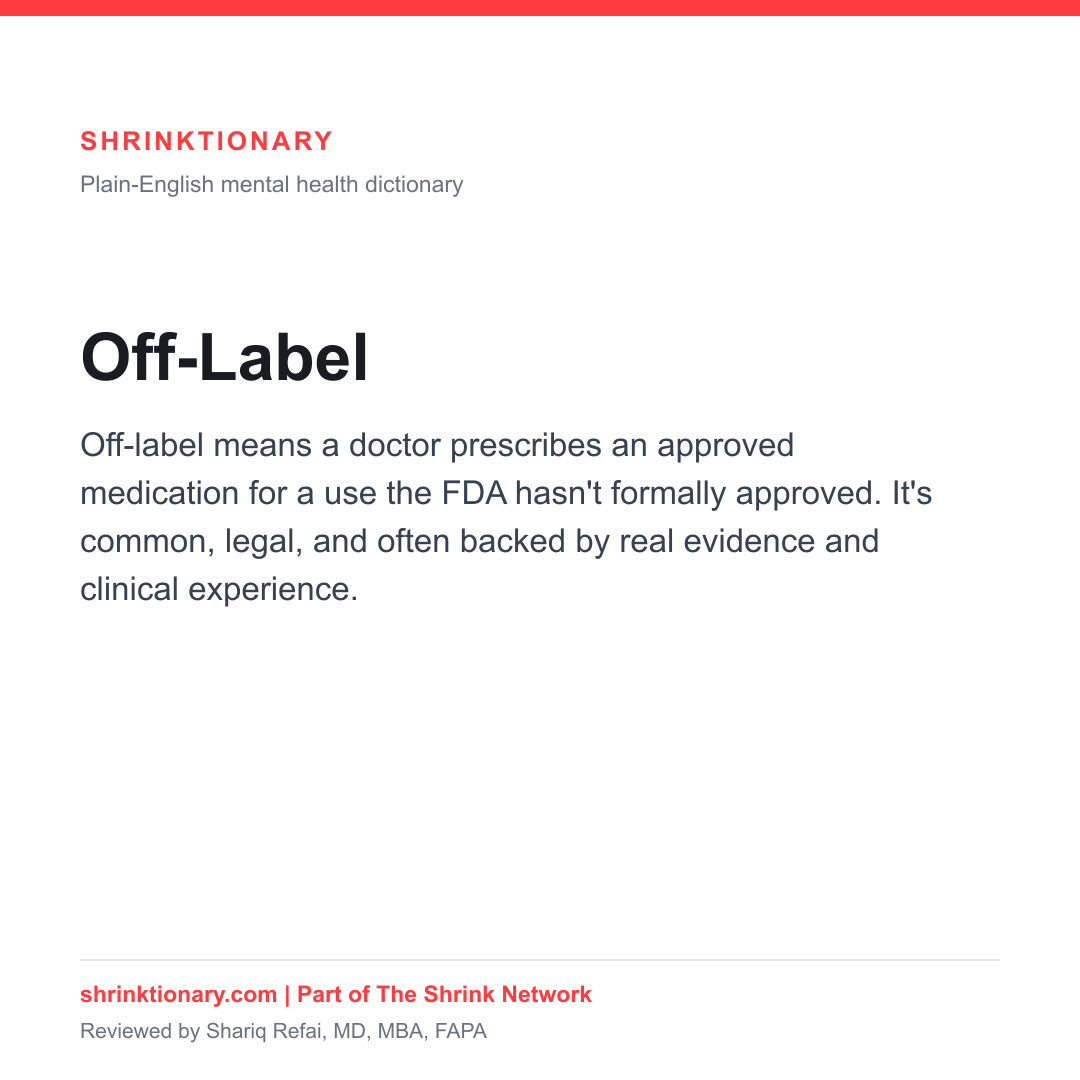
Off-label means a medication is being used in a way that isn’t listed in its official FDA approval. When the FDA approves a drug, it approves it for specific conditions, age groups, and doses. Using it outside those exact terms, for a different condition, a different age, or a different purpose, is called off-label use.
This sounds like a loophole, but it’s a normal and accepted part of medicine. Once a drug is approved, doctors are allowed to use their clinical judgment about how best to use it for a given patient, even in ways the approval doesn’t specifically cover.
How it works
Getting a drug formally approved for a new use takes large, expensive studies. Sometimes good evidence for a new use builds up faster than a company files for that formal approval, or there’s no commercial reason to pursue it. Meanwhile, doctors see the drug help and continue using it that way.
A common example in mental health is the beta-blocker, a heart medication used off-label to calm physical anxiety symptoms. Many medications are used off-label, and the practice is especially common in psychiatry, pediatrics, and cancer care. Off-label doesn’t mean experimental or reckless. The best off-label use rests on published evidence and established practice.
What to know
Off-label isn’t a quality grade. A medication used off-label can be a first-rate choice for a particular situation, and a medication used exactly on-label can still be a poor fit for a given person. What matters is the reasoning behind the prescription.
It’s reasonable to ask a prescriber whether a medication is being used on-label or off-label, and what the evidence is. A good answer explains why this choice fits you. Off-label use is legal and routine, but like any prescribing decision, it should be made by a qualified prescriber who knows your history.
Related terms you’ll see next
When to seek professional care
If you learn a medication you take is being used off-label and you have questions, ask your prescriber to walk you through the reasoning and the evidence. That’s a normal conversation, not a confrontation. Decisions to start, change, or stop any medication, on-label or off, belong with a prescriber who can weigh your full health picture.
When this word matters
The distinction matters when a medication is prescribed for something other than its FDA-approved use, which is legal and common but worth understanding so patients know what the evidence behind their prescription looks like.
Commonly confused with
Frequently asked questions
What does off-label prescribing mean?
It means a doctor prescribes an approved medication in a way that isn't listed in its official FDA approval, such as for a different condition, age group, or purpose. It's a normal and accepted part of medicine.
Is off-label use legal and safe?
Off-label use is legal and routine, and the best off-label use rests on published evidence and established practice. It doesn't mean experimental or reckless, but like any prescribing decision it should be made by a qualified prescriber who knows your history.
Can I ask whether my medication is being used off-label?
Yes, that's a reasonable and normal conversation, not a confrontation. You can ask your prescriber to walk you through the reasoning and the evidence behind the choice.
Related terms
In these language clusters
Sources
- Understanding Unapproved Use of Approved Drugs Off Label , U.S. Food and Drug Administration
- Mental Health Medications , National Institute of Mental Health
Use or cite this definition
Free to reuse with attribution. Paste the block into your own page, or grab a citation.
Embed on your site
<blockquote>
<p><strong>Off-Label:</strong> Off-label means a doctor prescribes an approved medication for a use the FDA hasn't formally approved. It's common, legal, and often backed by real evidence and clinical experience.</p>
<p>— <a href="https://shrinktionary.com/terms/off-label/">Shrinktionary</a>, a plain-English mental health dictionary, medically reviewed by a board certified psychiatrist.</p>
</blockquote>Cite (APA)
Refai, S. (2026). Off-Label. Shrinktionary. https://shrinktionary.com/terms/off-label/
Cite (MLA)
"Off-Label." Shrinktionary, https://shrinktionary.com/terms/off-label/. Accessed September 26, 2026.
Your next step in The Shrink Network
You are here: Shrinktionary, the language layer of The Shrink Network.
Each site in the network has one job. No matter where you enter, we help you find the next step that makes sense.
Want to understand more first?
See how this connects to everything else in the Term Web →
Take it with you
Free printable references you can save or share. For education, not medical advice.