What augmentation actually is
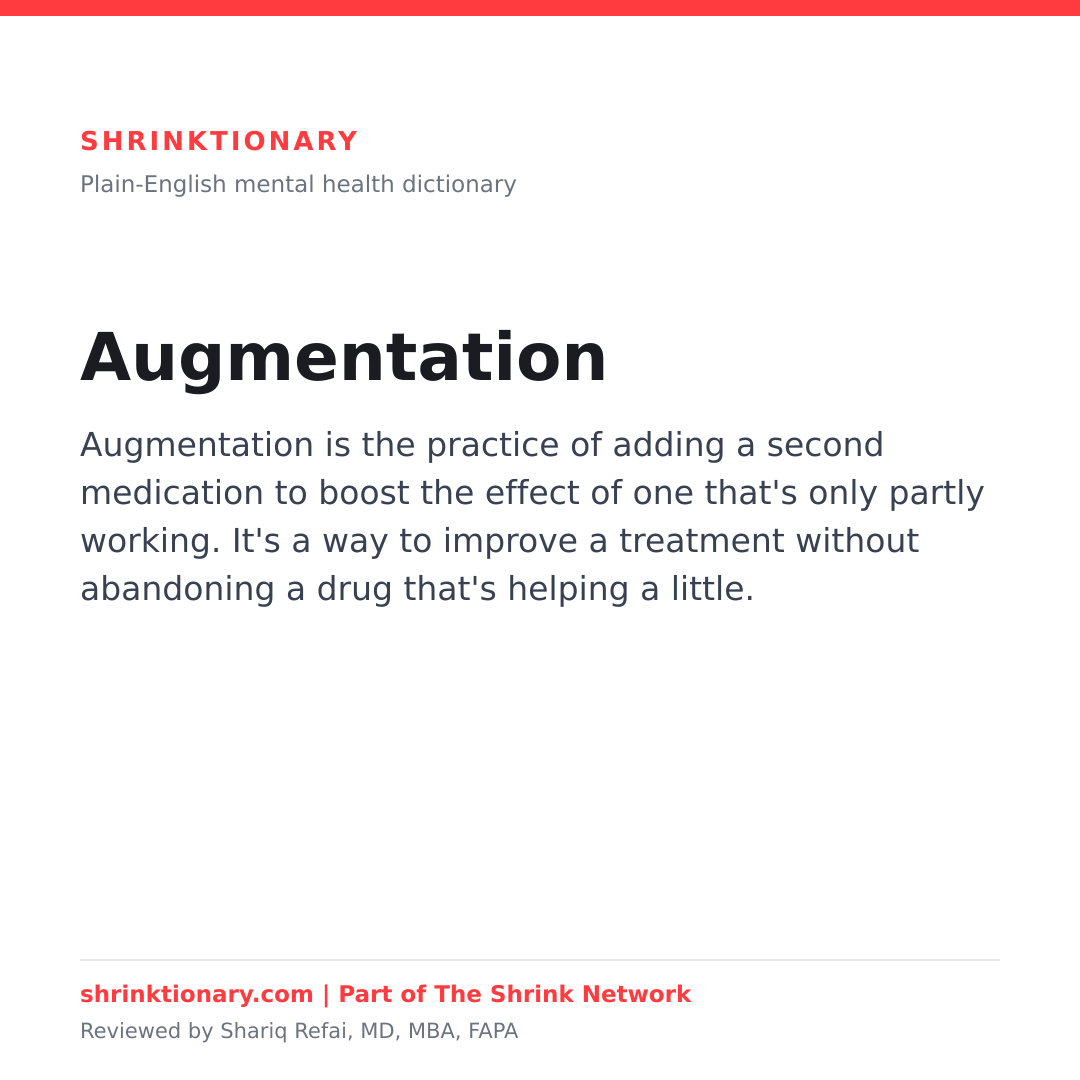
Augmentation means adding a second medication to strengthen the response to a first one that’s giving partial relief. The idea is to build on something that’s already doing part of the job rather than throwing it out and starting over. A partial response is a common reason to reach for it, since roughly half of people don’t get full relief from the first medication they try.
It shows up most often in depression treatment, but the concept applies elsewhere too, including in bipolar disorder and psychosis. The first drug stays in place, and a second agent is layered on top to push the response further. Common augmenting agents in depression include a low-dose second-generation antipsychotic, lithium, or another agent chosen by the prescriber for that person’s situation.
How it works
When someone responds a little to a medication but not enough, a prescriber has a few choices. They can raise the dose, switch to a different drug, or add a second one. Augmentation is that last path. The added medication is often from a different class, chosen because it works through a separate mechanism that complements the first, so the two hit the problem from different angles.
The goal is a bigger combined effect than either drug would give alone. Because two medications interact, a prescriber watches for side effects and checks that the combination makes sense for that person. They also weigh how long the first drug has had a fair trial, since adding a second agent too early can muddy the picture of what’s actually working. Augmentation usually comes after the first medication has been given enough time and dose to prove itself.
What it isn’t
It isn’t the same as simply piling on more drugs without a plan. Augmentation is a deliberate strategy with a target in mind, not random stacking. That distinction is what separates it from unplanned polypharmacy, where medications accumulate without a clear purpose and nobody has stepped back to review the whole list.
It also isn’t a sign that the first medication failed. A partial response is still a response, and augmentation treats it as a foundation worth building on rather than a dead end. Switching medications throws away that partial gain, while augmentation keeps it and tries to add to it. It’s also different from combination therapy in the strict sense, though the words are sometimes used loosely.
Related terms you’ll see next
What to do about it
Augmentation is a prescriber’s call, made with knowledge of your full medication list and history. If your current treatment is only partly working, that’s worth raising at your next visit, along with any side effects you’ve noticed and how long you’ve been at the current dose. Don’t add supplements or other medications on your own to “boost” a drug, since some combinations carry real risks like serotonin toxicity or dangerous interactions. A clinician can decide whether adding something makes sense, choose an agent that fits your situation, and monitor how the combination goes over the following weeks. If it doesn’t help, they can just as deliberately take it back off.
When this word matters
Augmentation matters when a medication is helping only partway and a second drug is added to boost it rather than switching off the first one. The distinction matters because it's different from simply taking many drugs, and different from swapping one medication for another.
Commonly confused with
Frequently asked questions
What does augmentation mean in psychiatry?
Augmentation means adding a second medication to strengthen the response to a first one that's giving only partial relief. The first drug stays in place while a second is layered on top.
Does augmentation mean my first medication failed?
No. A partial response is still a response, and augmentation treats it as a foundation worth building on rather than a dead end.
Can I boost my medication on my own with supplements?
Augmentation is a prescriber's call made with knowledge of your full medication list and history. Adding supplements or other medications on your own can carry real risks, so it's best discussed with a clinician.
Related terms
In these language clusters
Sources
- Mental Health Medications , National Institute of Mental Health
- Antidepressants , MedlinePlus
Use or cite this definition
Free to reuse with attribution. Paste the block into your own page, or grab a citation.
Embed on your site
<blockquote>
<p><strong>Augmentation:</strong> Augmentation is the practice of adding a second medication to boost the effect of one that's only partly working. It's a way to improve a treatment without abandoning a drug that's helping a little.</p>
<p>— <a href="https://shrinktionary.com/terms/augmentation/">Shrinktionary</a>, a plain-English mental health dictionary, medically reviewed by a board certified psychiatrist.</p>
</blockquote>Cite (APA)
Refai, S. (2026). Augmentation. Shrinktionary. https://shrinktionary.com/terms/augmentation/
Cite (MLA)
"Augmentation." Shrinktionary, https://shrinktionary.com/terms/augmentation/. Accessed September 26, 2026.
Your next step in The Shrink Network
You are here: Shrinktionary, the language layer of The Shrink Network.
Each site in the network has one job. No matter where you enter, we help you find the next step that makes sense.
Want to understand more first?
See how this connects to everything else in the Term Web →
Take it with you
Free printable references you can save or share. For education, not medical advice.